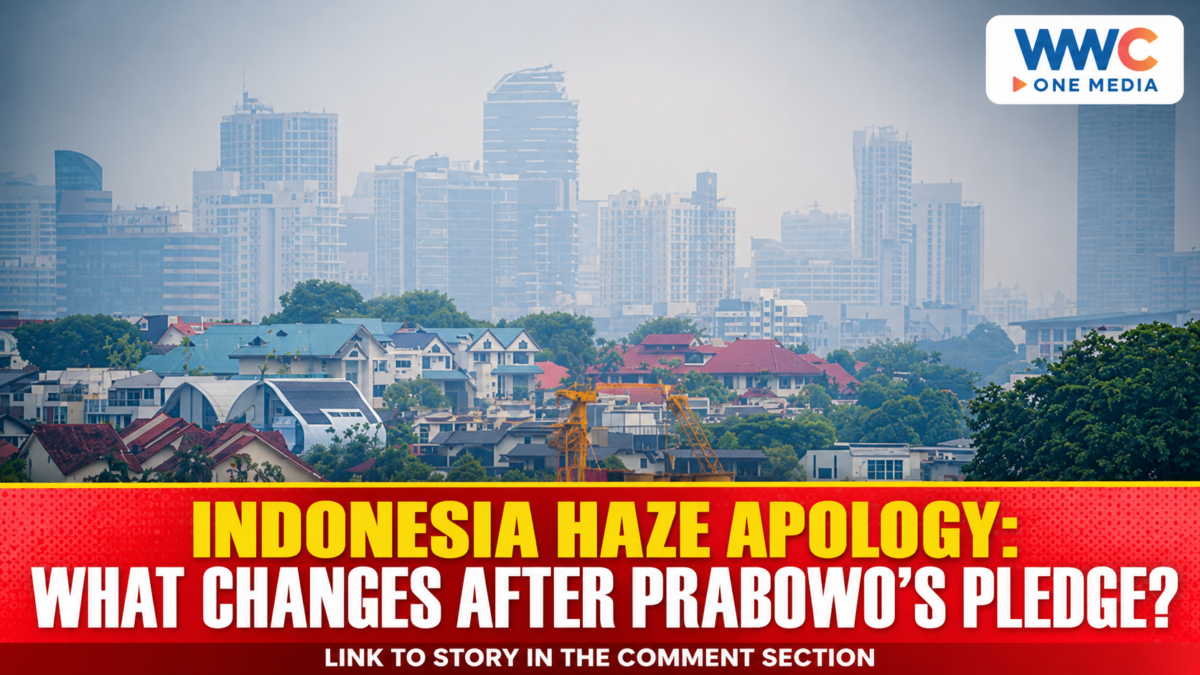
Indonesian President Prabowo Subianto apologised to Singapore and Malaysia on Nov. 15, 2026, over the cross-border haze generated by forest and land fires in Indonesia, as he outlined his government’s enforcement actions and plans to strengthen fire prevention.
The apology came during the 49th ASEAN Summit in Manila, where regional leaders are confronting an environmental problem that continues to affect neighbouring countries despite decades of cooperation agreements.
But Prabowo’s announcement carried another important message: Indonesia is not simply promising to fight existing fires. Its government says it is moving towards tougher action against companies suspected of involvement and a more systematic approach to preventing future outbreaks.
The challenge now is whether those commitments will translate into sustained enforcement, stronger regional coordination and fewer incidents of transboundary air pollution.
Indonesia Haze Apology Comes With a Major Enforcement Announcement
The Indonesian Presidential Secretariat published an official statement on Nov. 15 following Prabowo’s participation in the ASEAN leaders’ plenary session at the Philippine International Convention Center in Pasay City.
In the statement, Prabowo conveyed an apology on behalf of the Indonesian government and people for the impact that forest and land fires had caused in Singapore and Malaysia.
He also outlined the government’s enforcement efforts against businesses suspected of involvement in forest-fire incidents.
The figures disclosed in the presidential statement included:
- 17 corporate concessions had been revoked.
- 26 companies were under investigation.
- 11 companies had been charged.
- 23 additional companies were identified for possible charges.
- 104 companies were under investigation by the Indonesian police.
These are separate categories reported in the official statement and should not be added together as a single number of companies facing prosecution.
The figures nevertheless indicate the scale of the enforcement effort Jakarta says it has undertaken.
For businesses operating in forestry, agriculture and land development, the announcement highlights the growing importance of environmental compliance and fire-prevention responsibilities.
It also establishes a distinction between companies under investigation and those that have already faced charges. Investigation alone does not establish guilt. Presiden RI
The Firefighting Response Came at a Significant Human Cost
Prabowo also disclosed the scale of Indonesia’s firefighting deployment.
The government said it had mobilised 71,000 forest-fire personnel during an emergency that had continued for nearly four months.
The presidential statement also reported that 16 personnel had died during firefighting operations, while two helicopters were lost.
These figures underline the operational difficulties involved in containing fires across extensive forest and land areas.
Firefighting is particularly challenging when dry conditions, difficult terrain and multiple fire locations complicate access and response operations.
However, the government’s announcement also pointed towards a broader policy question: whether the country can reduce the likelihood of fires starting in the first place.
Emergency deployments can help contain an existing outbreak, but they cannot independently address the land-management practices that contribute to recurring fires.
Singapore’s Ministry of Sustainability and the Environment addressed this distinction in a Nov. 3 parliamentary response.
It identified human activities, including peatland drainage and slash-and-burn practices, as primary sources of fires, while explaining that challenging El Niño conditions had extended the regional dry season and intensified the problem.
This combination of human activity and environmental conditions makes prevention an important part of any long-term solution. Ministry of Sustainability and the Environment+1
Why Singapore and Malaysia Continue to Demand Regional Cooperation
Transboundary haze is not confined to the country where a fire begins.
Smoke can travel across national borders, affecting communities, businesses, transportation and environmental conditions in neighbouring territories.
For Singapore and Malaysia, this creates a challenge that cannot be addressed entirely through domestic policies.
Singapore has already pursued bilateral cooperation with Indonesia.
On Oct. 28, 2026, Singapore’s Ministry of Foreign Affairs confirmed that Foreign Minister Vivian Balakrishnan and Indonesian Foreign Minister Arrmanatha Christiawan Nasir had agreed to establish a Joint Task Force.
The arrangement is intended to strengthen information-sharing and cooperation, including through a hotline connecting the two ministries.
This provides a formal channel for communication between the countries when addressing transboundary haze.
Singapore also made clear that its approach involves both regional cooperation and domestic enforcement.
In October, its National Environment Agency issued preventive measure notices to Indonesian companies whose concession areas were associated with fires that could have contributed to smoke reaching Singapore.
The notices required the companies to deploy firefighting personnel where necessary, stop burning activities and submit plans to prevent fires from spreading or recurring.
Importantly, receiving such a notice does not establish that a company caused the fires or committed an offence.
The distinction between an investigation and proven responsibility remains essential to fair enforcement.
Malaysia has also pushed for stronger regional measures, reflecting concerns that existing cooperation arrangements need to produce more effective results.
WWC previously examined Malaysia’s call for ASEAN to strengthen its transboundary haze agreement, highlighting the continuing debate over prevention, accountability and regional enforcement. Ministry of Foreign Affairs+2
ASEAN Already Has a Haze Agreement, But Implementation Matters
The region is not starting from zero.
ASEAN member states signed the ASEAN Agreement on Transboundary Haze Pollution on June 10, 2002, in Kuala Lumpur, Malaysia.
The agreement entered into force in 2003 and established a framework for preventing, monitoring and mitigating land and forest fires through national action and regional cooperation.
Indonesia eventually ratified the agreement on Oct. 14, 2014, depositing its instrument of ratification on Jan. 20, 2015.
All ASEAN member states have since ratified or approved the agreement.
Its provisions cover several areas, including monitoring, prevention, preparedness, emergency response, cross-border assistance and scientific cooperation.
The agreement also established the institutional framework for an ASEAN Coordinating Centre for Transboundary Haze Pollution Control.
However, having an agreement does not automatically guarantee that every member country can respond immediately or uniformly when fires emerge.
Governments still need effective communication, reliable monitoring, sufficient resources and the willingness to coordinate their actions.
Singapore’s Nov. 3 parliamentary response also identified the planned establishment of a strengthened regional coordinating centre in Indonesia.
The establishment agreement for that centre requires ratification by six ASEAN member states before it can come into force.
This makes institutional progress an important development to monitor following the latest diplomatic discussions. ASEAN Haze Portal+1
The Philippine Connection: Why the Haze Crisis Matters Beyond ASEAN Diplomacy
The latest developments carry particular relevance for the Philippines because the country has also experienced the effects of regional air pollution.
In September 2026, Metro Cebu recorded deteriorating air-quality conditions associated with smoke from fires in Kalimantan, Indonesia.
The Environmental Management Bureau Region 7 recorded an Air Quality Index of 167 at 4 p.m. on Sept. 21, placing the reading in the Very Unhealthy category.
The episode demonstrated how environmental emergencies originating outside Philippine territory can affect communities much farther from the original fire locations.
WWC previously reported on Metro Cebu’s deteriorating air quality during the Indonesian haze episode.
The economic consequences also extend beyond environmental monitoring.
When air pollution worsens, outdoor businesses, transport operators and workers whose income depends on public activity can experience disruptions.
The impact on Indonesian communities was explored in WWC’s report on how the haze crisis affected workers and small businesses in Sumatra.
For the Philippines, the issue reinforces the importance of regional environmental cooperation.
A neighbouring country’s forest-fire emergency can become a concern for Philippine communities depending on weather conditions and the movement of smoke.
That is why ASEAN’s environmental commitments matter beyond diplomatic statements. They affect the region’s ability to protect communities from problems that cross national boundaries.
What Happens Next
The 49th ASEAN Summit is scheduled to run from Nov. 15 to 17, 2026, under the Philippines’ chairmanship.
Prabowo’s announcement provides a significant diplomatic development, but the effectiveness of Indonesia’s response will ultimately depend on what happens after the summit.
Three areas deserve particular attention.
First, the implementation of enforcement measures against companies suspected of involvement in forest fires must proceed through proper investigations and legal processes.
Second, Indonesia and Singapore need to translate their Joint Task Force agreement into practical information-sharing and coordinated action.
Third, ASEAN member states must continue working towards a stronger regional coordinating mechanism and better prevention strategies.
The presidential statement also indicated that Indonesia was preparing to establish a new government body and introduce programmes to strengthen systematic forest-fire prevention.
The details and implementation timeline of those measures remain important questions.
Prabowo’s apology acknowledges the regional consequences of Indonesia’s forest and land fires. However, an apology alone cannot prevent another haze episode.
The lasting test will be whether Indonesia can reduce recurring fires, establish accountability where evidence supports it and work with its neighbours to protect the region’s air quality.
For Southeast Asia, the goal is not simply to respond when the skies turn grey again.
It is to prevent the next crisis before it spreads across borders.
Frequently Asked Questions
Why did Indonesia’s President apologise to Singapore and Malaysia?
President Prabowo Subianto apologised on Nov. 15, 2026, over the impact of forest and land fires in Indonesia that caused transboundary haze affecting communities in Singapore and Malaysia.
How many companies are being investigated over Indonesia’s forest fires?
The Indonesian Presidential Secretariat reported that 104 companies were under investigation by the country’s police force. The same statement separately disclosed 26 companies under investigation, 11 charged and 23 identified for possible charges.
How many firefighters were deployed by Indonesia?
The Indonesian government reported deploying 71,000 forest-fire personnel. Its presidential statement also reported 16 deaths among firefighting personnel and the loss of two helicopters.
What is the ASEAN Agreement on Transboundary Haze Pollution?
It is a regional agreement signed on June 10, 2002, to help ASEAN countries prevent, monitor and mitigate land and forest fires and the resulting cross-border haze.
Will Indonesia’s apology end the regional haze problem?
Not by itself. Addressing recurring haze requires sustained fire prevention, effective enforcement, responsible land management and cooperation among ASEAN member states.