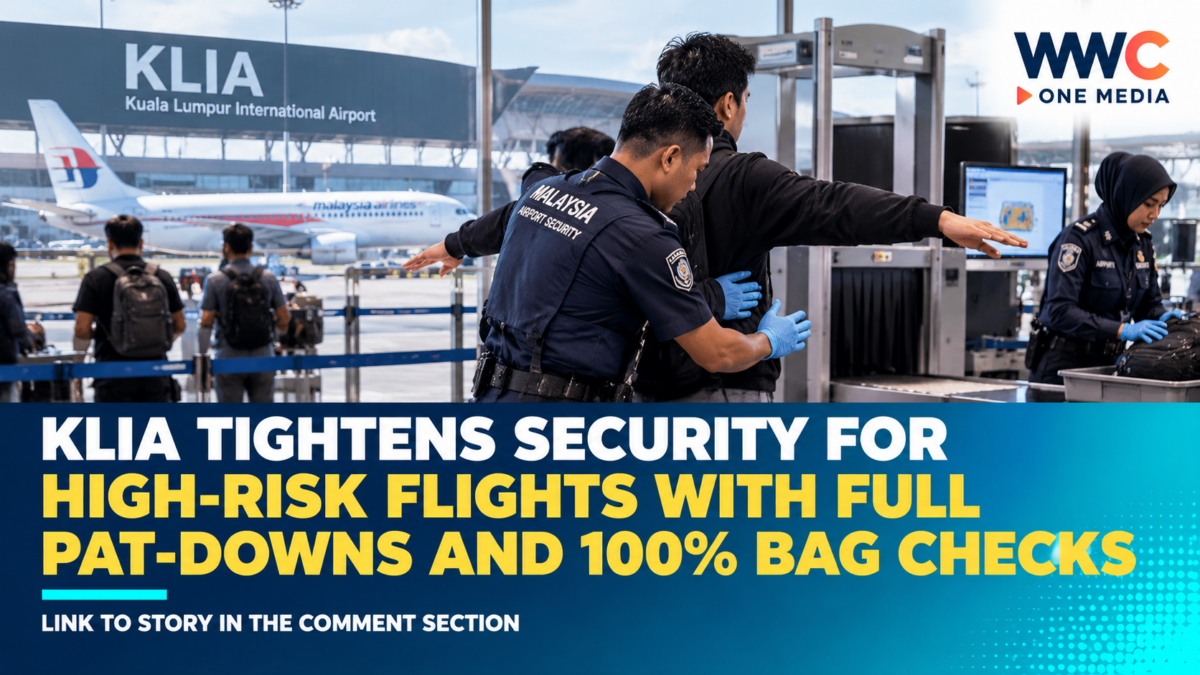
Passengers flying from Kuala Lumpur International Airport (KLIA) to destinations classified as high risk will face tougher security checks, including head-to-toe physical screening and 100 per cent baggage inspections, Malaysia’s Home Minister has announced.
Home Minister Datuk Seri Saifuddin Nasution Ismail told Parliament on Tuesday (Oct 6) that the measures are part of a broader government effort to strengthen security at KLIA and other international entry points.
The enhanced checks are being introduced under a 17-point security plan approved by the Cabinet, following concerns over airport security and several drug-smuggling incidents.
High-Risk Flights Face Full Screening
Saifuddin said Malaysia is adopting a targeted, risk-based approach rather than applying the same level of screening to every flight.
Flights heading to destinations identified as high risk based on intelligence, data and previous smuggling cases will receive additional scrutiny.
“For outbound flights from KLIA, we carry out physical head-to-toe pat-downs of people as well as 100 per cent baggage checks,” he told the Dewan Rakyat.
He specifically cited Indonesia and other destinations where authorities have identified frequent smuggling incidents, although the government has not published a complete list of routes classified as high risk.
The measures mean passengers travelling on affected routes should expect more extensive checks before departure.
Security Overhaul Triggered by Drug Case
The stricter controls follow the arrest of a Malaysia Airlines co-pilot in Jakarta in July after he was allegedly found with drugs.
Malaysian authorities subsequently investigated how the pilot and his baggage had passed through KLIA security without being flagged for additional inspection.
Police said an airport employee assigned to a security screening area was identified as a person of interest in that investigation. Authorities said the baggage had not been classified as high risk under the existing procedures.
The incident prompted the Malaysian Cabinet to order an overhaul of security controls at KLIA and other international entry points.
Saifuddin said the government regarded the incident as more than an ordinary security breach because of its potential implications for national security, Malaysia’s sovereignty and the country’s international reputation.
17 Recommendations to Be Implemented in Three Phases
The government’s 17 recommendations were approved in August by the Cabinet following a joint memorandum from the Home Ministry and Transport Ministry.
Implementation has been divided into three phases.
The first phase began in August and covers immediate measures that will be implemented over six months. Medium- and long-term phases will focus on technology, equipment, manpower, information sharing, governance and wider implementation at international entry points nationwide, depending on security risks.
Saifuddin said Phase Two would begin after the six-month first phase is completed.
Airport Workers Face Stricter Checks
The new security programme also targets people working inside airports.
The government plans to shorten the validity period of certain security-vetted access cards from five years to two years.
Daily passes issued by Malaysia Airports Holdings Bhd and the Civil Aviation Authority of Malaysia will also face tighter controls.
Aviation personnel, including pilots, cabin crew and ground-handling staff, are subject to enhanced drug screening from the pre-employment stage, with periodic and random checks to follow.
The programme involves the Civil Aviation Authority of Malaysia, Royal Malaysia Police and National Anti-Drug Agency.
The aim is to strengthen oversight of employees who have access to restricted airport areas and reduce the possibility of airport personnel being exploited by criminal networks.
Armed Security Presence Increased
Authorities have also increased the visible security presence at KLIA.
Saifuddin said personnel from the 19th Battalion of the General Operations Force, Central Brigade, had been deployed at all airport terminals following the drug-smuggling incident.
The personnel have maintained an armed presence as a deterrent while agencies improve intelligence sharing and assess potential security threats.
Authorities are also strengthening coordination between agencies operating at international airports, including police, the Malaysia Border Control and Protection Agency, Customs, the Malaysian Quarantine and Inspection Services Department and the Department of Wildlife and National Parks.
KLIA Already Has Thousands of CCTV Cameras
Surveillance infrastructure is another part of the airport’s security network.
Malaysia Airports Holdings Bhd currently operates more than 5,000 CCTV cameras across KLIA Terminal 1 and Terminal 2, with a dedicated control room, according to Saifuddin.
The government is also working on broader improvements involving intelligence sharing, technology and security management as part of the later phases of its 17-point plan.
What Passengers Should Expect
For travellers departing KLIA to a designated high-risk destination, the immediate change is straightforward: security screening may take longer and involve substantially more physical and baggage checks.
However, the government has described the approach as risk-based, meaning the enhanced measures are targeted at routes and situations identified through intelligence and previous cases rather than necessarily being applied to every passenger departing KLIA.
The government has not indicated that all international departures will automatically be subject to head-to-toe pat-downs and 100 per cent baggage inspections.
Instead, the measures are being used on flights and destinations classified as higher risk under the enhanced screening system.
Broader Push to Strengthen Malaysia’s Borders
The KLIA measures form part of a wider effort by Malaysia to tighten controls at international entry points.
The government’s 17 recommendations include immediate screening measures as well as longer-term changes involving technology, manpower, information sharing and governance.
The immediate focus is on closing gaps that could be exploited by drug traffickers and other criminal networks, while authorities work towards a more integrated security system across Malaysia’s international gateways.
For passengers, the most visible result will be increased screening on high-risk outbound routes. For airport personnel, the changes mean more frequent vetting, drug testing and tighter controls over access to restricted areas.
The government is expected to continue refining the measures as the first six-month phase progresses and prepare for the second phase of the security overhaul.