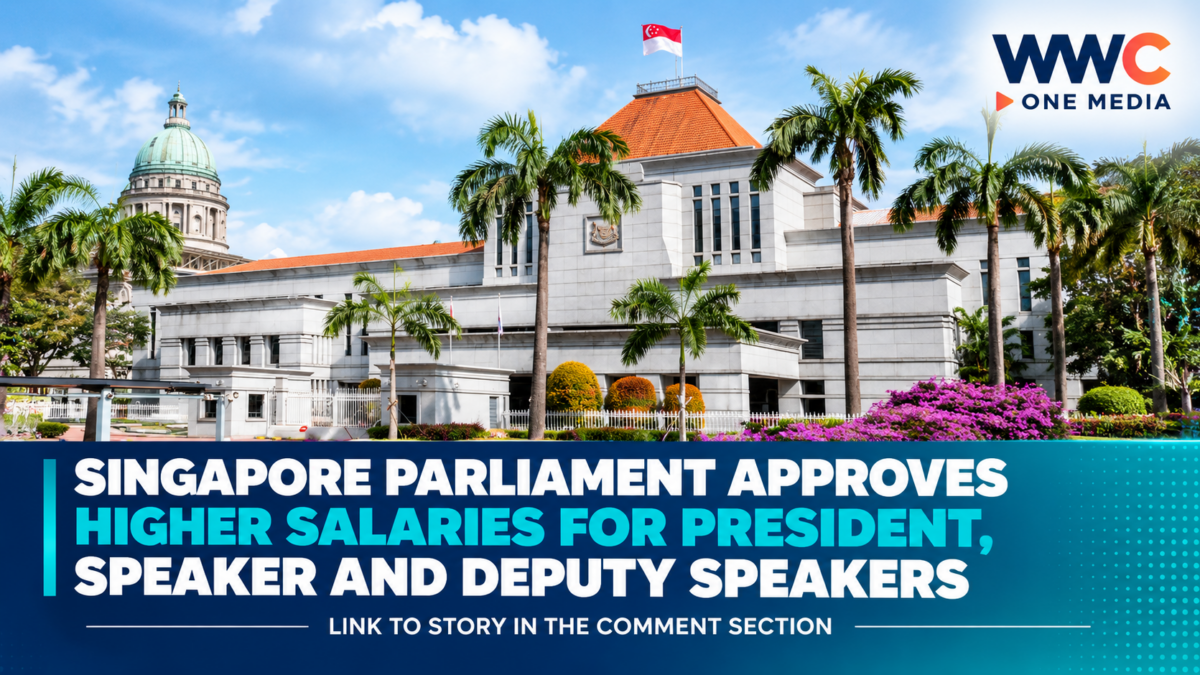
Singapore’s Parliament has unanimously approved higher salaries for the President, Speaker of Parliament and Deputy Speakers, following the Government’s acceptance of recommendations from an independent committee reviewing the country’s political salary framework.
Three motions were moved by Leader of the House Indranee Rajah on Tuesday (Oct 6), with all three approved without debate. The revised remuneration will take effect from Oct 15, 2026.
The changes form part of a broader review of political salaries that was announced earlier this year after the framework had remained largely unchanged for 15 years.
President’s annual package rises to S$2.57 million
Under the first motion, the amount allocated for President Tharman Shanmugaratnam’s salary and medical benefits will increase from S$1,568,900 to S$2,568,200.
The sum is part of the Civil List, which provides funding for the President’s Office.
The President’s salary is pegged to the Prime Minister’s monthly salary. The package includes a monthly base salary, a 13th-month bonus and an annual variable component linked to the rates received by the general civil service.
The revised allocation assumes an annual variable component equivalent to 1.25 months when budgeting for the President’s package.
However, the actual amount of the variable component received each year will depend on the same basis used to determine such payments for civil servants.
The allocation also includes S$3,200 for medical benefits, although the actual amount claimed could be lower.
According to the Government, the President’s remuneration was adjusted in line with the updated political salary framework following the independent review.
Speaker’s salary increases to S$900,000
Speaker of Parliament Seah Kian Peng will see his annual salary rise from S$550,000 to S$900,000, assuming an annual variable component of one month.
The Speaker’s salary remains pegged at 50 per cent of the annual reference salary for an entry-level MR4 minister.
The Government has updated that MR4 reference salary from S$1.1 million to S$1.8 million under the new framework.
Because the Speaker’s position is treated as a part-time appointment, the 50 per cent peg results in an annual package of S$900,000.
The revised amount represents an increase of about 64 per cent from the previous S$550,000.
Deputy Speakers to receive S$135,000 each
The two Deputy Speakers, Christopher de Souza and Xie Yao Quan, will each receive S$135,000 a year under the revised framework.
Their annual remuneration remains pegged at 15 per cent of the Speaker’s part-time annual salary.
Like the Speaker, the Deputy Speaker positions are part-time parliamentary appointments.
The new amount is substantially higher than the previous remuneration under the old salary framework.
Changes follow wider political salary review
The adjustments are part of a broader review of Singapore’s political salaries commissioned by the Government.
An independent committee was appointed in December 2025 to review the framework, which had not been updated for 15 years.
The committee recommended updating the MR4 reference annual salary from S$1.1 million to S$1.8 million, along with changes affecting ministers, other political office holders and Members of Parliament.
The Government accepted the recommendations in September.
Prime Minister Lawrence Wong said the revised framework would take effect from Oct 15.
For ministers and other political office holders, however, the Government decided not to immediately move salaries all the way to the new benchmarks. Instead, existing office holders will receive a one-off adjustment of up to 9 per cent, depending on individual circumstances.
MPs’ monthly allowances also increasing
The review also affects Members of Parliament.
From Oct 15, the monthly allowance for MPs will rise from S$13,750 to S$18,500.
The Government said the increase was intended to account for inflation and reflected the previous review committee’s assessment in 2012 that the existing allowance was appropriate at the time.
At the same time, the Government will study whether MP allowances should eventually be delinked from the MR4 ministerial salary benchmark, since the responsibilities of MPs and full-time political office holders differ.
Non-Constituency MPs will also receive higher allowances. Their monthly allowance will rise to S$5,550, while Nominated MPs will receive S$2,775 a month under the revised framework.
Government says regular reviews are needed
The Government has also accepted a recommendation for the political salary framework to undergo regular independent reviews every five years.
Between those reviews, adjustments could still be made when justified by changing economic and social conditions.
Chan Chun Sing, Coordinating Minister for Public Services, said the framework had effectively been frozen for 15 years after earlier decisions not to proceed with adjustments.
The Government has argued that keeping the framework current is important to ensure Singapore can continue attracting capable people from different backgrounds to political office, including younger Singaporeans with established careers and family commitments.
Higher costs for the Government
The salary changes will increase government expenditure.
The Public Service Division estimated that applying the maximum 9 per cent increase to all political appointment holders would cost about S$5 million more annually.
The updated allowances for all Members of Parliament are estimated to cost approximately S$6.6 million more each year.
Prime Minister Wong has separately said he will donate the full increase in his own salary arising from the adjustment for the next five years, assuming he remains Prime Minister.
He said the additional money would go to suitable good causes, while stressing that this was his personal decision and that he did not expect other office holders to follow suit.
Parliament passes motions without debate
The three motions covering the President, Speaker and Deputy Speakers were approved unanimously on Tuesday.
The changes formally put into effect the salary framework that the Government accepted last month following the independent review.
They will take effect on Oct 15, alongside the wider adjustments to political salaries and parliamentary allowances.
The Government has defended the changes as part of an effort to keep Singapore’s political remuneration framework relevant after more than a decade without a general update, while the five-year review cycle is intended to prevent another prolonged gap between salary reviews.