OTTAWA — Canada is trying something increasingly familiar in fast-growing emerging economies: build at home, attract massive pools of capital, diversify trade and use infrastructure and industrial policy to reshape the economy.
But there is a major difference.
Canada is doing it from the position of an advanced G7 economy whose economic model has long been deeply tied to the United States.
Prime Minister Mark Carney’s government is now attempting to change that formula by targeting C$1 trillion in new investment over five years, expanding tax incentives, accelerating major infrastructure projects, developing critical-mineral and energy supply chains, and opening new markets beyond the United States.
The strategy comes as Canada’s relationship with its largest trading partner faces increased tariff and geopolitical uncertainty.
And the scale of the proposed economic reset is attracting attention from some of the world’s largest investors.
Canada wants an investment supercycle
At the center of Carney’s strategy is a simple proposition: Canada has enormous natural resources, energy capacity, skilled workers and financial stability, but needs significantly more private capital to turn those advantages into productive assets.
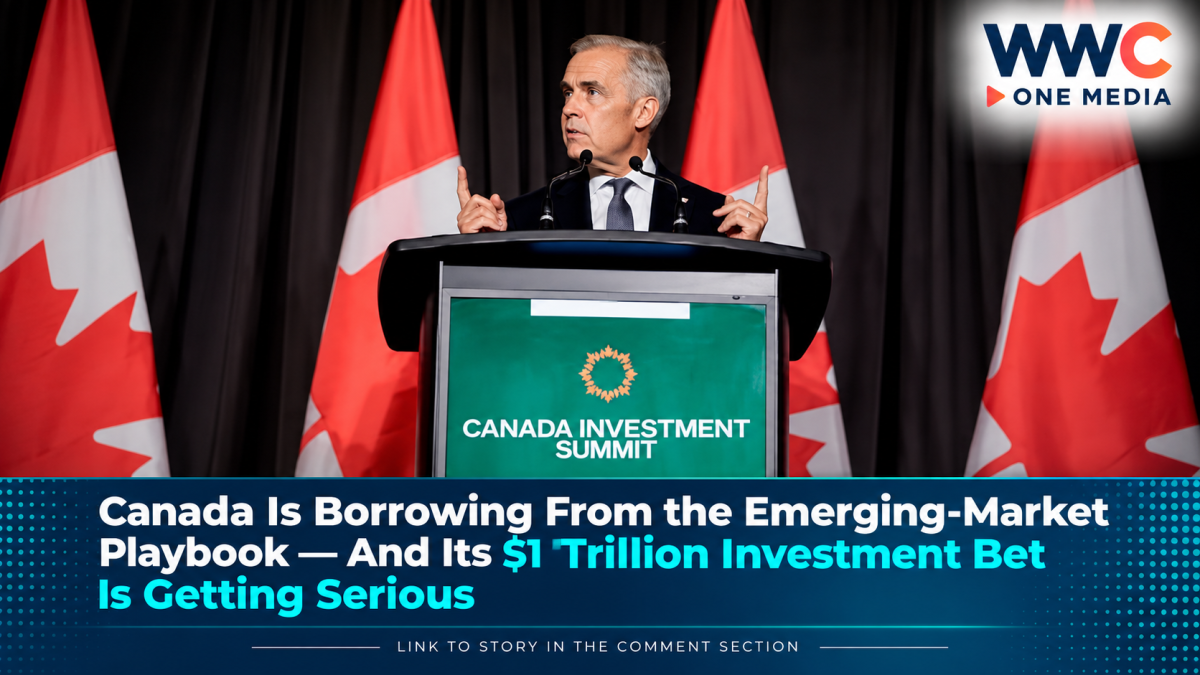
At the Canada Investment Summit in Toronto this week, the government promoted more than 160 investment opportunities spanning energy, infrastructure, critical minerals, technology, defense and other strategic industries.
Carney has set a goal of catalyzing C$1 trillion of investment over five years.
The Canadian government says 27 nation-building initiatives have already been referred to its new Major Projects Office, representing approximately C$500 billion in potential private investment opportunities.
That includes projects involving ports, mines, energy corridors and other infrastructure intended to connect Canadian resources with global markets.
The government is effectively betting that the combination of tax incentives, faster approvals and infrastructure spending can unlock private-sector capital on a much larger scale.
The tax change is one of the biggest pieces
One of the most significant measures is what Ottawa calls the Productivity Mega Deduction.
Under the new policy, Canada is allowing immediate expensing for a much broader range of new capital investments.
The government says roughly two-thirds of eligible capital assets will now qualify, compared with about 15% previously.
The eligible assets include machinery and manufacturing equipment, software, patents, research and development, fiber-optic infrastructure, railways and pipelines.
The idea is straightforward: businesses can deduct the cost of qualifying investments much sooner, reducing the tax burden associated with putting new capital to work.
Ottawa estimates the measure will cost about C$36 billion over five years.
The government says the resulting increase in investment and economic activity could eventually generate substantially more economic output, although those gains are estimates rather than guaranteed results.
Canada is trying to become more competitive for capital
Ottawa says the new tax treatment will give Canada the lowest marginal effective tax rate on new business investment among G7 economies.
The government compares Canada’s resulting rate with those of the United States, Japan, Germany, France, Italy and the United Kingdom.
The policy is intended to address a longstanding Canadian problem: relatively weak business investment and productivity compared with some other advanced economies.
That weakness has become more urgent as Canada faces higher trade barriers and greater competition for investment.
The government therefore wants companies to view Canada not simply as a resource supplier but as a location where they can build processing facilities, manufacturing operations, digital infrastructure and energy projects.
This is where the “emerging-market playbook” comes in
For decades, emerging economies have often attempted to accelerate development by combining several strategies:
- Attracting foreign capital
- Building major infrastructure
- Expanding export markets
- Developing domestic industrial capacity
- Securing access to strategic resources
- Creating incentives for companies to invest locally
Canada is now applying versions of those same tools.
But it is doing so from a very different starting point.
Canada already has sophisticated financial markets, high-income consumers, established institutions and deep integration with global supply chains.
The challenge is therefore less about basic economic development and more about rebuilding Canada’s growth model around productivity, investment and strategic diversification.
The U.S. remains crucial — but Canada wants alternatives
Canada’s strategy is not to abandon the United States.
The U.S. remains by far Canada’s most important trading partner.
But recent tariff disputes have exposed the risks of relying so heavily on one market.
Global Affairs Canada says the share of Canadian exports going to countries other than the U.S. increased in 2025, while non-U.S. exports rose strongly. The non-U.S. share of Canadian exports reached its highest level in more than four decades.
The government’s objective is therefore diversification rather than simply replacing U.S. trade.
That distinction matters.
Canada wants to retain its existing American supply chains while simultaneously developing additional customers in Europe, Asia, the Middle East and other markets.
Energy is at the heart of the strategy
Canada’s energy resources are a major part of the diversification plan.
Carney’s government has proposed expanding LNG exports, developing new energy corridors and potentially building a pipeline capable of transporting at least 1 million barrels of lower-emission Alberta oil per day toward Asian markets.
Canada also wants to expand carbon capture and storage and develop infrastructure capable of moving energy products to ports.
The underlying objective is to give Canadian producers more than one major export route.
That could become increasingly important if trade tensions with the United States remain elevated.
Critical minerals are another major weapon in the diversification strategy
Canada is also trying to position itself as a reliable supplier of minerals needed for batteries, defense systems, electronics and advanced manufacturing.
The Canadian government says it signed more than 50 critical-minerals agreements with over 15 countries during the past year, helping unlock approximately C$20 billion in investment.
These efforts are aimed at strengthening supply chains at a time when governments and companies are seeking alternatives to concentrated dependence on particular countries.
The strategy is not limited to mining.
The larger objective is to develop processing, transportation and manufacturing capacity around Canada’s resource base.
Canada is looking toward Europe
Another major component is Canada’s attempt to deepen economic and security ties with Europe.
Carney traveled to Strasbourg this week after the Canada Investment Summit and promoted closer cooperation with the European Union.
European Commission President Ursula von der Leyen has proposed exploring an “associate member” relationship for Canada, although the concept remains under discussion and would require agreement among EU member states.
Canada and the EU are also discussing greater cooperation in areas including:
- Defense
- Energy
- Critical minerals
- Artificial intelligence
- Research
- Strategic supply chains
The proposal is significant, but it should not be confused with EU membership.
Ottawa itself has emphasized that the focus should be on practical cooperation rather than the label attached to the relationship.
Asia is just as important
Canada’s diversification strategy also extends toward Asia.
The government says it wants to expand trade with ASEAN and India and has highlighted the Indo-Pacific as an important destination for Canadian energy, minerals and other exports.
Canada’s trade with non-U.S. markets has already been growing.
Global Affairs Canada reported that non-U.S. exports increased sharply in 2025, with gold, crude oil and other commodities contributing to the increase. Services exports have also proved less dependent on the U.S. than merchandise exports.
That gives Canada another potential growth channel, although geographic distance means new infrastructure will be necessary.
The infrastructure problem cannot be ignored
This is where the strategy becomes much harder.
Signing trade agreements does not automatically create the physical capacity to sell more products overseas.
Canada needs ports, railways, pipelines, electricity infrastructure and other transportation links capable of moving resources to new customers.
Analysts have repeatedly identified infrastructure, production capacity and market access as barriers to faster diversification.
The geography is also challenging.
Canada’s existing transportation network has been built around its enormous trade relationship with the United States.
Redirecting significant volumes toward Europe and Asia requires new investment.
Canada still has a productivity problem
The investment push is also an attempt to address Canada’s productivity challenge.
The country’s economy grew slowly in 2025, according to Canada’s chief economist, while U.S. trade uncertainty weighed on export-oriented industries.
Business investment was also weak in parts of early 2026.
Canada’s second-quarter performance improved, however.
BDC Economics reported that real GDP rebounded at a 3.3% annualized rate in the second quarter of 2026, after a weak first quarter, while household consumption and business investment strengthened.
The improvement does not eliminate the structural issues.
It does, however, mean the current Canadian economy is not simply a story of contraction.
Tariffs are forcing the issue
The urgency behind Ottawa’s strategy comes partly from the escalating trade dispute with Washington.
New U.S. tariffs have targeted additional Canadian products, while Canada has responded with its own measures.
The result is uncertainty for companies whose supply chains were built on decades of relatively frictionless cross-border commerce.
Canada’s auto, steel, lumber and other industries remain particularly exposed.
The World Economic Forum, citing Reuters reporting, noted that new U.S. tariffs affect roughly 5.5% of Canadian exports to the United States, while the wider trade relationship remains worth hundreds of billions of dollars.
That means the Canadian government has a difficult balancing act:
diversify away from excessive dependence on the U.S. without damaging the trade relationship that remains central to the economy.
Foreign investors are showing interest — but commitments are not yet construction
The investment summit attracted executives from major global investment institutions including BlackRock, Blackstone, Temasek and other large funds.
The Canadian government has reported roughly C$500 billion in investment commitments or opportunities associated with the summit and its broader investment campaign.
But there is an important caveat.
Announcements, expressions of interest and potential investment opportunities are not the same as completed projects.
Reuters reported ahead of the summit that some major deals could take 12 to 18 months to materialize.
The real test will therefore be whether announced projects secure financing, receive regulatory approvals and ultimately break ground.
Canada is also trying to speed up approvals
Ottawa has introduced regulatory reforms designed to accelerate major infrastructure projects.
The new Major Projects Office is intended to coordinate approvals and reduce delays for projects considered nationally significant.
The government says 27 projects have already been referred to the office.
This reflects another lesson associated with investment-led development: capital will not wait indefinitely for permits.
If Canada wants to compete with jurisdictions aggressively courting investors, faster approvals could become as important as tax incentives.
The strategy has risks
There are no guarantees that Canada’s investment push will deliver C$1 trillion in actual new capital.
Businesses may still decide that projects are uneconomic because of construction costs, labor shortages, regulation, transportation constraints or uncertainty about future trade policy.
Tax incentives also carry fiscal costs.
And expanding resource exports does not automatically solve Canada’s productivity challenge if the country remains primarily a commodity exporter rather than moving further into processing, technology and higher-value manufacturing.
There is also the risk that Canada simply shifts from dependence on one external market to dependence on several commodity markets.
Canada isn’t becoming an emerging market
The comparison to emerging economies needs an important qualification.
Canada remains a wealthy, highly developed G7 economy with mature institutions, sophisticated capital markets and established trade relationships.
What is changing is the policy toolkit and economic strategy.
The government is increasingly emphasizing industrial capacity, infrastructure, strategic resources, export diversification and state-supported investment incentives—approaches commonly associated with development strategies used by faster-growing emerging economies.
The objective is to use those tools to address Canada’s own structural weaknesses.
A different economic model is taking shape
Canada’s old economic formula relied heavily on three advantages:
proximity to the United States, abundant natural resources and deep integration into North American supply chains.
Those advantages remain.
But the trade dispute has exposed the risks of relying on them too heavily.
Carney’s government is now trying to add another layer:
Canada as an investment hub, energy supplier, critical-minerals powerhouse, technology and AI partner, and diversified global trading nation.
The government says the ultimate goal is greater economic resilience and strategic autonomy.
Whether that transformation succeeds will depend on what happens after the announcements.
Can Canada actually build the ports, pipelines, mines, factories, data infrastructure and energy systems needed to support the strategy?
Can it attract the capital required to finance them?
Can it raise productivity?
And can it diversify its exports without sacrificing the enormous U.S. market that remains its largest customer?
Those questions will determine whether Canada’s emerging-market-style investment playbook becomes a lasting economic transformation—or simply another ambitious policy campaign.
For now, Ottawa is making its bet.
C$1 trillion in investment is the target. The next challenge is turning that headline number into projects, productivity and exports.