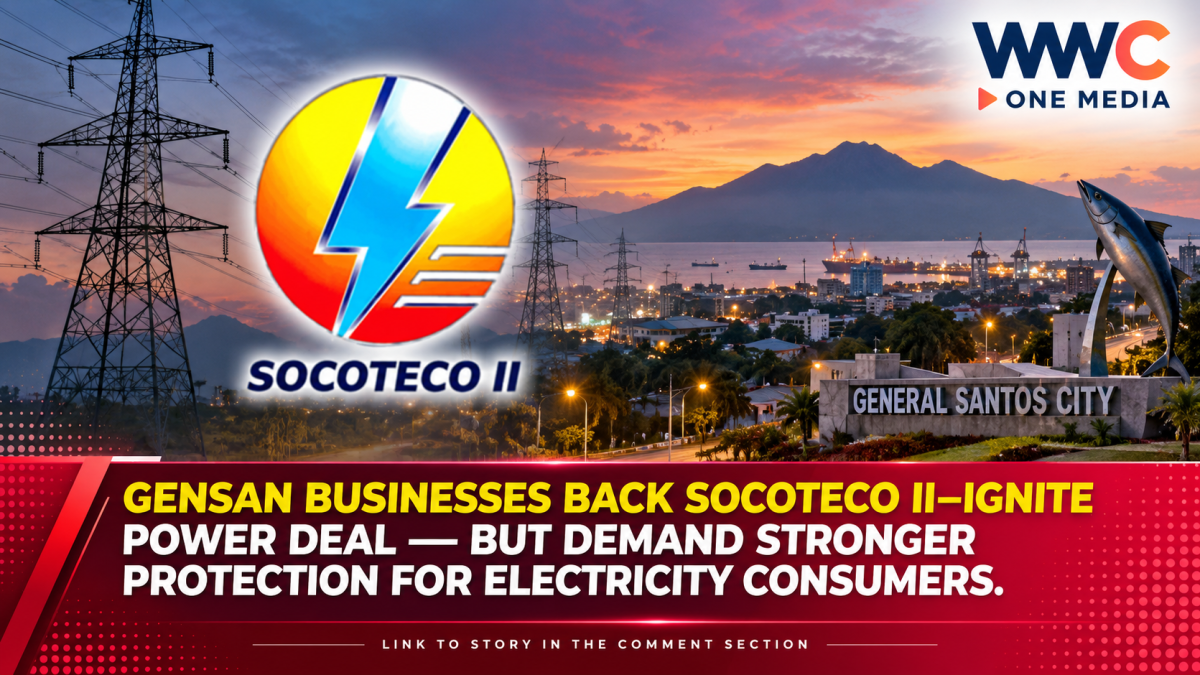
GENERAL SANTOS CITY — General Santos City’s business community is backing the proposed joint venture between South Cotabato II Electric Cooperative (SOCOTECO II) and IGNITE Power and Energy Holdings Inc., but it is making one point clear: modernizing the power system cannot come at the expense of consumers.
The General Santos City Chamber of Commerce and Industry said it supports the proposed Conditional Joint Venture Agreement (CJVA), citing SOCOTECO II’s financial losses, aging infrastructure and operational difficulties.
But the chamber is also calling for enforceable safeguards covering electricity rates, reliability, consumer rights, transparency and the cooperative’s ownership position.
The issue has become particularly significant as SOCOTECO II member-consumer-owners prepare to vote on the proposed partnership.
Why the SOCOTECO II–IGNITE deal matters
SOCOTECO II has been dealing with serious financial and operational challenges.
According to figures cited by GMA News, the electric cooperative reported cumulative losses of about ₱2.1 billion as of December 2025, while system losses had climbed to roughly 14%, contributing to losses estimated at around ₱40 million per month. Its distribution network also requires substantial investment and rehabilitation.
The proposed partnership with IGNITE Power is designed to inject capital and modernize the distribution system.
IGNITE Power is a partnership between Primelectric Holdings Inc., associated with businessman Enrique Razon Jr., and Manny Pacquiao’s MP Holdings Inc.
Under the proposed arrangement, SOCOTECO II would transfer its distribution assets to a new distribution company. Reports on the agreement indicate that 70% of the consideration would be paid in cash, while the remaining 30% would be converted into SOCOTECO II’s equity stake in the new entity.
The promise: lower system losses and a modernized grid
One of the most closely watched commitments is the proposed reduction of the system-loss charge passed on to consumers.
IGNITE has proposed bringing the recoverable system-loss level down to 5.5%, compared with SOCOTECO II’s current recoverable cap of 8.25%. SOCOTECO II’s actual system losses have been reported at substantially higher levels, reaching around 14%.
System losses refer to electricity lost within the distribution system before it reaches customers. Under applicable regulatory rules, a portion of allowable system losses can be recovered through consumers’ electricity bills.
Reducing the amount that can be recovered from consumers could therefore affect the system-loss component of their bills.
But there is an important distinction:
A 5.5% system-loss target does not mean total electricity bills will automatically fall by the same amount.
Electricity bills contain multiple components, including generation, transmission, distribution, taxes and other charges. Generation costs, for example, can change depending on power contracts, fuel prices, supply conditions and market conditions.
Gensan Chamber wants rate safeguards written into the deal
The General Santos chamber said the partnership should be accompanied by firm safeguards against sudden electricity-rate increases.
It wants any tariff adjustments to remain subject to the rules and oversight of the Energy Regulatory Commission, rather than allowing the joint venture to independently determine what consumers ultimately pay.
The chamber is also asking for measurable performance targets covering:
- Power reliability
- Service quality
- Customer responsiveness
- Infrastructure modernization
- System-loss reduction
- Technical response times
It further wants penalties, remedies and termination provisions if IGNITE fails to meet its investment or service commitments.
That could become an important issue after the partnership begins, because the proposed investments will ultimately have to be measured against actual improvements experienced by consumers.
The chamber also wants an independent watchdog
Another significant proposal is the creation of an independent monitoring committee.
The chamber wants such a body to include consumer representatives, business leaders and technical experts who could monitor the implementation of the joint venture and assess whether its commitments are being fulfilled.
This would give consumers and other stakeholders a mechanism for tracking whether promised improvements in reliability, infrastructure and customer service actually materialize.
What happens to SOCOTECO II’s 30% stake?
The chamber is also raising questions about the cooperative’s ownership position.
Because SOCOTECO II is expected to retain a reported 30% equity stake in the new distribution company, the business group is asking for anti-dilution protections.
It wants the cooperative’s equity position, board representation and voting rights protected so that its ownership does not become significantly weakened without appropriate safeguards.
The chamber is also calling for disclosure of the CJVA’s:
- Financial projections
- Asset valuation methods
- Asset-transfer terms
- Investment commitments
- Potential risks
- Other material financial information
The goal, according to the business group, is to ensure that member-consumer-owners have sufficient information before voting.
The vote has already faced a court battle
The proposed plebiscite has also been the subject of litigation.
A temporary restraining order initially halted the voting process after SOCOTECO II member-consumer-owner Eugene Mangilaya challenged the plebiscite and sought injunctive relief.
MindaNews reported that an earlier court order had extended the TRO while the application for a preliminary injunction was being considered.
But the legal situation subsequently changed.
In a September 11 resolution, the Regional Trial Court in Polomolok, South Cotabato, granted SOCOTECO II’s motion to lift the TRO and denied Mangilaya’s request for a preliminary injunction.
The court said the proposed transaction remained conditional and that the plaintiff had not established the requirements for the requested injunction.
GMA News subsequently reported that the court’s action cleared the way for the plebiscite.
September 19–20 voting is scheduled to proceed
SOCOTECO II originally scheduled its plebiscite over four weekends in September.
After the legal dispute affected the initial schedule, the cooperative deferred the September 12–13 voting dates.
According to the cooperative’s current notice, the September 19–20 plebiscite is scheduled to proceed, followed by another voting period on September 26–27.
SOCOTECO II had previously expected approximately 200,000 qualified member-consumer-owners to participate in the plebiscite.
For the proposed joint venture to proceed, the vote is subject to the applicable requirements governing electric cooperatives and their member-consumer-owners.
Not everyone has been convinced
The proposed deal has generated debate beyond the business community.
In August, the Social Action Center of the Diocese of Marbel called for greater transparency and questioned aspects of the proposed joint venture, including what SOCOTECO II would give up, what it would receive, the risks involved and whether members had sufficient information before voting.
Those were concerns raised by the organization and should not be treated as court findings or established violations.
The court’s later decision to lift the TRO and deny the preliminary injunction likewise did not constitute a ruling that the proposed joint venture would be beneficial or harmful to consumers. It cleared a legal obstacle to the plebiscite.
What consumers should watch if the deal is approved
If member-consumer-owners approve the partnership and it eventually takes effect, several numbers will become particularly important.
1. The 5.5% system-loss target
Consumers can monitor whether the proposed reduction from the current recoverable level of 8.25% to 5.5% is actually achieved and sustained.
2. Distribution charges
The proposal has been presented with a commitment concerning the distribution charge during the initial years of the partnership. But consumers should distinguish this from the total electricity bill, which includes other charges that can change independently.
3. Infrastructure spending
The promised capital investments should be measurable through improvements to substations, lines, transformers and other distribution facilities.
4. Reliability
The ultimate consumer-facing test will be whether power interruptions, voltage problems and response times improve.
5. Consumer protection
Rate adjustments, complaints, service standards and the enforcement of contractual commitments will remain important issues even after the joint venture begins operating.
The bigger question: Can financial rescue and consumer protection coexist?
The Gensan Chamber’s position reflects the central tension surrounding the proposed transaction.
SOCOTECO II needs significant investment to address its financial difficulties, system losses and aging infrastructure.
IGNITE is offering a structure designed to provide capital and operational modernization.
But for consumers and member-owners, the question goes beyond whether new money enters the system.
The critical issue is whether that investment produces better reliability, stronger infrastructure, lower system losses and accountable service without undermining consumer protections or the cooperative’s remaining ownership position.
That is why the chamber is supporting the concept of modernization while simultaneously demanding safeguards.
What happens next
The immediate focus is the SOCOTECO II plebiscite.
With the TRO lifted, the voting process can proceed under the cooperative’s announced schedule. The outcome will determine whether the proposed Conditional Joint Venture Agreement receives the required member approval.
But even a favorable vote would not make every promised benefit automatic.
Regulatory requirements, implementation conditions, capital investments, operational targets and contractual safeguards would still matter.
For electricity consumers across the SOCOTECO II service area, the most important numbers may ultimately be the ones that appear after the headlines disappear:
system losses, distribution charges, outage frequency, response times, infrastructure investment and the quality of service delivered to every household and business.
The Gensan business community has now put its position on record: it supports the proposed partnership, but wants measurable protections to travel with it.
The next chapter will be decided by the cooperative’s member-consumer-owners — and what follows the vote could have consequences for the region’s electricity system for years to come.