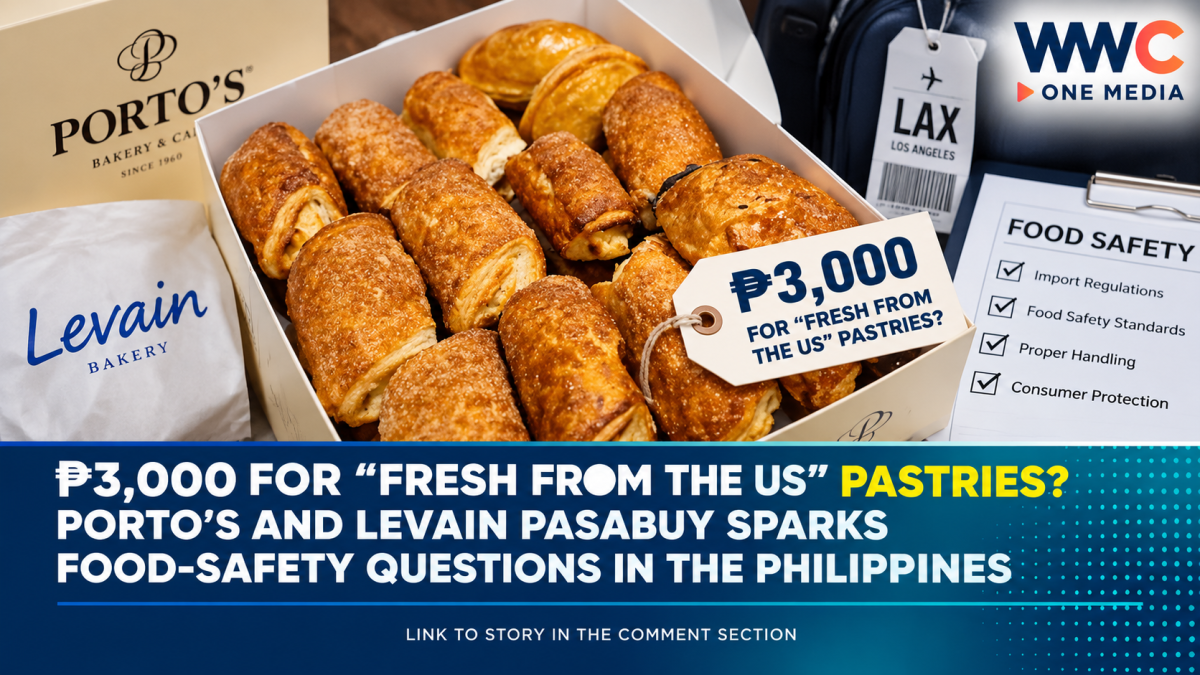
What looked like a premium pasabuy service for Filipinos craving famous American baked goods has turned into a social-media debate over freshness, food handling and the rules surrounding imported food.
A Taguig-based reseller, Sab and Cucay Shop, recently drew online scrutiny after advertising American products including Levain cookies, Porto’s cheese rolls and Crumbl cookies as “fresh from the US.”
Prices cited in social-media discussions included around ₱3,199 for a box of Porto’s cheese rolls, ₱2,999 for Porto’s Dulce de Leche Besitos and about ₱3,399 for a box of Crumbl cookies. The controversy quickly shifted from the price tag to a more fundamental question: How are perishable baked goods kept safe during a long journey from the United States to the Philippines?
The “pasabuy” problem: freshness is more complicated than distance
Online users questioned whether products traveling thousands of miles in passenger baggage could reasonably still be described as “fresh,” particularly when the trip involves flights, airport waiting time and ground transportation.
Some commenters also raised concerns about the handling of the products, after a photo/video associated with the seller drew attention to the condition of a handler’s fingernails.
Those online reactions are allegations and consumer concerns, not proof that the products were contaminated or caused illness.
The more important issue is temperature and handling control.
Porto’s own shipping system illustrates why.
The bakery says its bake-at-home pastries are prepared fresh, then packed unbaked and frozen. For shipment, the products are placed inside insulated coolers with dry ice so they remain frozen during transit. Porto’s advises customers to put the pastries in a freezer immediately after arrival and says most unbaked pastries can be kept for approximately 40 days when properly frozen, subject to the item’s use-by date.
That means a Porto’s pastry traveling through an official cold-chain system is very different from a pastry simply being placed in ordinary luggage for a long-haul international flight.
Levain has its own shipping system, too
Levain Bakery similarly says its cookies are baked fresh to order and shipped directly from New York.
For nationwide shipping, the bakery packages its cookies in individual bags before placing them in specially designed shipping boxes. Levain says it tries to minimize transit time and generally aims for no more than two days in transit for freshness.
Its consumer guidance also says cookies can be stored in an airtight container for up to one week, while freezing is recommended for longer storage.
Again, that distinction matters.
A bakery’s commercial shipping process is designed around known packaging, transit conditions and delivery procedures. A hand-carried product may experience a very different chain of custody.
The reseller responds
Sab and Cucay Shop responded to the backlash on Sept. 18, acknowledging that it should have noticed the cleanliness concern before publishing its promotional material.
The shop apologized and said it takes product cleanliness and handling seriously.
It also said its products are not handled directly with bare hands and that its Porto’s orders are purchased in small batches, generally only a few hours before the flight. The reseller further said it taste-tests each batch to check freshness and quality.
In response to a question about the lengthy journey from the United States, the shop said it hand-carries the products.
That response addresses the seller’s stated handling practices, but it does not independently establish what temperatures the products experienced throughout the entire journey.
Porto’s also has a major commercial-use warning
There is another detail that has received comparatively less attention.
Porto’s terms and conditions state that customers are not permitted to resell or otherwise use its products for commercial purposes.
The bakery also says customers are responsible for determining the freshness of products after delivery and warns that improper handling, storage and preparation can increase the risk of foodborne illness.
This is important because the question is not merely whether a Filipino traveler can personally bring food home.
There is a distinction between personal pasalubong and bringing products into the Philippines as part of a commercial resale operation.
Philippine Customs rules make that distinction important
The Bureau of Customs says travelers may bring certain food products for personal use within prescribed limits without FDA-DOH clearance.
Its current guidance lists processed food at up to 10 kilograms among products that may be brought in without FDA-DOH clearance when they are for personal use and within the allowed quantity.
But the same Customs guidance makes clear that commercial quantities are treated differently.
Customs says goods brought in for commercial purposes can be subject to duties and taxes, while regulated imports may require authorization from the appropriate government agency. Its restricted-importation guidance specifically identifies food products as regulated imports and says the necessary permits, clearances or licenses must be secured where required.
That means a pasabuy transaction cannot automatically be treated as ordinary personal baggage simply because a traveler physically carries the products on a flight.
Food registration can also become an issue
The Philippine FDA’s regulatory framework covers imported and locally produced processed and prepackaged food products under the Food Safety Act framework.
FDA materials state that food establishments operating as importers, distributors or traders have responsibilities relating to food safety and compliance, while applicable processed food products are subject to registration and labeling requirements.
The FDA has also previously warned that products that have not undergone the required evaluation cannot have their quality and safety assured by the agency and should not be distributed, advertised or sold when regulatory requirements have not been met.
However, this does not establish that Sab and Cucay Shop violated Philippine FDA rules. No such finding has been established in the sources reviewed for this report.
The bigger lesson: “Fresh from the US” is not automatically a safety guarantee
The controversy highlights an increasingly common phenomenon in the Philippines: social-media sellers importing hard-to-find food, cosmetics and other products through personal-shopping or pasabuy arrangements.
For consumers, the attraction is obvious. A product that normally requires a trip to Los Angeles or New York suddenly appears on Instagram, Facebook or Threads for delivery in Manila.
But with food, the logistics are more complicated.
A pastry can be genuine and still have suffered quality deterioration if it was improperly stored.
Likewise, the mere fact that a product traveled internationally does not automatically mean it is unsafe. What matters is the product’s characteristics, packaging, temperature control, handling, shelf life and compliance with applicable food-safety requirements.
That distinction is particularly important for products containing dairy, eggs, cream or other ingredients that may require controlled storage.
Philippine sanitation regulations, for example, require cream- and custard-filled pastries to be refrigerated at 7°C (45°F) or below when they are not being served immediately.
Why the ₱3,000 price tag became part of the controversy
The price is another reason the issue exploded online.
For buyers, paying several thousand pesos for a box of American pastries can be justified by scarcity, shipping costs and the convenience of having someone personally bring the product home.
But the premium also creates an expectation: customers are paying not only for the famous brand but for the seller’s ability to deliver the product in an acceptable condition.
If the product is marketed as “fresh from the US,” consumers naturally want to know when it was purchased, how long it was in transit, how it was stored and whether the original bakery permits commercial resale.
Those questions are especially relevant when the same bakeries themselves use controlled shipping methods for their products.
What consumers should check before buying imported pastries
For Filipinos considering similar pasabuy offers, several practical questions can help:
- When was the product purchased?
- Was it shipped or hand-carried?
- How long was it outside controlled storage?
- Was the product frozen, refrigerated or kept at room temperature?
- What is the original bakery’s recommended storage method?
- Is the product within its use-by or recommended consumption period?
- Does the seller have the necessary authorization if the transaction constitutes commercial food importation?
- Does the original bakery allow its products to be resold?
The last question is particularly relevant in the Porto’s case because its published terms explicitly prohibit resale for commercial purposes.
Bottom line
The Porto’s and Levain pasabuy controversy is bigger than whether a ₱3,000 box of pastries is worth the money.
It raises questions about cold-chain handling, freshness claims, commercial resale, imported-food rules and what consumers should reasonably expect when buying perishable products through social-media sellers.
Sab and Cucay Shop has acknowledged the online concerns and said it will do better. Meanwhile, Porto’s published shipping practices show that its own system relies on freezing, insulated packaging and dry ice for many products, while Levain emphasizes controlled shipping and limited transit times.
There is currently no verified evidence in the sources reviewed that these particular pasabuy products caused food poisoning or were contaminated.
But the controversy offers a useful reminder: when food travels thousands of miles before reaching your doorstep, the journey matters almost as much as the brand printed on the box.
SEO Keywords
Porto’s Bakery Philippines, Porto’s cheese rolls pasabuy, Levain cookies Philippines, US pastries pasabuy, ₱3,000 pastries Philippines, food safety Philippines, imported food Philippines, pasabuy food safety, Porto’s reseller Philippines, Levain Bakery Philippines, food handling, Philippine FDA food regulations, Bureau of Customs food imports, viral food controversy Philippines