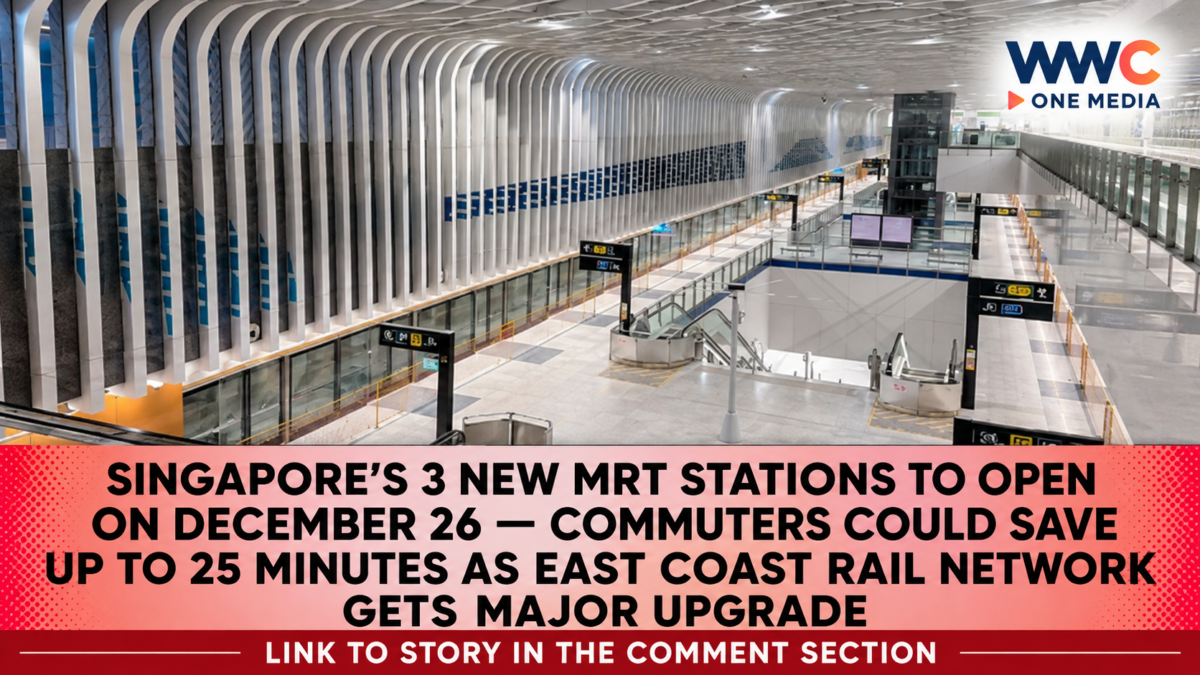
Singapore commuters are about to receive a major year-end transport upgrade, with three new MRT stations in the eastern part of the island officially scheduled to open on December 26, 2026.
The new stations — Bedok South, Xilin and Sungei Bedok — will extend two major rail lines and create a new interchange connecting the Thomson-East Coast Line (TEL) and Downtown Line (DTL).
The opening is expected to make journeys across eastern Singapore faster and more convenient, particularly for residents travelling to employment centres such as Changi Business Park and Tampines Regional Centre.
According to the Land Transport Authority (LTA), some commuters could save as much as 25 minutes on selected journeys once the extensions begin passenger service.
One of the biggest changes will be at Sungei Bedok, where passengers will be able to transfer between the two MRT lines without having to travel through the existing network to make the connection.
Transport Minister Jeffrey Siow announced the opening date on November 4 during the Singapore Urban Mobility Week 2026.
The December 26 launch will mark an important milestone in Singapore’s rail expansion, particularly for residents who have waited years for better train connections in the eastern corridor.
December 26 Confirmed: Three New MRT Stations Will Open
The LTA confirmed that the Thomson-East Coast Line Stage 5 and Downtown Line 3 Extension will begin passenger service on Saturday, December 26, 2026.
The three stations are:
- Bedok South (TE30): A new station on the Thomson-East Coast Line.
- Sungei Bedok (TE31/DT37): An interchange connecting the Thomson-East Coast Line and Downtown Line.
- Xilin (DT36): A new station on the Downtown Line.
Together, the extensions will add approximately 4.3 kilometres of railway infrastructure to Singapore’s MRT network.
The project consists of two separate extensions.
The TEL Stage 5 section will extend the Thomson-East Coast Line from Bayshore to Sungei Bedok, covering approximately 2.1 kilometres.
Meanwhile, the Downtown Line 3 Extension will extend the line from Expo to Sungei Bedok, adding approximately 2.2 kilometres.
The two extensions will meet at Sungei Bedok, creating a new interchange that gives commuters additional options for travelling between the eastern part of Singapore and other parts of the island.
Sungei Bedok Becomes a Major New MRT Interchange
Among the three stations, Sungei Bedok is arguably the most significant from a network-connectivity perspective.
The underground station will connect the Thomson-East Coast Line and Downtown Line, allowing passengers to transfer between the two services.
It will become the second interchange connecting the TEL and DTL, following Stevens station.
This connection is particularly important because the two lines serve different parts of Singapore.
The Thomson-East Coast Line provides access to the city centre, northern Singapore and the East Coast corridor.
The Downtown Line connects the north-western and eastern regions through the central business and downtown areas.
By linking them at Sungei Bedok, the new interchange will give commuters more flexibility when planning their journeys.
It could also help distribute passenger demand across different routes instead of concentrating travellers on existing connections.
For residents in the east, the new interchange means more ways to reach workplaces, shopping areas and other destinations without relying as heavily on buses or making longer transfers.
Commuters Could Save Up to 25 Minutes on Selected Journeys
One of the most significant benefits highlighted by the LTA is the potential reduction in travel time.
The authority provided examples of journeys that could become considerably shorter after the stations open.
The clearest example involves commuters travelling from Havelock to Changi Business Park.
| Journey | Current travel time | After opening | Potential savings |
|---|---|---|---|
| Havelock to Changi Business Park | 70 minutes | 45 minutes | Up to 25 minutes |
| Marine Parade to Tampines | More than 40 minutes by bus | About 25 minutes by rail | Up to 10 minutes |
The Havelock-to-Changi Business Park journey currently takes approximately 70 minutes and involves a bus transfer.
With the new rail connections, the LTA estimates that the same journey could take around 45 minutes without the need for that bus transfer.
That represents a potential reduction of approximately 25 minutes.
Commuters travelling between Marine Parade and Tampines could also benefit, with the rail journey expected to take about 25 minutes compared with more than 40 minutes by bus today.
These are projected journey times provided by the LTA, not guaranteed savings for every passenger. Actual travel times will depend on the starting point, destination, waiting time and route selected.
Nevertheless, the examples demonstrate how connecting the two rail corridors could improve daily commuting across the east.
Bedok South Station to Improve Access for Nearby Residents
Bedok South station will serve residents and commuters along Upper East Coast Road, including people living near the Bayshore precinct.
The station is part of the final stage of the Thomson-East Coast Line.
Its opening is expected to improve access to public transportation for nearby residential communities, schools and surrounding developments.
For people who currently depend on buses to reach an MRT station, the new facility could reduce the need for additional transfers.
The improvement is particularly relevant for residents in areas where reaching an existing train station can involve a longer walk or an additional bus journey.
The new station will also strengthen the eastern portion of the Thomson-East Coast Line, giving residents more direct access to destinations along the corridor.
Xilin Station to Connect Changi South and Business Areas
Xilin station will form part of the Downtown Line 3 Extension.
Its location will improve access to Changi South industrial estate, Changi Business Park and nearby employment areas.
This could be particularly beneficial for employees who travel to the eastern business districts for work.
Changi Business Park is an important employment location, with offices and businesses that attract workers from different parts of Singapore.
Improved rail access could make commuting more convenient while reducing dependence on road-based transportation.
The station will also provide additional connections for people travelling between the east and the city centre.
For workers who currently need to combine bus and MRT journeys, the extension could offer a more direct alternative.
More Than 460,000 Households to Benefit From Improved Rail Access
The LTA estimates that the two extensions will significantly increase the number of households located within convenient walking distance of the respective MRT lines.
With the opening of TEL Stage 5, more than 240,000 households will be within a 10-minute walk of a Thomson-East Coast Line station.
Meanwhile, the Downtown Line 3 Extension is expected to bring more than 220,000 households within a 10-minute walk of a Downtown Line station.
These figures are separate estimates for the two rail lines. They should not be interpreted as 460,000 unique households because some households may fall within both service areas.
The wider benefit is improved access to public transportation for people living and working along the East Coast corridor.
For Singapore, expanding the number of homes within walking distance of an MRT station is also part of a broader effort to make public transportation a more practical alternative to private vehicles.
Thomson-East Coast Line Finally Reaches Its Planned Final Stage
The opening of Bedok South and Sungei Bedok will complete the Thomson-East Coast Line’s planned five-stage rollout.
The line began operations in January 2020 with its first three stations in Woodlands.
It was subsequently expanded in stages, gradually connecting northern Singapore, the Thomson area, the city centre and the East Coast.
Stage 4 opened in June 2024, bringing seven additional stations into service.
The final stage will extend the line from Bayshore to Sungei Bedok.
Following the opening, the TEL will have 29 operational stations spanning approximately 42.8 kilometres, according to the LTA’s latest announcement.
The authority also expects the line to serve approximately one million daily commuters in the longer term after the future extension to Changi Airport Terminal 5.
That figure is a longer-term projection, not the expected immediate daily ridership when the December stations open.
Downtown Line Extension Strengthens Singapore’s Eastern Rail Network
The Downtown Line has been operating since 2013 and connects the north-western and eastern parts of Singapore through the city centre.
The new extension will add Xilin and Sungei Bedok to the line.
After the extension opens, the DTL will have 37 operational stations spanning approximately 44.6 kilometres.
The new connection is expected to improve access to Changi Business Park and the Expo area while providing additional routes toward the central business district.
It will also create a more convenient transfer option for passengers travelling between the Thomson-East Coast Line and Downtown Line.
The project is part of Singapore’s broader effort to build a more connected rail network, where passengers can reach destinations through multiple routes rather than depending on a single corridor.
Why Did the MRT Stations Take So Long to Open?
The opening of the three stations has been a long-awaited development for residents in the eastern part of Singapore.
The Thomson-East Coast Line’s final stage and the Downtown Line extension were originally expected to be completed earlier.
The timeline was pushed back, with the COVID-19 pandemic contributing to delays in the broader TEL construction programme.
However, construction challenges also played an important role.
In previous reporting, The Straits Times said the LTA had cited difficulties associated with tunnelling near existing critical infrastructure as a reason for the delayed opening timeline.
The engineering work was particularly challenging because the extension passes through an area with underground utilities, water channels and existing infrastructure.
Construction near the Sungei Bedok river mouth required careful planning because of the surrounding soil conditions.
The project also involved complicated tunnelling arrangements and coordination with other infrastructure systems.
These challenges help explain why the final sections required additional time before they could be opened safely.
The new December 26 date is therefore an important milestone after years of construction and schedule adjustments.
New Stations Could Support Future Travel Between Singapore and Johor Bahru
The expansion also comes as Singapore prepares for closer transport connections with neighbouring Malaysia.
Transport Minister Jeffrey Siow said residents in eastern Singapore would be able to travel on the Thomson-East Coast Line continuously into the city centre and north towards Woodlands.
When the Johor Bahru–Singapore Rapid Transit System Link is completed, passengers will have another important cross-border travel option.
The RTS Link will connect Woodlands North in Singapore with Bukit Chagar in Johor Bahru.
This means eastern residents will eventually be able to use the TEL to travel towards Woodlands North before transferring to the cross-border rail service.
However, an important distinction must be made: the three new MRT stations will not provide a direct train service into Johor Bahru when they open on December 26.
The cross-border connection depends on the separate RTS Link project becoming operational.
The new stations will improve access to the Singapore side of that future connection, but passengers will still need to transfer at Woodlands North.
Singapore’s Wider MRT Expansion Continues Beyond 2026
The opening of Bedok South, Xilin and Sungei Bedok is only one part of Singapore’s longer-term transport plans.
Other major rail projects are also progressing.
The Jurong Region Line is being developed to improve connectivity across western Singapore, while the Cross Island Line is expected to provide additional connections between different regions.
The LTA is also planning the Downtown Line 2 Extension, which will add three stations and connect the Downtown Line to the North-South Line in the north-western region.
That extension is expected to be completed by 2035.
Separately, the government is studying possible future Seletar and Tengah MRT lines.
These projects reflect Singapore’s approach to long-term transport planning: expanding rail access as residential communities, business districts and employment centres develop.
But the challenge is not simply building more stations.
The network must also remain reliable as new lines and extensions are integrated into the existing system.
WWC One Media previously reported that Singapore’s MRT network reached a record reliability level in August 2026, although some commuter-focused performance measures moved slightly in the opposite direction. Read: Singapore’s MRT Just Hit Its Highest Reliability Ever — But One Key Commuter Metric Went the Other Way.
The expansion also highlights the importance of transparent planning around future station locations. In a separate report, WWC One Media examined the investigation involving eight public officers whose property purchases near future MRT stations were referred to police for further scrutiny. Read: Singapore Investigates 8 Civil Servants Over Property Purchases Near Future MRT Stations.
These developments show that Singapore’s railway expansion affects more than commuting. It also influences urban development, property decisions and the way communities connect to employment centres.
What Commuters Should Know Before December 26
For passengers planning to use the new stations, the most important details are straightforward:
- Opening date: December 26, 2026.
- Bedok South: Thomson-East Coast Line.
- Xilin: Downtown Line.
- Sungei Bedok: Interchange between the Thomson-East Coast Line and Downtown Line.
- New rail extensions: Approximately 4.3 kilometres combined.
- Potential journey savings: Up to 25 minutes on selected trips.
- Major employment areas served: Changi Business Park and Changi South industrial estate.
The LTA has confirmed the passenger-service opening date. Commuters should check official LTA and train-operator announcements closer to the launch for operational details, including first-train timings and any updated journey information.
The Bottom Line
Singapore’s eastern rail network is set for a major upgrade on December 26, 2026, when Bedok South, Xilin and Sungei Bedok MRT stations officially open to passengers.
The biggest development is the new Sungei Bedok interchange, which will connect the Thomson-East Coast Line and Downtown Line and provide commuters with additional ways to travel across the island.
The LTA estimates that selected journeys could become up to 25 minutes shorter, while hundreds of thousands of households are expected to gain improved access to the two rail corridors.
For residents near Bedok South and Sungei Bedok, the opening represents the arrival of a long-awaited transport connection. For workers travelling to Changi Business Park and Changi South, it could mean a more convenient daily commute.
The new stations will also strengthen Singapore’s long-term transport plans, particularly as the country prepares for the future Johor Bahru–Singapore RTS Link and other major rail projects.
But the real impact will become clearer once passengers begin using the new services and actual commuting patterns emerge.
Will these three new MRT stations finally transform daily travel across eastern Singapore — and could the Sungei Bedok interchange become one of the area’s most important transport connections?