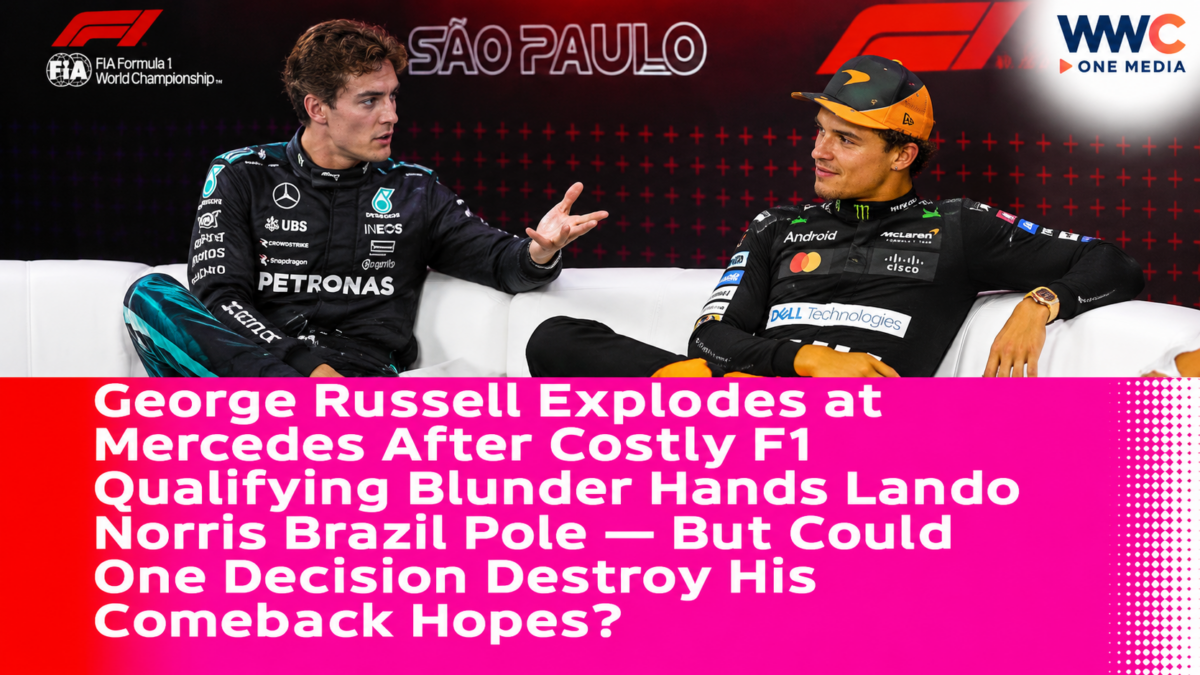
SAO PAULO, BRAZIL — George Russell’s frustration erupted over Mercedes team radio after a controversial qualifying decision potentially cost him pole position for the 2026 Formula 1 Sao Paulo Grand Prix, turning a stunning wet-weather performance into another painful setback in his increasingly difficult season.
The British driver looked capable of challenging McLaren’s Lando Norris for the fastest lap during Saturday’s rain-soaked qualifying session at Interlagos.
But when Russell caught Williams driver Alex Albon during his final flying lap, Mercedes instructed him to back off and create space for another attempt.
It was a decision that would immediately backfire.
Before Russell could complete another competitive lap, worsening rain swept across the circuit, leaving him stranded in second place and furious with his team.
The 28-year-old had qualified just 0.204 seconds behind Norris, but the disappointment became even more significant because he already faced a five-place grid penalty for an engine change.
That means Russell will start Sunday’s Brazilian Grand Prix from seventh position rather than the front row.
For a driver who began 2026 with championship ambitions, the missed opportunity represented another blow in a season that has delivered both remarkable performances and bitter disappointments.
And with his Mercedes teammate Kimi Antonelli having already secured the world drivers’ championship, Russell’s frustration extends far beyond a single qualifying session.
Russell’s Angry Team Radio Reveals the Scale of the Frustration
The drama unfolded during the final phase of qualifying, known as Q3, when drivers battled deteriorating track conditions in pursuit of pole position.
Russell had consistently demonstrated impressive speed in the wet and briefly appeared capable of securing the fastest qualifying time.
However, as he approached Albon’s Williams, Mercedes engineers feared that traffic would compromise his lap.
The team instructed Russell to reduce his speed, assuming there would be sufficient time for another attempt.
When the rain intensified, that assumption proved costly.
Russell immediately challenged the decision over the radio, demanding to know why he had been instructed to abandon the lap.
His anger became particularly evident when Mercedes team principal Toto Wolff confirmed that he had finished second.
Russell’s response was unmistakable:
“P2. I don’t want to be P2. I want to be P1.”
The exchange illustrated a driver desperate to prove that he remains capable of delivering race-winning performances despite losing the championship fight to his younger teammate.
Russell later described the situation as a collective misjudgment by Mercedes.
He maintained that the abandoned lap had been quick enough to challenge Norris.
However, because he never completed the attempt, the claim cannot be established with certainty.
How Mercedes’ Decision Turned Into a Qualifying Disaster
The critical sequence involved three developments that unfolded in rapid succession.
First, Russell was producing a competitive lap on intermediate tyres after qualifying conditions had gradually improved.
Second, he encountered Albon ahead of him, creating uncertainty about whether he could finish the lap without losing significant time.
Third, Mercedes decided to prioritize another attempt rather than allowing Russell to complete the lap already underway.
That strategy depended on the weather remaining stable for a little longer.
Instead, rain intensified and prevented Russell from improving his time.
The decision is especially painful because Mercedes possessed the pace to compete for pole.
According to Formula1.com’s official qualifying analysis, Russell had demonstrated strong speed throughout the session and was ahead of Norris’ benchmark during portions of his abandoned lap.
But there was an important complication.
Independent analysis from The Race suggested that Russell’s rapidly closing gap to Albon might have compromised his lap even if Mercedes had instructed him to continue.
In other words, the abandoned lap may have been capable of securing pole—but finishing it successfully was not guaranteed.
This distinction matters because the incident was not simply a case of Mercedes ordering Russell to slow down for no reason.
The team faced a difficult real-time decision involving traffic, track conditions and weather forecasts.
Unfortunately for Russell, its chosen strategy failed.
Toto Wolff Admits Mercedes Faced a 50-50 Decision
Mercedes team principal Toto Wolff acknowledged the frustration following qualifying.
The Austrian described the call as a finely balanced decision made under exceptionally difficult circumstances.
Russell was closing on Albon, raising the possibility that continuing the lap would cost time.
Mercedes therefore attempted to create space for another flying lap.
The gamble failed when the weather deteriorated sooner than expected.
Wolff nevertheless praised Russell’s driving throughout the session.
According to Mercedes’ official comments published by Formula1.com, the British driver had shown sufficient pace to challenge for pole position.
The team’s disappointment was compounded by the knowledge that Russell had delivered one of his strongest wet-weather performances of the season.
But Wolff’s explanation also underscored the uncertainty surrounding the incident.
The team could not know for certain whether Russell would have completed the lap faster than Norris.
It could only weigh the likelihood of losing time behind Albon against the risk of worsening conditions.
That split-second judgment ultimately became one of the biggest talking points of the qualifying session.
Lando Norris Seizes Pole as Mercedes Misses Its Opportunity
While Russell was left furious, McLaren’s Lando Norris emerged as the biggest beneficiary of the chaotic qualifying session.
The British driver secured pole position for the Sao Paulo Grand Prix, beating Russell by just over two-tenths of a second.
Norris’ performance was particularly impressive because heavy rain had disrupted qualifying and made grip levels difficult to predict.
The session was delayed by approximately 90 minutes because of dangerous conditions at Interlagos.
Drivers initially faced standing water and poor visibility before conditions improved sufficiently to allow qualifying to proceed.
Even after the restart, changing weather continued to create strategic uncertainty.
Norris ultimately delivered the lap that mattered, securing his third consecutive Sao Paulo Grand Prix pole position.
His achievement continued an extraordinary sequence of qualifying performances at the Brazilian circuit.
The result also offered McLaren an important opportunity to challenge Mercedes and other leading teams in Sunday’s race.
However, Norris’ pole did not end the debate surrounding Russell’s pace.
McLaren team principal Andrea Stella acknowledged that Russell appeared to have one of the fastest cars during the final qualifying segment.
He suggested the Mercedes driver’s abandoned lap was potentially competitive with Norris’ benchmark.
That assessment strengthened Russell’s argument that a major opportunity had slipped away, although it did not conclusively prove he would have taken pole.
For Norris, the priority now is converting his qualifying success into a strong race result.
As previously covered by WWC ONE MEDIA in its report on Norris’ controversial Spanish Grand Prix defeat, the McLaren driver has already experienced how quickly race strategy and unpredictable events can transform a promising weekend.
Brazil could offer another reminder that pole position does not guarantee victory.
Russell Drops to Seventh Despite Qualifying Second
The qualifying disappointment was made worse by Russell’s existing engine-related penalty.
Mercedes had fitted a new internal combustion engine component, resulting in a five-place grid drop.
Consequently, Russell’s second-place qualifying result will translate into seventh position on Sunday’s starting grid.
The penalty also means he would not have started from pole even if he had completed the fastest lap.
Nevertheless, securing the official pole position would have represented an important personal achievement.
It would have highlighted his competitiveness during a season dominated by teammate Kimi Antonelli.
Russell now faces a more demanding challenge.
Instead of defending a front-row position, he must navigate traffic and potentially difficult weather conditions while attempting to recover places.
His starting position creates additional strategic complications involving overtaking, tyre management and the possibility of safety-car interruptions.
However, Russell has already demonstrated that he can overcome adversity during the 2026 championship.
In September, he delivered a dramatic victory at the Azerbaijan Grand Prix, holding off Max Verstappen in a closely contested finish.
As WWC ONE MEDIA reported in its coverage of Russell’s Azerbaijan Grand Prix victory, the British driver successfully converted pole position into a race win despite late pressure from Red Bull.
That performance demonstrated both his speed and his ability to manage high-pressure situations.
But Interlagos presents a different challenge.
Starting seventh in potentially wet conditions will require more than outright pace.
Russell must also avoid incidents, make the right strategic decisions and capitalize on opportunities as they develop.
Kimi Antonelli’s World Championship Adds Another Layer of Pressure
One of the most significant aspects of Russell’s frustration is the broader context surrounding Mercedes’ 2026 season.
His teammate Kimi Antonelli secured the Formula 1 drivers’ championship at the previous race in Mexico City.
The achievement made the young Italian the sport’s youngest world champion.
For Mercedes, Antonelli’s success represents a major milestone.
For Russell, however, it has intensified scrutiny of a season that began with high expectations.
The British driver entered 2026 as one of the leading title contenders.
But a combination of setbacks and Antonelli’s remarkable form ultimately ended his hopes of becoming world champion.
That explains why a potential pole position in Brazil carried unusual emotional importance.
It offered Russell an opportunity to remind the paddock that he remains among the quickest drivers on the grid.
The internal Mercedes rivalry has been one of the defining stories of the championship.
Earlier in the season, Antonelli’s rise placed increasing pressure on his experienced teammate.
As WWC ONE MEDIA previously reported on Antonelli’s historic championship bid at the United States Grand Prix, the young Italian had established himself as a formidable competitor while still pursuing his first world title.
That breakthrough has now become reality.
But the championship battle has given way to another Mercedes objective: securing the Constructors’ Championship.
The team entered Brazil with a substantial advantage over Ferrari and an opportunity to seal the title.
For Russell and Antonelli, strong results at Interlagos could help complete another successful championship campaign.
Antonelli Moves to the Front Row After Russell’s Penalty
Although Russell’s qualifying session ended in frustration, Mercedes still has reason for optimism.
Antonelli qualified third fastest but will move up to second position because of Russell’s penalty.
That places the newly crowned world champion alongside Norris on the front row.
The Italian admitted that qualifying in the wet was challenging.
He made mistakes during his final flying lap but remained competitive enough to secure a strong starting position.
Starting second gives Antonelli an opportunity to challenge Norris immediately.
It also strengthens Mercedes’ chances of collecting the points needed to secure the Constructors’ Championship.
Antonelli’s development has been one of the biggest stories of the season.
In September, he produced a spectacular comeback at the Italian Grand Prix, winning at Monza after starting 19th.
As detailed in WWC ONE MEDIA’s report on Antonelli’s remarkable Monza victory, the Italian delivered an extraordinary recovery drive to triumph in front of his home supporters.
With the drivers’ championship already secured, Antonelli can now focus on helping Mercedes finish the season with another major team achievement.
But his front-row starting position also raises a fascinating question.
Could the newly crowned champion capitalize on Russell’s misfortune and deliver another victory?
Sao Paulo Grand Prix Qualifying: The Key Results
Saturday’s rain-affected session produced several surprises and created an intriguing starting order.
Pole position: Lando Norris — McLaren
Second-fastest qualifier: George Russell — Mercedes, 0.204 seconds behind Norris
Third-fastest qualifier: Kimi Antonelli — Mercedes
Russell’s grid penalty: Five places for an engine change
Russell’s starting position: Seventh
Antonelli’s starting position: Second, following Russell’s penalty
Race venue: Autodromo Jose Carlos Pace, Interlagos, Sao Paulo, Brazil
Race distance: 71 laps, approximately 305.9 kilometers
Race date: Sunday, November 8, 2026
Heavy rain, rapidly changing grip levels and strategic uncertainty could continue influencing the weekend.
The Interlagos circuit is famous for producing unpredictable races, particularly when the weather changes.
Drivers must balance speed with caution through its challenging corners and elevation changes.
For competitors starting outside the leading positions, the circuit can offer overtaking opportunities, but poor visibility and standing water can make aggressive racing dangerous.
Those conditions could become particularly important for Russell.
Could Rain Actually Help George Russell’s Comeback?
Despite his disappointment, Russell remains encouraged by the Mercedes car’s performance in wet conditions.
The British driver said he felt more comfortable in the rain than he had in recent dry-weather sessions.
That confidence may become important if Sunday’s race is affected by additional rainfall.
Wet conditions can reduce the predictability of race strategy and create opportunities for drivers starting further down the grid.
A well-timed pit stop, an effective tyre choice or a safety-car period can dramatically change the running order.
However, those same factors can also destroy a driver’s race.
Russell must therefore balance the desire to recover lost ground against the risk of making costly mistakes.
Mercedes’ strategy team will also face considerable pressure following the qualifying controversy.
Any further mistake could intensify criticism of the decisions made on the pit wall.
Wolff has indicated that the team expects further rain, increasing the possibility of an eventful Grand Prix.
For Russell, that could provide the opportunity he needs.
But it could also create another frustrating chapter in his 2026 campaign.
Why the Controversy Matters Beyond One Qualifying Lap
The Russell incident highlights one of Formula 1’s most difficult challenges: making strategic decisions when circumstances are changing by the second.
Drivers often rely on their engineers to provide information about traffic, weather and tyre performance.
Engineers, in turn, must make recommendations based on data that can become outdated almost immediately.
During dry qualifying sessions, teams generally have more predictable conditions in which to plan their runs.
Wet qualifying is different.
A sudden downpour can eliminate an opportunity within moments.
Traffic can ruin an otherwise competitive lap.
And a decision that appears sensible when it is made can become disastrous seconds later.
That is precisely what happened to Mercedes at Interlagos.
The team attempted to maximize Russell’s chances by creating space for another attempt.
Instead, worsening weather closed the window.
The incident may fuel debate about whether teams should allow drivers greater discretion during unpredictable qualifying sessions.
However, there is no evidence that Mercedes intentionally disadvantaged Russell.
Both the driver and the team have characterized the outcome as a strategic misjudgment.
The real issue is whether the team can learn from the mistake before another critical qualifying or race situation arises.
Mercedes Faces a Major Test of Trust and Teamwork
Russell’s furious radio reaction created dramatic headlines, but the bigger question concerns how Mercedes responds.
The team remains one of Formula 1’s strongest competitors.
It has already delivered Antonelli’s drivers’ championship and is positioned to secure the Constructors’ title.
Yet even successful teams can experience communication breakdowns under pressure.
Russell’s disappointment is understandable given the apparent pace he possessed.
At the same time, Mercedes engineers were attempting to manage a difficult traffic situation.
Both perspectives matter.
The challenge now is to ensure that one controversial decision does not undermine the cooperation needed to finish the season strongly.
Russell has publicly acknowledged that the team made a collective misjudgment.
That distinction suggests his frustration was directed at the outcome rather than an accusation of deliberate wrongdoing.
For Mercedes, a strong race result would be the most effective response.
If Russell can recover from seventh and Antonelli challenges for victory, the team could transform an ugly qualifying episode into a successful Grand Prix weekend.
The Bigger Picture: Russell Still Has Something to Prove
George Russell’s 2026 season has delivered a complicated mixture of promise and disappointment.
He has demonstrated race-winning speed, defeated formidable rivals and produced outstanding qualifying performances.
But he has also watched his younger teammate claim the championship he hoped to win.
That makes every remaining opportunity especially important.
Brazil offered a chance to showcase his speed in one of Formula 1’s most challenging qualifying conditions.
Instead, a Mercedes strategy decision left him second fastest and visibly furious.
The penalty means he must now begin the race from seventh, facing a difficult recovery through a competitive field.
Yet his wet-weather performance demonstrated that he has not lost the ability to challenge at the front.
For Mercedes, the immediate objective is the Constructors’ Championship.
For Norris, the challenge is converting pole into victory.
For Antonelli, it is continuing his extraordinary championship-winning campaign.
And for Russell, Sunday’s race offers something more personal.
An opportunity to turn frustration into performance.
The question now is whether George Russell can fight his way from seventh to the podium—or whether Mercedes’ costly qualifying decision will become another painful symbol of a season that promised him so much more.