
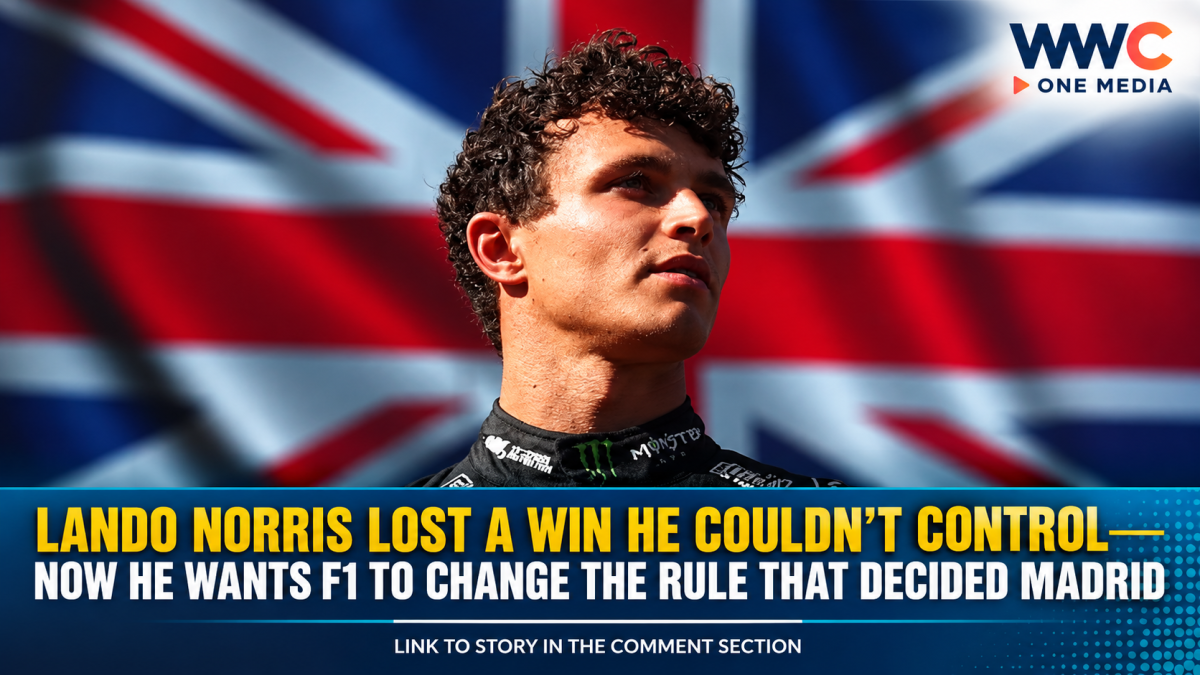
MADRID — Lando Norris has called for changes to both Formula 1’s Virtual Safety Car (VSC) procedure and Madrid’s new Madring circuit, after a perfectly timed caution period helped turn what looked like a likely victory into a frustrating third-place finish at the inaugural Spanish Grand Prix in Madrid.
Norris started from pole and controlled the opening stages of the race, but his advantage disappeared when a VSC was deployed after Lance Stroll’s Aston Martin stopped on track.
The timing proved decisive.
Norris had already passed the pit entry when the VSC was activated, meaning several rivals behind him were able to make their pit stops under the slower neutralised conditions and gain a significant advantage.
By the time Norris reached the pit lane on the following lap, the VSC period had ended.
He emerged without the race lead and was unable to recover because overtaking proved extremely difficult around the new Madrid circuit. Kimi Antonelli went on to win, with Max Verstappen second and Norris third.
‘Nothing I could do’
Norris was particularly frustrated because he believed there was little he or McLaren could have done differently.
The reigning world champion had taken pole, led the race and built a substantial advantage before the VSC intervention.
The FIA’s official race report confirms that the decisive VSC was triggered when Stroll stopped at Turn 20, while Norris’ hopes of victory were subsequently damaged by the timing of his pit stop.
Norris argued that the current system can create an unfair situation in which the driver leading the race is punished simply because a neutralisation occurs immediately after that driver passes the pit entry.
He suggested several possible solutions, including giving every driver an opportunity to complete a pit stop under the same conditions or temporarily preventing cars from entering the pit lane during a VSC, except in emergencies such as a puncture.
The underlying concern is straightforward: a race should not be decided by which driver happens to be closest to the pit entry at the exact moment a VSC is called.
The issue has been raised before, and Norris acknowledged that VSC outcomes can benefit some drivers while hurting others over the course of a season. But losing a potential victory in this way, he argued, makes the problem much more difficult to ignore.
Why the VSC mattered so much
A VSC is designed to neutralise a race without deploying the physical Safety Car.
Under the VSC procedure, drivers must slow to a prescribed minimum pace while maintaining their positions. The FIA regulations allow tyre changes during a VSC, creating a strategic advantage because a pit stop costs significantly less race time than it normally would.
Reuters estimated that a pit stop during VSC conditions can save roughly 11 seconds compared with a normal stop.
That difference became critical in Madrid.
Because Norris had already passed the pit entry when the VSC was activated, he could not take advantage of the same opportunity as drivers behind him. When he finally stopped, his rivals had effectively gained the strategic advantage.
And there was another problem: Madring offered very few realistic opportunities for Norris to win the position back.
Norris also wants Madring redesigned
Norris didn’t reserve his criticism for the VSC.
The McLaren driver also questioned parts of the newly built Madring circuit, particularly Turns 18 and 19, which he believes contribute little to the racing spectacle.
He suggested replacing the sequence with a more straightforward section leading into a hairpin, potentially creating a better overtaking opportunity.
The criticism is significant because the Madrid circuit was introduced as a major new addition to the F1 calendar. Formula1.com lists Madring at 5.414 kilometres with 22 corners and 57 laps, making it one of the newest major venues on the championship schedule.
Before the race, drivers had already highlighted the circuit’s challenging characteristics, including blind corners, high-speed sections and difficult braking zones.
But what looked potentially spectacular on paper did not necessarily translate into easy overtaking during the Grand Prix.
Norris ultimately described the circuit as enjoyable to drive but argued that it needs modifications to become a better racing venue.
Antonelli admits Norris deserved better
Perhaps most strikingly, race winner Kimi Antonelli also acknowledged that Norris had been unfortunate.
Antonelli secured his eighth victory of the 2026 season, but he reportedly admitted that Norris deserved the win and that the Mercedes driver did not feel the result unfolded exactly as he would have wanted.
That reaction adds another layer to the controversy: the debate isn’t simply Norris complaining after losing a race. Even the driver who benefited from the circumstances recognised how heavily the VSC timing influenced the outcome.
Verstappen and Stella expect the issue to return
Four-time world champion Max Verstappen also indicated that the VSC issue could be discussed at the next drivers’ briefing.
McLaren team principal Andrea Stella, meanwhile, warned that changing the procedure would not necessarily be simple.
Any alteration would require significant institutional backing from the FIA and Formula 1 because the VSC is embedded in the sport’s regulations and race-control procedures.
There are also practical complications.
For example, completely closing the pit lane during a VSC could create problems if weather suddenly changes and drivers need to switch from slick tyres to wet-weather tyres. Norris himself recognised that any solution would have to account for such situations.
The bigger question for Formula 1
The Madrid controversy now leaves F1 with a difficult question:
Should a race-neutralisation system designed to improve safety be allowed to create such a major strategic advantage simply because of the timing of the VSC?
Norris’ argument is not that VSCs should disappear. Instead, he wants the procedure examined so that drivers have a more equal opportunity when a caution is triggered.
At the same time, the debut of Madring has raised questions about whether the circuit’s layout can deliver the wheel-to-wheel racing Formula 1 needs.
For Norris, the frustration is particularly sharp because the ingredients for victory were already there: pole position, race-leading pace and control of the opening stages.
Instead, a VSC that arrived at exactly the wrong moment—and a circuit where overtaking was extremely difficult—combined to take the victory out of his hands.
And that could be the real story coming out of Madrid.
The first Spanish Grand Prix at Madring may have produced a winner, but it also left F1 with two problems it may have to solve before the championship returns to Madrid.



Leave a Reply