WASHINGTON / BRUSSELS / TEHRAN / MANILA — November 7, 2026 | WWC ONE MEDIA | World News, US Politics and Global Geopolitics
President Donald Trump’s sweeping defeat in the 2026 US midterm elections has dramatically weakened his political position in Washington. But the Republican president still holds some of the most powerful tools in American government — and many of them can be exercised beyond US borders.
With Democrats preparing to take control of both chambers of Congress in January 2027, Trump’s ability to advance major domestic legislation faces significant obstacles.
However, foreign policy presents a different political and constitutional landscape.
As commander in chief and the nation’s chief diplomatic representative, Trump retains substantial authority over military operations, negotiations with foreign governments, sanctions and aspects of international trade.
According to Bloomberg’s November 6 analysis, American presidents have frequently turned toward foreign affairs when their domestic legislative agendas became constrained by opposition-controlled congressional chambers.
That historical pattern is raising a serious question about Trump’s final two years in office.
Will his midterm defeat force him to moderate his approach to international affairs — or encourage him to pursue even more ambitious military and diplomatic decisions abroad?
The stakes extend from the war with Iran and Russia’s invasion of Ukraine to US-China trade relations, NATO’s future and tensions across Latin America.
For governments around the world, the election results have created uncertainty rather than a clear indication that American foreign policy will change direction.
Democrats Win Congress, but Trump Remains Commander in Chief
The November 3 midterm elections produced a major political setback for Republicans.
Democrats captured both the House of Representatives and the Senate, ending unified Republican control of Congress.
Economic pressures, the cost of living, tariffs and dissatisfaction with the Iran war helped shape the result.
As WWC ONE MEDIA reported on the Democrats’ historic congressional victory, the incoming Democratic majority will gain substantial authority to investigate the administration, scrutinize government spending and challenge the White House’s legislative priorities.
But winning Congress is not equivalent to winning the presidency.
Trump will remain in office until January 2029.
He retains constitutional authority over executive-branch operations, military command and diplomatic relations.
Congress has important powers of its own, including control over appropriations, oversight, legislation and the Senate’s role in confirming certain appointments and approving treaties.
The result is likely to be a period of divided government in which both branches possess considerable influence but neither can automatically impose its entire foreign-policy agenda.
1. Iran: Trump’s Biggest Military Decision Could Still Be Ahead
The most urgent challenge involves the ongoing US war with Iran.
The conflict has become one of the most politically damaging issues facing the Trump administration.
Higher fuel prices, military costs and the risk of further escalation have contributed to public concern.
Trump has acknowledged that the war hurt Republican candidates in the midterm elections, although he continues defending his decision to launch military operations.
As WWC ONE MEDIA reported on Trump’s admission that the Iran conflict damaged Republicans politically, the president has argued that preventing Iran from obtaining nuclear weapons remains a major US security objective.
The election has intensified pressure to reconsider the conflict.
According to Associated Press reporting published November 6, Trump faces options ranging from maintaining the current military posture to pursuing additional strikes or seeking a negotiated arrangement.
However, these are possible policy choices, not announcements of new military operations.
In a recent interview reported by Bloomberg, Trump indicated that he had no immediate plan for fresh strikes but remained prepared to act if he considered it necessary.
That distinction matters.
Trump has not announced a new post-election military offensive against Iran.
Nevertheless, his authority to direct US forces remains substantial, subject to legal limits and congressional powers.
A new escalation could have implications for oil prices, shipping routes, regional security and the wider global economy.
For Democrats, the challenge will be determining whether congressional pressure can influence military decisions before they are implemented.
2. Ukraine: Trump Can Continue Negotiating With Russia
Another major foreign-policy issue is Russia’s ongoing war in Ukraine.
Trump has repeatedly expressed interest in reaching an agreement that would end the fighting.
His administration has pursued diplomatic contacts involving Moscow, Kyiv and European governments.
The midterm defeat does not prevent the president from continuing those negotiations.
He can direct diplomatic envoys, establish negotiating priorities and communicate with foreign leaders.
The challenge is whether the terms emerging from the talks will be acceptable to Ukraine, Russia and the governments expected to support a settlement.
As WWC ONE MEDIA reported on preparations for new US-mediated Russia-Ukraine talks in Abu Dhabi, discussions were being planned for November 10 and 11.
The proposed talks represent an attempt to restart diplomacy.
They do not establish that a ceasefire has been reached.
Territorial disputes, security guarantees and the future of Ukraine’s defense remain major obstacles.
A Democratic-controlled Congress could advocate increased military assistance to Kyiv.
It could also try to impose conditions on the administration’s spending decisions.
But Trump would retain significant influence over negotiations and the execution of foreign policy.
European governments are therefore watching closely to determine whether the White House becomes more accommodating toward Moscow, increases pressure on Russia or pursues another diplomatic approach.
3. NATO and Europe: The President Still Shapes America’s Alliances
Trump has frequently challenged European allies to take greater responsibility for their own defense.
His administration has pressed NATO members to increase military spending while questioning some aspects of America’s traditional security commitments.
The new Congress may attempt to reinforce US relationships with European allies.
But the president still represents the United States in diplomatic meetings and directs much of the executive branch’s engagement with NATO.
The Council on Foreign Relations has warned that a Democratic congressional victory does not guarantee a rapid improvement in US-European relations.
Congress can impose certain restrictions through legislation and funding.
However, overriding a presidential veto normally requires two-thirds support in both chambers.
That creates a substantial obstacle for Democrats acting without Republican cooperation.
The United States also continues supporting mechanisms through which European allies finance American weapons for Ukraine.
As WWC ONE MEDIA reported on Washington’s planned push for additional NATO funding for Ukraine’s defense, the administration has sought to distribute more of the financial burden among allied governments.
The future of those arrangements will depend on decisions in Washington, European capitals and NATO institutions.
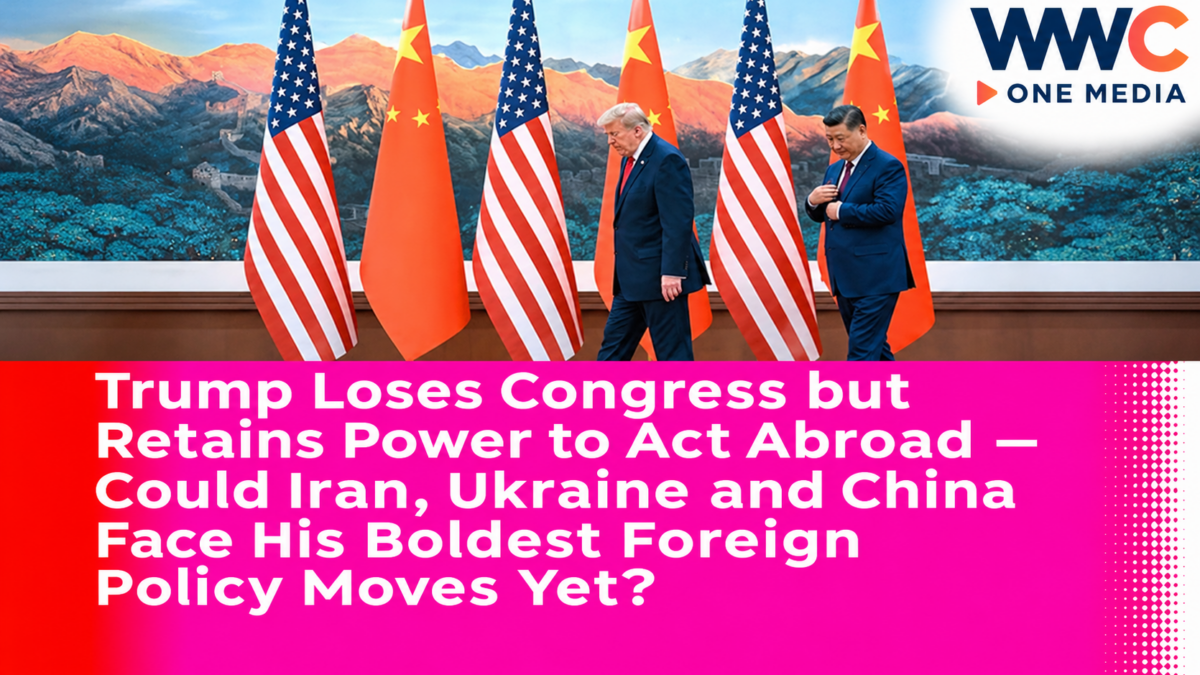
4. China: Trade Pressure and Strategic Competition Could Continue
Trump’s midterm defeat also raises questions about US-China relations.
The administration has used tariffs, trade negotiations and technology restrictions to advance its economic and national-security objectives.
Democrats may challenge aspects of those policies, especially where tariffs contribute to higher prices for American households.
However, presidents possess considerable trade authority delegated by Congress under existing laws.
The Council on Foreign Relations noted that changing those authorities over Trump’s veto would require support Democrats do not appear to possess on their own.
This means the president can retain substantial influence over trade negotiations.
Nevertheless, his powers are not unlimited.
Tariffs, sanctions and export restrictions must comply with relevant statutes and remain subject to judicial review where applicable.
Congress can also amend laws, conduct oversight and impose funding conditions within its constitutional authority.
The immediate relationship with China remains complicated by disagreements involving agriculture, critical minerals and technology.
Senior US officials have recently pressed Beijing to fulfill commitments under the existing trade truce.
The dispute has not automatically resulted in a new blanket tariff increase.
For international markets, the central concern is whether negotiations produce greater stability or another period of economic confrontation.
5. Cuba and Latin America: Military and Sanctions Decisions Remain Sensitive
Latin America is another region where analysts are closely monitoring Trump’s future decisions.
The president has pursued a confrontational approach toward certain governments, including Venezuela and Cuba.
Bloomberg’s earlier reporting raised the possibility that Trump could take additional actions in the region as his domestic political options narrow.
But speculation about future military action must not be confused with a formal policy announcement.
As of November 7, the election results do not establish that Trump has ordered a new intervention in Cuba.
American policy toward the region involves sanctions, diplomatic relations, national-security concerns and commercial restrictions.
Some measures can be pursued through existing executive authority.
Others require statutory authorization, funding or compliance with applicable international obligations.
A Democratic Congress could examine the administration’s Latin America policies and potentially challenge their funding or legal basis.
Still, the president may retain considerable latitude to direct diplomacy and certain executive measures.
For regional governments, uncertainty about Washington’s intentions could become an important diplomatic challenge.
Can Democrats Stop Trump From Launching Military Operations?
The Constitution divides national-security powers between Congress and the president.
The president serves as commander in chief.
Congress has the authority to declare war, fund military operations and legislate on matters within its constitutional jurisdiction.
The War Powers Resolution also establishes procedures concerning the introduction of US armed forces into hostilities and congressional involvement.
However, the interpretation and enforcement of presidential war powers have long been contested.
Presidents from both political parties have undertaken military actions without obtaining a new formal declaration of war.
Congress can seek to limit military activities through legislation or appropriations.
But disagreements over executive authority, veto powers and congressional procedure can complicate those efforts.
The Carnegie Endowment for International Peace argues that investigations alone are unlikely to force major policy reversals.
Meaningful limits generally require enforceable legislation, appropriations restrictions or sufficient political pressure to alter executive decisions.
Consequently, Democratic control of Congress increases scrutiny of military policy without creating an automatic veto over every presidential action overseas.
Congressional Investigations Could Become a Major Political Weapon
The new Democratic majority is expected to use congressional committees aggressively.
Lawmakers may investigate the planning and conduct of the Iran war, defense procurement, sanctions policy and decisions affecting US allies.
As WWC ONE MEDIA reported on the Democrats’ proposed five-front congressional offensive, committee hearings and document requests could significantly increase pressure on the administration.
Incoming chairs will be able to pursue authorized investigations and issue subpoenas within the limits of their powers.
But subpoenas can be challenged, and executive-privilege disputes may require judicial resolution.
Investigations can reveal information, shape public opinion and influence negotiations.
They do not, by themselves, reverse military orders or enact new laws.
That means Democrats will need to decide how to convert oversight findings into practical policy changes.
Trump’s Veto Could Protect His Foreign-Policy Agenda
One of the most important remaining powers is the presidential veto.
Even after Democrats assume control of both chambers, Trump can reject legislation passed by Congress.
Overriding a veto requires a two-thirds majority in both the House and Senate.
The incoming Democratic majority is not expected to possess that level of support independently.
This makes bipartisan cooperation essential for legislation that the president strongly opposes.
Democrats may still influence major spending bills or negotiate conditions attached to government funding.
But they cannot assume that controlling Congress will allow them to direct every aspect of US foreign policy.
Trump’s ability to veto legislation will remain a significant source of political leverage.
Why Foreign Policy May Become Trump’s Main Focus
American presidents have sometimes placed greater emphasis on foreign affairs during the later stages of their administrations.
International negotiations and executive decisions may provide opportunities to influence policy even when Congress blocks domestic legislation.
But foreign policy is not free from constraints.
Military commitments can become expensive.
Trade restrictions can damage economic relationships.
Diplomatic efforts may fail if other governments reject proposed terms.
Public opinion can also shape the political consequences of international decisions.
Reuters reported that analysts are divided over whether Trump’s defeat will make him more cautious or encourage dramatic actions aimed at defining his legacy.
Both possibilities remain open.
The president could seek negotiations that reduce international tensions.
He could also pursue more confrontational policies in areas where he believes executive authority permits action.
The outcome will depend on decisions that have not yet been made.
What the Midterm Results Mean for the Philippines
For the Philippines, the shift in congressional control matters because the United States remains an important defense, economic and diplomatic partner.
American foreign policy influences regional security, maritime cooperation and relations with China.
A Democratic-led Congress may support continued attention to US alliances in the Indo-Pacific.
The president, meanwhile, will continue directing much of the executive branch’s diplomatic and defense policy.
The result could be both continuity and political disagreement.
Congressional appropriations influence assistance programs and defense funding, while administration decisions shape the conduct of cooperation.
However, the November 3 election does not automatically cancel existing US-Philippines defense agreements or suspend American assistance.
Any specific change would need to be supported by official decisions.
For Philippine businesses, trade policy and global energy prices may also matter.
Escalation involving Iran could affect international fuel markets, while US-China trade tensions could influence supply chains and regional investment.
These potential effects should be monitored rather than presented as inevitable outcomes.
Three Scenarios for Trump’s Final Two Years
Scenario 1: Trump pursues major diplomatic breakthroughs.
The president could prioritize negotiations involving Iran, Russia, Ukraine and other governments in an attempt to secure foreign-policy achievements before leaving office.
Scenario 2: The White House becomes more confrontational.
Trump could pursue additional military or economic pressure where he believes US interests require it.
Such actions could create greater friction with Congress and foreign governments.
Scenario 3: Divided government produces selective cooperation.
Democrats and Republicans could find common ground on limited areas such as defense readiness, strategic competition with China and certain alliance commitments.
None of these scenarios is a confirmed future policy.
The direction will depend on White House decisions, Congress, international developments and domestic political pressures.
The Bigger Question: Will Trump’s Midterm Defeat Make the World Less Stable?
The 2026 midterm elections have changed American politics.
Democrats will control Congress, making Trump’s domestic legislative agenda more difficult to advance.
But the president remains commander in chief and retains substantial influence over international diplomacy and national-security decisions.
The Iran conflict could intensify or move toward negotiations.
Ukraine’s future remains uncertain as Washington pursues additional diplomatic talks.
Europe is assessing the reliability of its relationship with the United States.
And China continues negotiating with Washington over trade, technology and critical minerals.
At the same time, the incoming Congress will have meaningful powers over spending, oversight and appointments.
Trump’s political defeat has weakened his position in Washington, but it has not transferred control of US foreign policy to congressional Democrats.
The next two years will reveal whether the White House and Congress can reach agreements on international priorities or whether domestic confrontation spills into America’s relationships overseas.
And as governments from Tehran and Moscow to Beijing and Manila reassess Washington’s direction, one question now carries enormous global consequences:
Will Trump’s loss of Congress force a more cautious foreign policy — or could a president determined to secure his legacy use his remaining powers to make the final two years of his administration even more consequential than the first?