TOKYO / WASHINGTON / MANILA — November 7, 2026 | WWC ONE MEDIA | Global Economy, Japan, Central Banking and Financial Markets
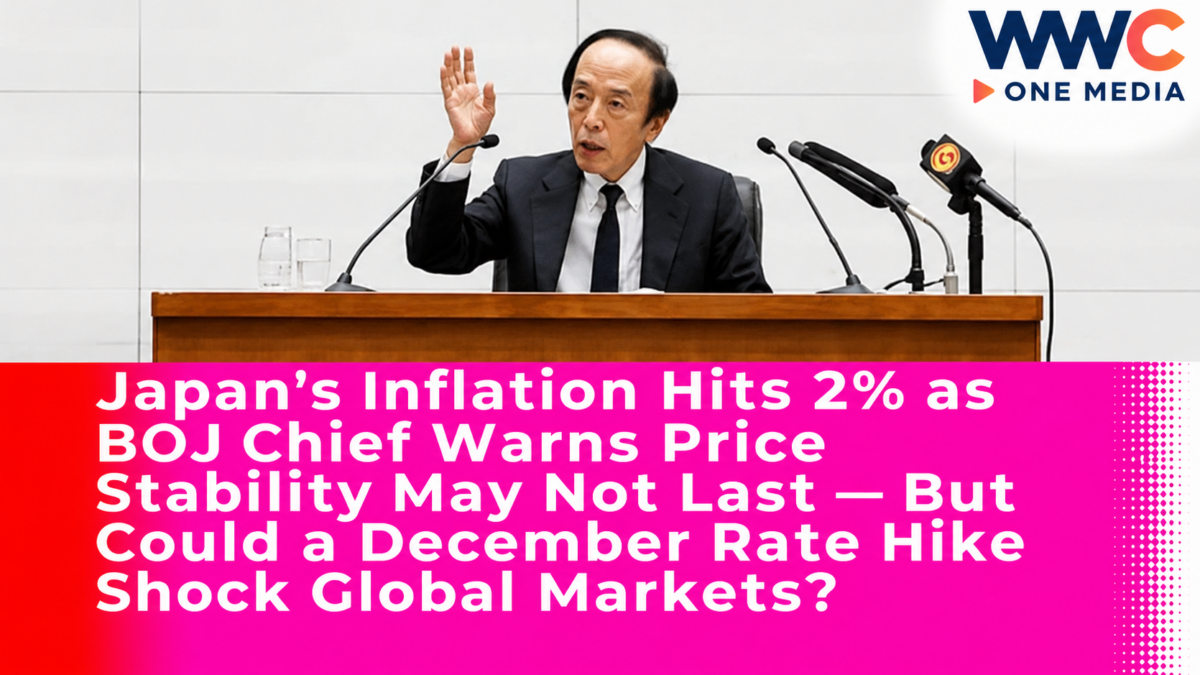
Japan has reached a historic milestone in its battle against deflation, but Bank of Japan Governor Kazuo Ueda is warning that keeping inflation sustainably near 2% could prove more difficult than reaching that level in the first place.
Speaking on November 6 at an International Monetary Fund event in Washington, Ueda acknowledged that Japan’s underlying inflation has reached a level broadly consistent with the central bank’s long-standing 2% price-stability target.
However, he questioned whether Japan’s emerging balance between rising wages and prices could be maintained over the long term.
The warning comes as investors increasingly expect the Bank of Japan to raise interest rates again in December, potentially lifting its benchmark rate from 1.25% to 1.50%.
According to Bloomberg and Reuters, Ueda believes Japan has reached an important turning point after decades of weak inflation and exceptionally low borrowing costs.
But reaching the target does not mean the central bank’s work is finished.
Higher energy prices, a weak yen, growing wage pressure and increased demand associated with artificial intelligence could push inflation above the desired level.
At the same time, raising interest rates too aggressively could weaken consumer spending, make borrowing more expensive and intensify financial-market volatility.
Could Japan’s historic escape from deflation become the beginning of a new inflation problem—and will the BOJ’s next interest-rate decision shake financial markets across Asia?
Ueda Says Japan’s 2% Inflation Milestone Is Not Yet Secure
During the IMF gathering, Ueda said Japan’s underlying inflation rate was now around the central bank’s target.
He described an economy in which wage increases and price growth had reached a more sustainable balance than Japan experienced during its prolonged struggle with deflation.
But he made clear that policymakers could not assume the equilibrium would last indefinitely.
Ueda’s concern is that Japan has not fully developed the economic conditions needed to maintain inflation consistently around 2%.
Businesses and workers are still adapting to an environment in which prices rise regularly rather than remaining nearly unchanged.
For years, Japan struggled to generate sufficient wage growth, consumer spending and inflation.
The Bank of Japan responded with extraordinary monetary policies, including near-zero or negative interest rates and large-scale asset purchases.
Now, policymakers face the opposite challenge.
They must ensure that inflation does not accelerate significantly beyond the target.
Ueda’s latest remarks demonstrate that the BOJ is moving from stimulating inflation to managing it.
Bank of Japan Keeps Interest Rates at 1.25%
The BOJ’s benchmark policy rate currently stands at 1.25%, its highest level in approximately 31 years.
The central bank raised borrowing costs from 1.00% to 1.25% in September.
At its October 30 meeting, policymakers voted 8–1 to leave rates unchanged.
The decision provided time to evaluate recent economic data and the financial effects of earlier rate increases.
However, the BOJ also strengthened its assessment of underlying inflation, indicating that the economy had reached a level broadly consistent with its 2% objective.
As WWC ONE MEDIA reported when the BOJ raised rates to their highest level in 31 years, Ueda has repeatedly emphasized that future monetary decisions will depend on inflation, wages and economic conditions.
The October decision did not signal an end to the tightening cycle.
Instead, it reinforced expectations that additional increases remain possible.
Japan’s Consumer Inflation Rises to 2.1%
Japan’s latest nationwide inflation figures reveal why the central bank remains cautious.
Core consumer prices, which exclude fresh food but include energy, increased 2.1% in September from a year earlier.
That was an acceleration from 1.7% in August.
An inflation measure excluding both fresh food and energy increased 2.4%.
These figures suggest price pressure is spreading beyond volatile energy and food components.
As WWC ONE MEDIA reported on Japan’s September inflation increase, the data strengthened expectations of another BOJ rate increase before the end of 2026.
However, it is important to distinguish the figures.
The 2.1% nationwide core CPI reading is an official measure of consumer-price changes.
Ueda’s approximately 2% underlying inflation assessment reflects the central bank’s evaluation of the broader, persistent inflation trend.
They are not identical indicators.
Energy Prices Threaten Another Inflation Surge
One of the biggest uncertainties comes from energy markets.
Japan imports substantial quantities of oil, natural gas and other fuels.
Consequently, changes in international energy prices can affect transportation, electricity generation and manufacturing expenses.
The prolonged conflict involving Iran has added pressure to global energy markets.
Higher imported fuel costs can eventually reach consumers through electricity bills, transportation charges and product prices.
Ueda warned that energy-related price increases were beginning to influence Japan’s consumer inflation.
He also indicated that inflation could accelerate further in early 2027.
That creates a difficult situation for households.
Higher prices can erode purchasing power if wages do not rise sufficiently.
But aggressively increasing interest rates can also make borrowing more expensive.
The BOJ must therefore balance the need to stabilize prices against the risk of unnecessarily slowing economic activity.
Stronger Wages Offer Hope for Japan’s Economy
Japan’s wage developments are another important part of the story.
For decades, limited salary growth made it difficult for businesses to raise prices consistently.
Workers often expected little increase in compensation, while companies hesitated to increase prices for fear of losing customers.
The pattern contributed to prolonged weakness in domestic demand.
That environment is gradually changing.
Ueda said wage growth is now broadly consistent with an economy experiencing 2% inflation.
The development could support more sustainable consumer spending.
As WWC ONE MEDIA examined in its coverage of Japan’s changing wage and inflation cycle, stronger compensation has become increasingly important to the country’s economic outlook.
But wage growth also introduces policy challenges.
If businesses repeatedly raise prices to cover labor costs, inflation may become more persistent.
The BOJ wants a stable cycle of moderate wage and price increases—not an uncontrolled acceleration.
December Rate Hike Expectations Intensify
The BOJ’s next monetary-policy meeting is scheduled for December 17–18, 2026.
Investors and economists are increasingly focused on whether policymakers will approve another quarter-point increase.
Such a move would lift the benchmark rate from 1.25% to 1.50%.
Reuters reported on November 6 that former BOJ chief economist Seisaku Kameda expects a December increase.
Kameda also believes the central bank could eventually raise rates toward 2%.
However, Kameda is a former official offering an independent assessment.
His forecast does not represent an official BOJ commitment.
Reuters has separately reported that the central bank’s estimate of Japan’s neutral interest rate lies within a broad range of approximately 1.1% to 2.5%.
The neutral rate is the level of borrowing costs considered neither stimulative nor restrictive to the economy.
Its uncertainty makes it difficult to determine precisely how far the BOJ should increase rates.
Ueda has avoided committing to a fixed timetable.
That means a December increase remains possible, not guaranteed.
Japan’s Corporate Borrowing Remains Surprisingly Resilient
Another challenge involves the response of businesses to higher interest rates.
Normally, rising borrowing costs make financing more expensive and can reduce demand for loans.
Yet Japan’s corporate credit market has shown considerable resilience.
As WWC ONE MEDIA reported on stronger Japanese corporate borrowing despite BOJ rate increases, company demand for financing has remained relatively firm.
That could indicate that businesses are becoming more confident about expansion and investment.
However, it also suggests that monetary tightening has not yet significantly restricted financial conditions across the economy.
For the BOJ, this may strengthen the argument for additional increases.
At the same time, the impact of previous rate changes can appear gradually.
Smaller businesses may be more vulnerable than large companies with strong balance sheets.
The central bank therefore needs to monitor lending conditions carefully.
AI Investment Creates Another Inflation Risk
Artificial intelligence is also affecting Japan’s economic outlook.
Ueda said AI-related investment is supporting demand while offering potential productivity benefits.
For Japan, the technology could be particularly important because the country faces persistent labor shortages.
Automation may allow businesses to produce more goods and services without requiring equivalent increases in staffing.
That could improve productivity and help contain certain costs over time.
But large AI investments also increase demand for electricity, advanced equipment and specialized components.
If supplies cannot expand quickly enough, those investments may contribute to higher prices.
The effects could therefore move in different directions.
AI may improve long-term productivity while generating shorter-term inflationary pressure.
Ueda indicated that policymakers must assess both effects.
Global Market Turmoil Could Complicate the BOJ’s Decision
Japan’s monetary-policy debate is taking place during a turbulent period for global equities.
Technology stocks have experienced steep declines as investors question whether enormous AI infrastructure investments can generate sufficient returns.
Japanese shares have also been affected by the global selloff.
In a November 6 report, Reuters said Prime Minister Sanae Takaichi was monitoring the market downturn while pursuing plans to support strategic investment.
A prolonged international financial-market decline could complicate the BOJ’s tightening strategy.
If weak markets undermine business confidence or economic growth, policymakers may become more cautious.
Conversely, continuing energy inflation and yen weakness could strengthen the case for further tightening.
The BOJ must assess these competing risks rather than respond mechanically to any single indicator.
Could Higher Japanese Rates Strengthen the Yen?
The Japanese yen is another key factor.
Higher Japanese interest rates can make yen-denominated assets more attractive relative to investments in currencies with lower or falling returns.
That can support the yen.
However, exchange rates also depend on US interest rates, economic growth expectations and global investor sentiment.
If the Federal Reserve raises rates at the same time as the BOJ, the effect on the dollar-yen exchange rate may be different from a situation where only Japan tightens policy.
As WWC ONE MEDIA reported on the yen’s reaction to the BOJ’s October decision, currency traders have been closely monitoring signs of further monetary normalization.
A stronger yen can help reduce the local-currency cost of imported goods.
But it can also affect the foreign-currency earnings of Japanese exporters.
There is therefore no guarantee that higher rates would benefit every sector of Japan’s economy.
Why Japan’s Interest Rates Matter to the Philippines
Japan is an important economic partner for the Philippines through trade, investment, tourism and development financing.
Changes in Japanese interest rates and exchange rates can influence the broader regional financial environment.
A stronger yen can change the peso value of yen-denominated payments and expenditures.
Higher Japanese borrowing costs may also affect some investment and funding decisions.
For Filipinos working in Japan, exchange-rate movements can influence the peso value of money sent home.
However, the impact depends on the actual exchange rate and transaction costs.
There is no confirmed direct effect on Philippine interest rates from Ueda’s November 6 remarks.
The Bangko Sentral ng Pilipinas makes its monetary-policy decisions based on Philippine inflation, economic conditions, financial stability and other relevant factors.
Japan’s changing policy nevertheless deserves attention because international capital markets are interconnected.
Three Possible Outcomes for Japan’s Next Rate Decision
Scenario 1: BOJ raises rates to 1.50% in December.
If inflation and wage developments remain consistent with the bank’s outlook, policymakers could decide that additional tightening is appropriate.
Scenario 2: BOJ holds rates while monitoring financial markets.
If global volatility intensifies or economic activity weakens, the central bank could choose to gather more information before acting.
Scenario 3: Inflation accelerates into 2027.
Higher energy costs, a weaker yen or continued domestic price pressure could increase the urgency of future rate adjustments.
None of these scenarios has been formally announced as the BOJ’s next decision.
The Bigger Question: Can Japan Keep Inflation Under Control Without Damaging Growth?
Japan has reached a major economic turning point.
After decades of deflationary pressure and ultra-low interest rates, the country’s underlying inflation has finally moved to approximately 2%.
Wage growth has improved.
Corporate borrowing remains resilient.
And the Bank of Japan has raised its benchmark policy rate to the highest level in roughly three decades.
But the central bank’s challenge is far from over.
Energy costs could accelerate inflation into early 2027.
Artificial intelligence investment could create both productivity gains and additional demand pressures.
A weak yen can increase import costs.
And higher interest rates may eventually slow spending or investment.
Ueda’s latest warning captures the uncertainty facing policymakers.
Japan has reached an important inflation milestone, but the BOJ has not established that price growth will remain sustainably at 2% for years to come.
With the next interest-rate decision approaching in December, the central bank must decide whether further tightening is necessary—or whether global market turbulence makes patience the safer choice.
And as Japan’s historic economic transition enters a new phase, one question could reshape financial markets across Asia: Will the Bank of Japan successfully lock inflation near 2%, or could its next rate hike unleash a new wave of volatility in the yen, Japanese stocks and global bond markets?