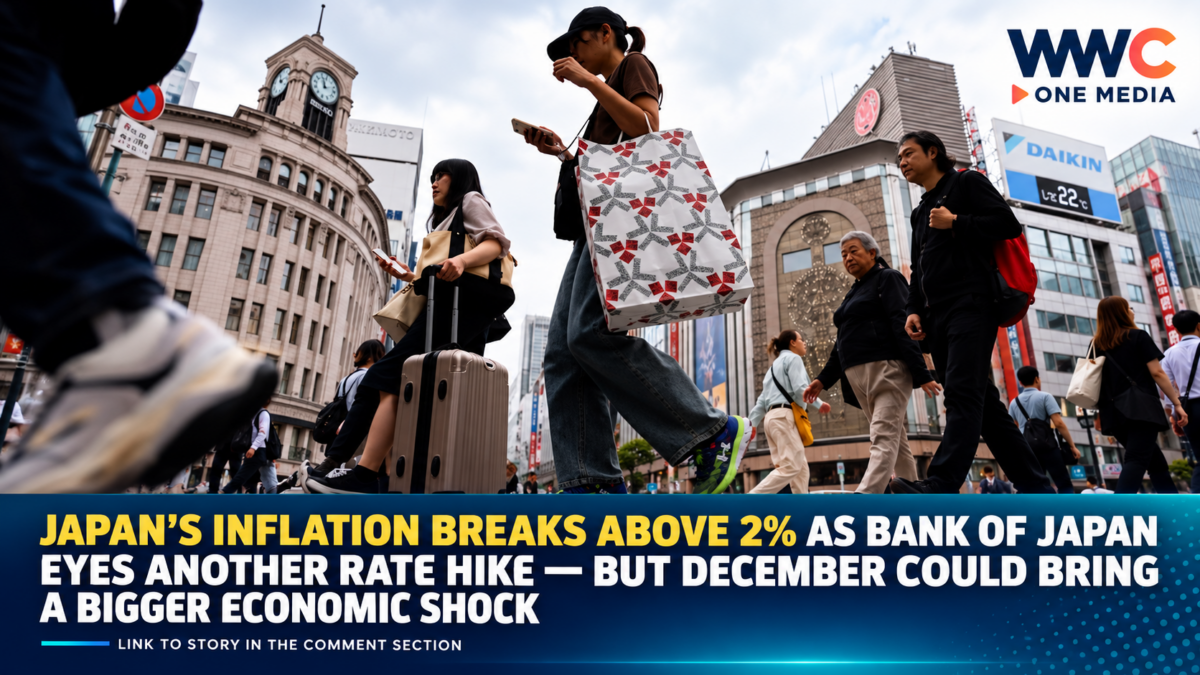
TOKYO, Japan — October 23, 2026. Japan’s inflation has climbed back above the Bank of Japan’s crucial 2% target, intensifying expectations that the country’s central bank could raise interest rates again before the end of the year as rising energy costs, a weak yen, and increasingly widespread price pressures threaten to squeeze households and businesses.
Official figures released Friday showed that Japan’s core consumer price index (CPI), which excludes fresh food but includes energy, increased 2.1% year-on-year in September, accelerating from 1.7% in August.
The result matched economists’ expectations but marked the first time in nine months that core inflation exceeded the Bank of Japan’s target.
The latest figures present a fresh challenge for policymakers who are attempting to maintain stable inflation without undermining economic growth after decades of unusually low interest rates.
Inflation Is Spreading Beyond Energy Prices
Japan’s inflation story is no longer just about expensive imported fuel.
A closely watched measure of consumer prices that excludes both fresh food and fuel climbed 2.4% in September, compared with 1.9% in August.
The increase suggests underlying inflationary pressures are strengthening even when some of the most volatile price categories are removed.
Goods prices increased 2.8% from a year earlier, while services inflation rose to 1.5%, up from 1.2% in August.
The acceleration in services prices is particularly significant because it may indicate businesses are passing higher labor costs to customers.
This development could make inflation more persistent and complicate the central bank’s efforts to keep price growth sustainably close to 2%.
Middle East Conflict, Weak Yen and AI Demand Add Pressure
Several global economic forces are contributing to Japan’s renewed inflation concerns.
Higher fuel costs associated with the prolonged Middle East conflict are raising energy-related expenses, while a weaker Japanese yen has made imported goods and raw materials more expensive.
Meanwhile, robust demand linked to artificial intelligence is adding pressure in parts of the economy, further complicating Japan’s inflation outlook.
Government fuel subsidies have helped cushion consumers against some price increases, but the latest data suggest those measures have not fully offset broader inflationary forces.
For Japanese households, the concern is that rising prices could continue eroding purchasing power unless wage growth keeps pace.
Bank of Japan’s Interest Rate Already at a 31-Year High
The renewed inflation acceleration comes just one month after the Bank of Japan increased its benchmark interest rate to 1.25% in September, its highest level in 31 years.
The move marked another milestone in Japan’s gradual departure from the ultra-loose monetary policies that defined much of its economic history.
Bank of Japan Governor Kazuo Ueda has signaled concern that underlying inflation could move beyond the central bank’s target.
However, policymakers face a difficult balancing act.
Raising interest rates can help control inflation by making borrowing more expensive and reducing demand. But moving too aggressively could weigh on businesses, households, investment, and economic growth.
For now, many economists expect the central bank to leave rates unchanged at its October 29–30 policy meeting.
Instead, investors will closely examine its updated economic forecasts and statements for evidence that another increase is approaching.
December Could Become Japan’s Next Major Economic Turning Point
Attention is increasingly shifting toward December.
Reuters reported that many analysts expect the Bank of Japan to raise its policy rate to 1.50% in December, potentially followed by additional increases over time.
Some economists estimate that Japan’s eventual peak policy rate could reach between 1.75% and 2.00%.
However, Capital Economics has warned that the ultimate level could move even higher if previous rate increases fail to cool the economy significantly.
Such a scenario would represent a notable shift in Japan’s monetary outlook.
Higher interest rates could affect mortgage borrowers, business financing, government debt costs, and the yen’s exchange rate.
Financial markets will therefore be watching closely for any indication that policymakers are becoming more concerned about inflation remaining above target.
Why Japan’s Inflation Matters Beyond Its Borders
Japan is one of the world’s largest economies and an important source of international capital.
A sustained increase in Japanese interest rates could influence global financial markets by altering the attractiveness of yen-denominated investments and changing incentives for investors who borrow in yen.
If Japanese borrowing costs rise faster than expected, investors may reassess positions in foreign bonds, equities, and other assets.
But the impact would depend on several factors, including interest rates elsewhere, currency movements, and how much tightening financial markets have already priced in.
For Asian economies, including the Philippines, changes in Japan’s financing conditions could also influence regional investment decisions and currency-market sentiment.
These outcomes remain possibilities rather than established consequences of the latest inflation report.
The Bigger Question: Can Japan Control Inflation Without Hurting Growth?
Japan spent decades struggling with weak inflation and periods of deflation.
Today, its central bank faces a different challenge: preventing rising prices from becoming excessive while preserving the conditions for sustainable wage growth and economic expansion.
The latest inflation data suggest that pricing pressures are becoming more widespread, strengthening the argument for further monetary tightening.
Yet the timing of the next rate increase remains uncertain.
The Bank of Japan’s October policy meeting is expected to provide a clearer picture of how officials are assessing these risks.
For now, Japan’s inflation has crossed a critical threshold. The next major question is whether the Bank of Japan can guide prices back toward stability — or whether December will mark the beginning of a more aggressive interest-rate cycle.