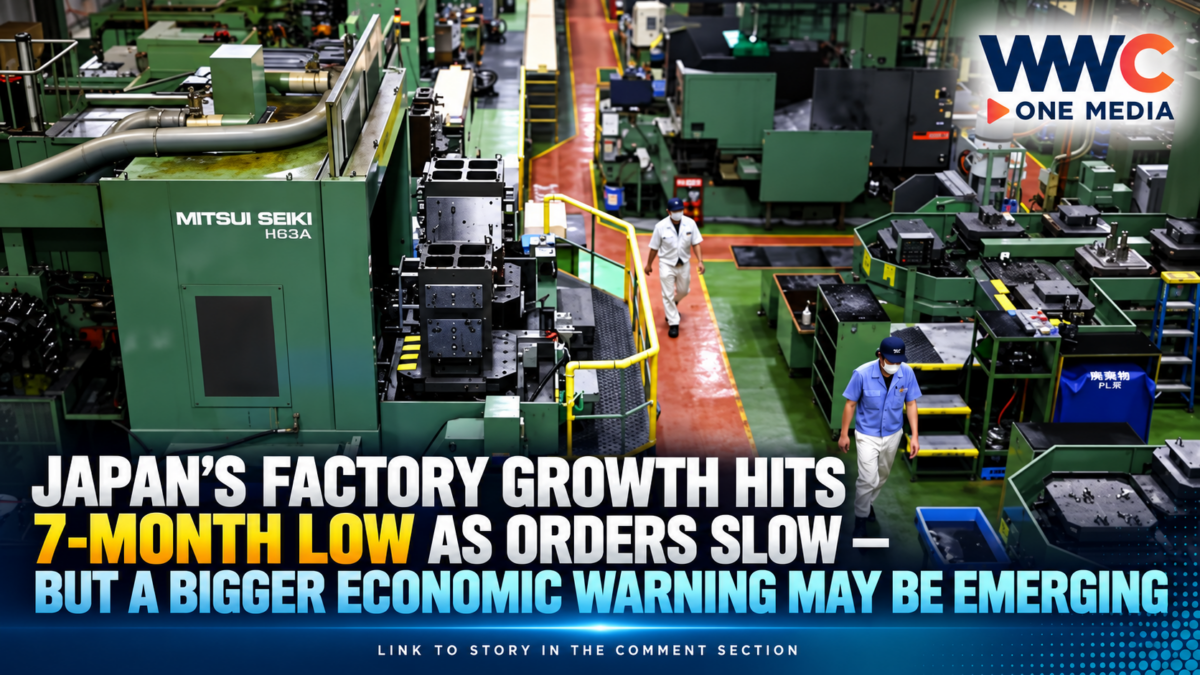
TOKYO, JAPAN — October 23, 2026 — Japan’s manufacturing industry is showing fresh signs of losing momentum, raising concerns about the resilience of one of Asia’s largest economies as factory production, new orders and export demand grow more slowly.
A closely watched economic survey released Friday revealed that Japan’s manufacturing activity expanded at its weakest pace in seven months, highlighting mounting challenges for businesses navigating higher costs, changing consumer demand and an uncertain global trade environment.
The preliminary S&P Global Japan Manufacturing Purchasing Managers’ Index (PMI) dropped to 53.3 in October from 54.1 in September, marking another slowdown in factory activity.
Although the reading remained above the crucial 50-point threshold separating expansion from contraction, the decline suggests that Japan’s industrial recovery is losing some of its earlier strength.
Factory Orders and Production Lose Momentum
The latest PMI report showed that Japanese manufacturers experienced their slowest growth in production since March, while new factory orders also expanded at their weakest rate over the same period.
The slowdown suggests businesses are facing softer demand even as production remains in expansion territory.
New export business across Japan’s private sector also increased at its slowest pace in four months, adding to concerns that international demand may no longer provide the same degree of support.
For Japan, a major global supplier of automobiles, electronic components, advanced machinery and industrial technology, weakening demand could eventually affect production planning, investment and supplier activity.
However, the figures do not indicate that Japan’s manufacturing sector has entered a recession. Factories are still expanding, but at a slower pace.
Manufacturing Inventories Rise as Companies Continue Purchasing
Despite cooling new orders, the survey revealed that Japanese manufacturers continued to increase their purchasing activity.
This contributed to the biggest buildup in stocks of purchased materials in almost four years.
The development presents a mixed picture.
Higher inventories can reflect preparation for future production, but they can also become a concern if customer demand fails to keep pace with expectations.
Manufacturing employment continued to rise moderately in October, indicating that companies had not broadly stopped hiring even as factory growth weakened.
Services Sector Offers a Bright Spot
While manufacturing growth slowed, Japan’s services industry showed signs of improvement.
The preliminary Services PMI Business Activity Index increased to 52.0 in October from 51.3 in September, supported by stronger business activity and faster sales growth.
The broader S&P Global Japan Composite PMI Output Index remained unchanged at 52.3, marking the 19th consecutive month of expansion across Japan’s private sector.
This suggests that improved service-sector conditions helped offset weaker manufacturing momentum.
However, the overall picture remains fragile.
New business growth across the private sector slowed to a three-month low, employment growth weakened to its slowest pace in 14 months, and business confidence about the coming year declined to its lowest level since July.
Rising Costs Add Another Challenge
Japanese businesses are also facing persistent cost pressures.
The October survey showed that input-price inflation accelerated slightly as companies reported higher raw material and labor costs.
Businesses continued to increase their selling prices, although the pace of output-price inflation moderated to a four-month low.
These pressures create difficult decisions for manufacturers balancing production costs, customer demand and profitability.
For policymakers, the combination of slower factory growth and continued inflation presents a complicated economic picture.
Asia’s Manufacturing Competition Adds to the Pressure
Japan’s slowdown comes as other Asian manufacturing economies benefit from technology-related investment and demand.
Reuters reported earlier in October that a global surge in artificial intelligence investment helped support manufacturing activity in several economies, including South Korea and Taiwan.
Japan has also benefited from demand associated with semiconductors, advanced technology, defense equipment and automobiles.
Nevertheless, the latest figures suggest that these opportunities have not prevented an overall moderation in Japan’s factory growth.
The contrast highlights how uneven the manufacturing expansion has become across Asia.
What Happens Next for Japan’s Economy?
The latest readings leave three crucial questions for the months ahead.
First, will new factory orders recover, allowing manufacturers to maintain production growth?
Second, can stronger service-sector activity continue to offset weaker industrial momentum?
And third, will rising business costs and softer hiring eventually weigh on consumer spending and corporate investment?
For now, Japan’s economy is still showing signs of expansion rather than outright contraction.
But with manufacturing growth slipping to a seven-month low, businesses and investors will be closely watching whether October’s slowdown proves temporary or signals a longer period of weaker industrial growth.
The bigger question is no longer whether Japan’s factories are growing — but how long that growth can withstand weakening orders, rising costs and an increasingly competitive Asian manufacturing landscape.