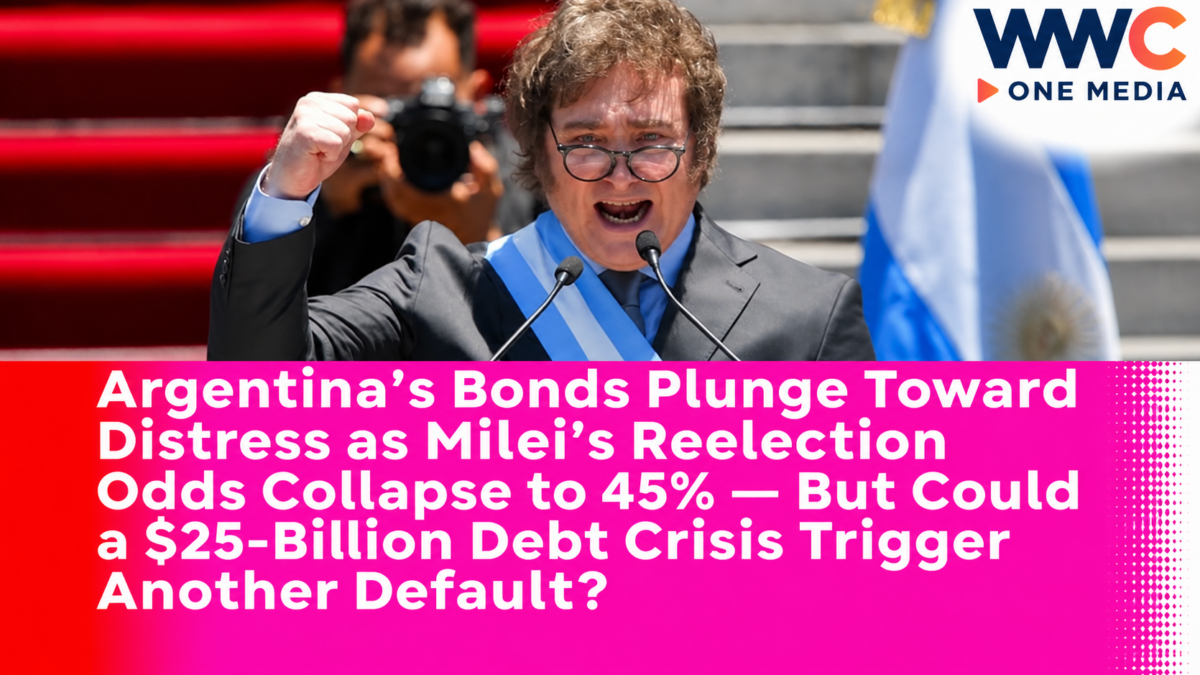
BUENOS AIRES / NEW YORK / MANILA — November 7, 2026 | WWC ONE MEDIA | Global Economy, Emerging Markets and Latin American Politics
Argentina’s financial markets are facing a fresh wave of selling as investors grow increasingly worried about President Javier Milei’s political future and the country’s ability to meet approximately $25 billion in foreign-currency debt obligations in 2027.
The country’s dollar-denominated government bonds headed for their worst weekly performance in more than a year, as a global retreat from risky investments collided with mounting uncertainty ahead of Argentina’s next presidential election.
According to Bloomberg’s November 6 report, the yield on Argentina’s benchmark sovereign bond maturing in 2035 climbed to 13.77%, compared with 12.67% at the end of the previous week.
The bond lost more than three cents on the dollar in value during the week.
Meanwhile, Argentina’s country-risk premium surged to approximately 928 basis points, approaching the 1,000-basis-point level that investors commonly associate with distressed sovereign debt.
The deterioration represents a sharp reversal from July, when the country’s risk premium reached an eight-year low near 400 basis points.
But the crisis of confidence is not being driven by debt alone.
Financial markets are now questioning whether Milei can secure another presidential term in 2027 and preserve the economic reforms that helped revive investor interest in Argentina.
One market-based model estimates his reelection probability at approximately 45%, down from nearly 90% in July.
The figures are raising an uncomfortable question for investors who had expected Argentina to regain easier access to international capital markets.
Could the combination of election uncertainty, expensive borrowing and massive debt repayments push Argentina toward another financial crisis—or will Milei’s fiscal reforms prove strong enough to restore confidence?
Argentina’s Bonds Suffer Their Worst Week in Over a Year
The selloff has affected Argentine dollar bonds across multiple maturities.
Bloomberg Línea reported that the country’s benchmark 2035 note declined by more than three cents per dollar during the week, driving its yield up to 13.77%.
Bond yields and bond prices generally move in opposite directions.
When investors demand a higher return to compensate for risk, the market price of an existing bond typically falls.
The increase in yields therefore reflects a deterioration in investor confidence.
Argentina’s government bonds have been particularly vulnerable because the country remains a relatively risky borrower.
A report from local investment firm Cohen Aliados Financieros confirmed that Argentine dollar bonds fell by an average of approximately 2.5% during the November 5 trading session.
That compared with a roughly 0.4% decline in broader emerging-market debt.
The difference demonstrates that Argentina’s losses were not caused solely by a global financial-market downturn.
Country-specific political and financing concerns also played an important role.
The selloff continued a trend that had been developing since July rather than beginning suddenly after the US midterm elections.
Country Risk Soars Toward the 1,000-Basis-Point Danger Zone
One of the most closely watched indicators is Argentina’s country-risk premium.
The JPMorgan measure reflects the additional yield investors demand for holding Argentine sovereign debt instead of comparable US government securities.
According to Bloomberg, the premium widened by nearly 140 basis points during the first four days of the week, reaching approximately 928 basis points.
That is equivalent to about 9.28 percentage points of additional yield.
The level is more than double the country’s July low.
Investors commonly regard a spread of approximately 1,000 basis points as an indicator of sovereign debt trading at distressed levels.
However, that threshold is a market convention, not a legal definition of default.
A country can have a high risk premium and continue making all scheduled debt payments.
Argentina’s current position therefore signals serious investor concern, not a completed default.
The rising premium also makes new borrowing more expensive.
That is particularly troubling for a country facing major foreign-currency obligations next year.
Milei’s Reelection Odds Fall as Investors Price In Political Risk
The upcoming October 2027 presidential election has become a central factor in the bond-market outlook.
Milei’s administration has introduced major economic reforms aimed at reducing inflation, restoring fiscal discipline and attracting private investment.
Those policies helped rebuild investor confidence during the earlier stages of his presidency.
But the political environment is changing.
Bloomberg cited a model developed by Pedro Siaba Serrate, strategy director at Portfolio Personal Inversiones, estimating that Milei’s market-implied reelection probability had fallen to around 45%.
That compared with approximately 90% in July.
The decline is dramatic, but the figure requires careful interpretation.
It is not an official election projection.
It is not a survey of Argentine voters.
The estimate is derived from financial-market prices and modeling assumptions.
Different models, polls and political analysts may reach different conclusions.
Nevertheless, the change illustrates how investors are increasingly considering the possibility that Milei’s economic policies may not continue after the election.
For holders of long-term Argentine debt, political continuity matters because future governments can alter fiscal, monetary and financing policies.
Brazil and US Elections Add to Milei’s Political Problems
Argentina’s difficulties have also been intensified by political developments outside its borders.
In Brazil, President Luiz Inácio Lula da Silva won reelection in October, defeating conservative challenger Flávio Bolsonaro.
The result disappointed investors who had expected a government more closely aligned with Milei’s economic philosophy.
The United States delivered another setback to the region’s political right when Democrats won control of Congress in the November 3 midterm elections.
Milei has maintained a close political relationship with President Donald Trump.
Some investors now question whether Washington would provide the same degree of financial support to Argentina during another market crisis.
As WWC ONE MEDIA reported on Brazil’s decision to hold interest rates at 13.75% after Lula’s reelection, Brazil is confronting its own combination of political uncertainty, inflation concerns and market volatility.
Brazil and Argentina have different economic conditions, and their debt risks should not be treated as identical.
But the regional political environment has become more challenging for Milei.
Argentina Faces Approximately $25 Billion in Debt Payments
The largest financial concern is the country’s repayment schedule.
Argentina faces approximately $25 billion in hard-currency debt obligations during 2027, according to the figures highlighted in Bloomberg’s latest reporting.
That creates significant demand for dollars.
The government needs enough foreign-currency resources to pay creditors, support financial stability and maintain confidence in the peso.
Argentina’s reserves remain an important source of concern.
The country also needs access to financing channels that allow it to refinance or manage upcoming maturities.
Earlier this year, investors had hoped Argentina would be able to return to international bond markets at more affordable rates.
But the increase in sovereign yields has made that prospect considerably less attractive.
Borrowing at yields exceeding 13% could create substantial future interest costs.
As a result, officials may need to rely more heavily on existing financing arrangements, multilateral institutions, domestic funding and export-generated dollars.
The situation is serious, but it is important not to equate large debt payments with an inevitable default.
Debt sustainability depends on repayment schedules, available reserves, government finances, creditor arrangements and access to funding.
IMF Support Provides a Financial Backstop—but Not a Complete Solution
Argentina’s relationship with the International Monetary Fund remains important.
The IMF reached a staff-level agreement on the third review of the country’s $20-billion program in late October.
That agreement, subject to approval by the IMF’s executive board, would allow an additional disbursement of approximately $900 million.
The IMF has acknowledged progress in Argentina’s fiscal and monetary policies.
It has also emphasized the need to rebuild financial buffers and preserve sustainable access to financing.
The distinction matters.
A staff-level agreement is not the same as final board approval or completed disbursement.
And IMF support does not eliminate all the risks associated with Argentina’s sovereign debt.
Reuters has previously reported that the IMF regards Argentina’s debt as sustainable but subject to exceptional risks.
The country’s ability to maintain fiscal discipline while generating enough foreign currency will be central to its outlook.
US Support Could Become Harder to Secure
Investors are also reassessing the importance of American financial support.
A $20-billion US currency-swap facility played an important role in stabilizing Argentina during market stress in 2025.
But the political balance in Washington has changed.
Democrats are preparing to control both chambers of Congress.
That could increase scrutiny of the Trump administration’s financial relationships with foreign governments.
Nevertheless, the congressional election result does not automatically cancel existing financial arrangements.
Nor does it establish that US officials have rejected any future request for assistance.
The uncertainty is about whether comparable support would be politically and financially feasible if Argentina required additional help in 2027.
That question matters because investors have previously treated Washington’s support as an important source of confidence.
Suspected Government Bond Buying Raises Questions About Reserves
Another concern involves unusual trading in Argentina’s domestic bond market.
Bloomberg reported that local peso-denominated bonds experienced a sharp increase in demand earlier in the week.
Some securities maturing in 2029 and 2030 rallied more than 4% during Wednesday’s trading.
Transaction volumes rose above three trillion pesos, approximately three times the usual level.
The unusual buying led several analysts to speculate that government-related institutions may have intervened to support bond prices and reduce yields ahead of Treasury auctions.
One market strategist estimated that the suspected purchases could have totaled around two trillion pesos.
However, Argentina’s Economy Ministry and central bank declined to comment on the intervention speculation.
It has not been independently established that government authorities conducted the suspected transactions.
Analysts nevertheless worry that attempts to stabilize markets could become costly if they require significant use of scarce financial resources.
The government faces the difficult task of maintaining currency stability while preserving liquidity and reserves.
Peso Financing Stress Adds Another Warning Sign
The bond-market turmoil has also affected short-term financing conditions.
According to Bloomberg reporting published by the Buenos Aires Times, Argentina’s one-day peso repurchase-agreement rate surged to an annualized 190% late on November 5, compared with approximately 26% the previous day.
A repurchase agreement, commonly called a repo, is a short-term financing transaction typically backed by securities.
A dramatic increase in repo rates can indicate tight liquidity and strong short-term demand for funds.
But an annualized overnight rate should not be confused with the interest actually charged for an entire year.
The spike occurred during a period of unusual market conditions, including a banking holiday.
It nonetheless illustrates the strain facing local financial markets.
For the government, the challenge is preventing temporary funding disruptions from undermining broader confidence.
Argentina’s Economic Reforms Are Still Producing Results
Despite the market turbulence, Milei’s administration has achieved important economic objectives.
Argentina has substantially reduced inflation from the extreme levels recorded when he took office.
The government has also maintained fiscal discipline and generated budget surpluses.
In 2024, Argentina recorded its first annual fiscal surplus in approximately 15 years.
Energy exports offer another potential source of support.
The Vaca Muerta shale formation has attracted investment and could help generate additional foreign-currency revenue.
As WWC ONE MEDIA previously examined in its report on Latin America’s investment opportunities, Argentina’s energy resources and market-oriented reforms have attracted international investor attention.
But fiscal improvement and natural-resource potential do not eliminate immediate financing challenges.
Major energy projects take time to develop.
Their export earnings may not arrive quickly enough to address every near-term debt obligation.
The country’s economic recovery has also been uneven.
Sluggish growth and employment concerns could influence voters in the 2027 election.
This creates a tension between maintaining investor-friendly fiscal policies and delivering stronger improvements in household living standards.
Some Investors Believe Argentine Bonds Are Becoming Too Cheap
Not every investor sees the selloff as a reason to abandon Argentina.
Some asset managers argue that bond prices now reflect more pessimism than the country’s economic fundamentals justify.
The country’s continued fiscal surpluses and potential export growth could support debt repayment.
If political uncertainty eases, bond yields may decline and prices could recover.
That would benefit investors who purchase debt during periods of market stress.
But the opportunity carries substantial risk.
A bond trading at a low price can become even cheaper if confidence deteriorates further.
Investors must also consider repayment terms, currency exposure and possible restructuring risks.
High yields can indicate attractive potential returns, but they can also reflect a meaningful probability of financial distress.
What Brazil’s Election Means for Argentine Investors
Brazil’s recent political developments have become part of the regional investment narrative.
Lula’s reelection changed market expectations about economic policy in Latin America’s largest economy.
As WWC ONE MEDIA reported on the diplomatic tensions following Brazil’s election, the result has also influenced relations among Brazil, Argentina and the United States.
For Argentina, Brazil is a major trading partner.
Changes in Brazilian economic growth, exchange rates or trade policy can affect Argentine exporters and manufacturers.
But the current Argentine bond crisis has its own specific drivers.
These include the country’s debt schedule, reserve position, borrowing costs and upcoming presidential election.
The broader regional environment can amplify those problems without being their sole cause.
What This Means for Investors in the Philippines
The Argentine selloff offers lessons for Philippine investors following emerging-market bonds and international funds.
Sovereign debt is not automatically risk-free.
Governments can experience financing difficulties when debt payments are large, reserves are limited or investor confidence weakens.
Exchange-rate movements and political uncertainty can also affect returns.
Investors holding global or emerging-market fixed-income products may have indirect exposure to sovereign issuers facing these risks.
However, the current developments do not establish that Philippine banks or investment funds have significant direct exposure to Argentina’s debt.
Any such claim would require specific portfolio disclosures.
The broader lesson is to assess country risk, currency risk, liquidity and the sustainability of government finances rather than focusing only on advertised bond yields.
Three Possible Outcomes for Argentina in 2027
Scenario 1: Milei restores investor confidence.
If fiscal discipline continues, exports increase and political support stabilizes, Argentine bond yields could fall.
That could improve the government’s ability to refinance debt and regain access to international markets.
Scenario 2: Election uncertainty keeps borrowing costs elevated.
Investors may remain cautious until the presidential election provides greater clarity about the future of economic policy.
The government would then need to rely more heavily on alternative financing arrangements.
Scenario 3: Financing stress intensifies.
If borrowing costs continue rising while reserves and market access weaken, Argentina could face more difficult debt-management decisions.
A restructuring or default would be a possible risk under severe conditions, not an established or inevitable outcome.
The Bigger Question: Can Milei Survive the Market’s Vote of No Confidence?
Argentina’s latest bond selloff has revealed how quickly investor sentiment can reverse.
Only a few months ago, markets were optimistic that Milei’s reforms could restore confidence and help the country return to international borrowing.
Now, the benchmark 2035 bond yield has climbed to 13.77%.
The country-risk premium has approached 1,000 basis points.
A market model puts Milei’s reelection probability near 45%.
And approximately $25 billion in hard-currency debt payments loom next year.
The pressures are significant.
But Argentina also retains important economic strengths, including fiscal discipline, substantial energy resources and support from international financial institutions.
The decisive issue will be whether those strengths can overcome the combination of political uncertainty and expensive financing.
Argentina has not announced a new sovereign default. Its bonds are approaching distressed pricing levels because investors increasingly doubt the ease with which the country can manage next year’s financial and political challenges.
The coming months will test whether Milei can preserve both his economic strategy and the political support required to sustain it.
And as international investors reconsider their exposure to Argentine debt, one question now dominates the outlook:
Will Javier Milei’s fiscal reforms and export boom pull Argentina back from the brink—or could the 2027 presidential election and a $25-billion debt wall ignite the country’s next major financial crisis?