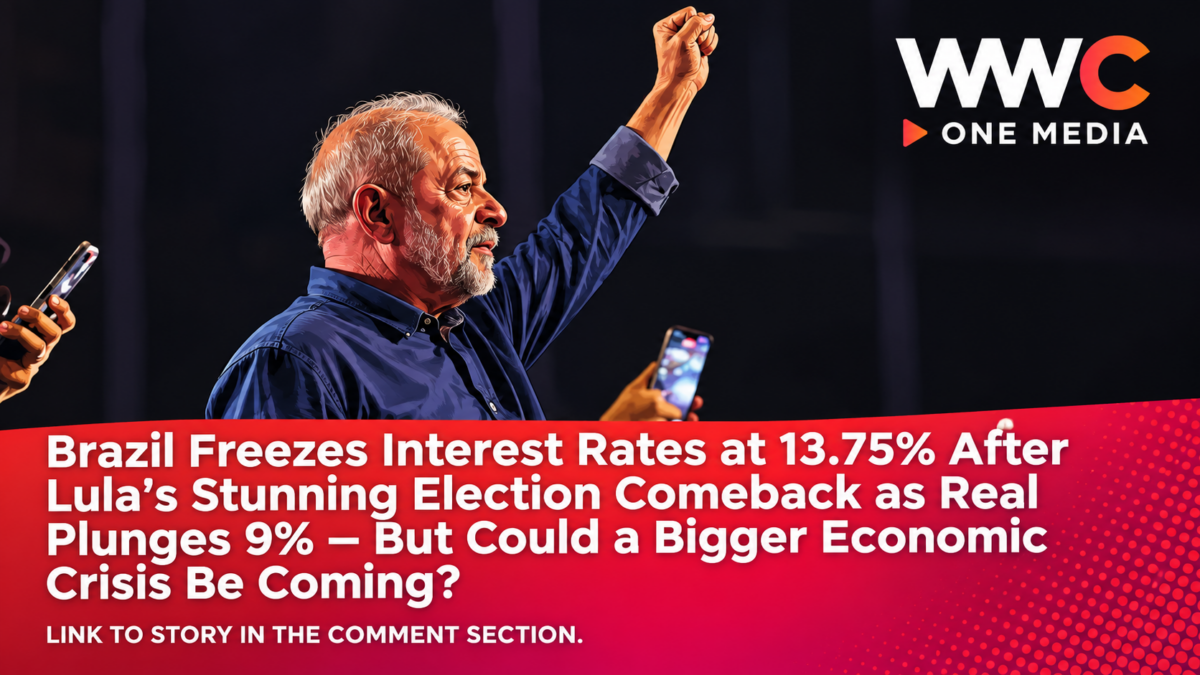
BRASÍLIA, BRAZIL / MANILA, PHILIPPINES — November 5, 2026 | WWC ONE MEDIA | Global Economy, Central Banking, Latin America and Financial Markets
Brazil’s central bank has abruptly halted its interest-rate cutting cycle, keeping borrowing costs at a punishing 13.75% after President Luiz Inácio Lula da Silva’s surprise reelection triggered financial-market turmoil and renewed fears over inflation, government spending and economic stability.
The unanimous decision on Wednesday, November 4, marks a dramatic reversal in monetary policy expectations for Latin America’s largest economy.
After five consecutive interest-rate reductions totaling 1.25 percentage points since March, policymakers have now signaled that inflation risks are too serious to justify further monetary easing.
According to Bloomberg, Reuters, Folha de S.Paulo and The Wall Street Journal, the decision reflects growing concerns about the depreciation of the Brazilian real, worsening inflation expectations and uncertainty surrounding Lula’s economic plans for his fourth presidential term.
Brazil’s currency has weakened approximately 9% against the US dollar since Lula’s October 25 election victory, while government bond yields have surged as investors demand higher returns for holding Brazilian debt.
The market reaction has created a difficult dilemma for the Banco Central do Brasil.
Lower interest rates could support businesses, consumers and an economy already showing signs of slowing.
But cutting rates too quickly could intensify capital outflows, weaken the currency further and make inflation harder to control.
The critical question facing investors is whether Lula can restore confidence in Brazil’s finances before high borrowing costs push its economy into an even more dangerous slowdown.
Brazil’s Central Bank Holds Selic at 13.75% After Five Consecutive Cuts
Brazil’s Monetary Policy Committee, known as Copom, unanimously voted to maintain the benchmark Selic rate at 13.75% per year.
The decision ended a monetary-easing cycle that began in March 2026, when rates stood at 15%.
The central bank subsequently delivered five consecutive reductions of 25 basis points each, bringing rates down by a total of 125 basis points.
Before Lula’s reelection, investors expected the easing cycle to continue.
However, the October 25 election changed market expectations.
Reuters reported that 33 of 48 economists surveyed expected rates to remain unchanged at the November meeting.
A separate Bloomberg survey found that 26 of 31 economists anticipated a hold.
The central bank’s decision was therefore widely expected immediately before the announcement, even though it represented a reversal from expectations ahead of the election.
Policymakers emphasized that monetary policy needed to remain restrictive while the inflation outlook was uncertain.
Their statement also acknowledged that Brazil’s economy was slowing more noticeably.
The combination of inflation risks and weaker growth has left the central bank facing difficult choices.
Lula’s Election Victory Triggers a Financial-Market Shock
The monetary-policy reversal followed Lula’s victory over right-wing Senator Flávio Bolsonaro in Brazil’s October 25 presidential runoff.
Lula secured approximately 51.79% of valid votes, defeating Bolsonaro’s 48.21%.
Before the runoff, investors had increasingly anticipated a victory for Bolsonaro, whose campaign emphasized fiscal restraint and market-oriented economic reforms.
Those expectations helped drive a remarkable rally in Brazilian financial assets earlier in October.
WWC ONE MEDIA covered the initial market reaction in Brazil Stocks Explode to Record High as Flávio Bolsonaro Takes Election Lead — But Investors May Be Pricing In Reforms That Will Be Hard to Deliver.
The report examined how Brazilian banks, retailers and other domestic companies surged following Bolsonaro’s stronger-than-expected first-round showing.
But the runoff produced a different outcome.
Lula’s victory forced investors to reassess expectations for fiscal policy, public spending and the direction of interest rates.
The resulting selloff affected stocks, bonds and the Brazilian real.
It also raised questions about whether the government could maintain investor confidence while pursuing its social and economic priorities.
Brazilian Real Loses Around 9% as Investors Demand Higher Returns
Brazil’s currency has experienced substantial pressure following the presidential election.
According to CNN Brasil, the US dollar rose approximately 9.46% against the real between the trading session preceding the October 25 runoff and November 4.
The exchange rate moved from roughly 4.98 reais per dollar to approximately 5.45 reais per dollar during that period.
These figures describe the dollar’s appreciation against the real; the corresponding percentage decline in the real’s dollar value is slightly smaller.
The distinction matters because currency movements are calculated differently depending on which currency is used as the base.
The Wall Street Journal also reported that Brazil’s 10-year government bond yield climbed to approximately 15.3%.
Higher yields generally indicate that investors are demanding greater compensation to hold government debt.
Several factors can influence those demands, including inflation expectations, fiscal uncertainty and global market conditions.
For Brazil, a weaker real creates additional inflation risks because imported goods become more expensive in local-currency terms.
That can affect fuel, machinery, industrial inputs and other products priced in international markets.
Currency depreciation can therefore complicate the central bank’s efforts to lower inflation.
Brazil’s Inflation Forecast Climbs to 5.6% as Price Pressures Intensify
Inflation is at the center of the central bank’s decision.
According to Reuters and Brazilian financial reporting, policymakers increased their inflation projections to approximately 5.6% for 2026 and 4.7% for 2027.
Brazil’s official inflation target is 3%, with a tolerance band extending from 1.5% to 4.5%.
Both annual forecasts therefore exceed the upper limit of that band.
The country’s official IPCA inflation rate had reached 4.58% over the 12 months through September.
The Wall Street Journal separately reported that inflation reached approximately 4.62% in the year through mid-October, based on the relevant preliminary inflation measure.
These are different reporting periods and indicators, not contradictory readings.
A weaker currency, elevated energy costs and uncertainty about future government spending have all contributed to the deterioration in inflation expectations.
The central bank also warned that international geopolitical risks could keep prices elevated.
This creates pressure to maintain higher interest rates even while economic activity slows.
Lula’s Government Spending Plans Become the Biggest Market Question
For international investors, Brazil’s fiscal outlook is becoming as important as the inflation rate itself.
Lula has emphasized the importance of social programs, public investment and policies intended to support lower-income households.
But investors are seeking evidence that his administration can finance those priorities without allowing public debt and deficits to rise unsustainably.
Brazil’s gross public debt is approaching 83% of gross domestic product, according to Reuters.
The country’s interest payments have also reached approximately 9% of GDP.
Those figures highlight the importance of maintaining confidence in government finances.
When investors worry that public borrowing may become more difficult to manage, they can demand higher returns on government bonds.
That can raise financing costs throughout the economy.
Higher government borrowing costs may also affect businesses and households by influencing the rates charged on commercial credit.
Bloomberg reported that investors are watching whether Lula will announce credible measures to strengthen fiscal discipline.
However, his administration also faces political pressure to protect social spending commitments.
The government must therefore balance demands for economic stability against the policies that helped secure Lula’s reelection.
Brazil’s Biggest Banks Face a New Test as Borrowing Costs Stay Elevated
High interest rates have complicated implications for Brazil’s financial institutions.
Banks can benefit from elevated lending rates and investment returns.
But expensive credit can also discourage new borrowing and increase the risk of customers struggling to repay loans.
This creates a delicate balance between profitability and credit quality.
Brazilian banking giant Itaú Unibanco recently reported strong third-quarter earnings despite the difficult economic environment.
WWC ONE MEDIA examined those results in Itaú Unibanco’s Profit Jumps 6.2% to R$12.6 Billion as Loans Hit R$1.54 Trillion — But Could Rising Defaults Threaten Brazil’s Banking Giant?.
Itaú reported recurring quarterly net profit of approximately R$12.62 billion, while its loan portfolio reached roughly R$1.54 trillion.
However, credit costs also increased.
The combination illustrates why investors will closely monitor Brazilian banks as interest rates remain elevated.
Strong lending income may support profits, but rising household and business financing expenses can increase credit risks.
Brazil’s Economy Is Slowing as High Interest Rates Hurt Consumers
The central bank’s decision comes at a time when Brazil’s domestic economy is losing momentum.
Policymakers identified a more pronounced slowdown in economic activity, particularly in sectors sensitive to borrowing costs.
Retail spending, industrial production and formal job creation have shown signs of weakening.
The latest Reuters survey of private economists projected Brazilian GDP growth of approximately 1.76% for 2026 and 1.2% for 2027.
Those are forecasts rather than confirmed economic outcomes.
They nevertheless indicate expectations for relatively subdued growth.
High interest rates can reduce consumer demand by making loans, vehicle financing and other forms of borrowing more expensive.
Businesses may also delay expansion plans when investment financing becomes costly.
Construction companies, retailers and other interest-rate-sensitive industries are particularly exposed.
Yet reducing rates prematurely could worsen inflation and currency pressures.
For the central bank, the challenge is finding a path toward lower inflation without causing excessive economic damage.
Economists Push Back Their Interest-Rate Cut Expectations
The market’s outlook for future Selic reductions has changed significantly.
Before Lula’s reelection, traders had expected additional cuts in November and December.
The latest inflation concerns have altered those forecasts.
Bloomberg Línea reported that economists now expect the Selic rate to reach approximately 13.5% by the end of 2026, compared with an earlier projection of 13.25%.
Forecasts for the end of 2027 have increased from 11.75% to 12.5%.
The expected rate for the end of 2028 has also risen to approximately 11%.
These projections suggest that investors anticipate a longer period of expensive borrowing.
However, none of the forecasts represent a binding central-bank commitment.
Future rate decisions will depend on actual inflation, economic growth, currency conditions and fiscal developments.
The next Copom meeting is scheduled for December 8–9, 2026.
Until then, investors will be watching whether the government provides greater clarity about its economic agenda.
Global Oil Prices and Geopolitical Risks Complicate Brazil’s Outlook
Brazil’s domestic challenges are unfolding against a difficult international economic environment.
The conflict involving the United States and Iran has contributed to volatile global oil prices.
Higher petroleum prices can increase transportation expenses and affect inflation expectations.
Brazil is a major oil producer, which means elevated crude prices can benefit some energy companies and export revenues.
However, higher fuel costs can simultaneously pressure businesses and households.
Other emerging economies face similar difficulties when inflation risks and global financial conditions change rapidly.
WWC ONE MEDIA previously examined the problem in BSP Has Room for More Rate Hikes as Inflation Risks From El Niño and Oil Persist.
That report discussed the Philippines’ exposure to energy prices, exchange-rate pressures and inflation uncertainty.
Although Brazil and the Philippines have different economic structures, their central banks must both weigh inflation risks against the cost of restricting economic activity.
The Brazilian experience demonstrates how political events can further complicate monetary-policy decisions.
Brazil’s Political Transition Adds to Investor Uncertainty
Lula’s reelection has also created questions about Brazil’s future diplomatic and trade relationships.
The country maintains important economic ties with the United States, China and other major markets.
Trade policies, investment agreements and geopolitical tensions can affect investor confidence.
The election has already complicated Brazil’s relationship with Washington.
WWC ONE MEDIA examined these developments in Rubio and Brazil’s Foreign Minister Plan High-Stakes Talks After Lula’s Election Victory — But Could Flávio Bolsonaro’s Flight to the US Derail Relations?.
The report detailed efforts to maintain diplomatic engagement between the Trump and Lula administrations amid post-election disagreements.
While foreign-policy disputes are not the direct cause of the November 4 interest-rate decision, broader political uncertainty can influence currency markets and international investment decisions.
Investors will therefore be watching both domestic fiscal announcements and Brazil’s international economic relationships.
What Happens Next for Brazil’s Interest Rates?
Brazil’s monetary-policy outlook now depends on several interconnected developments.
The first is inflation.
If consumer-price increases begin slowing and expectations move closer to the central bank’s target, policymakers may eventually regain room to reduce rates.
The second is fiscal policy.
Credible plans to manage public spending and debt could strengthen confidence in Brazilian financial assets.
The third is the exchange rate.
A stabilization or recovery in the real could help contain imported inflation.
The fourth is domestic economic activity.
A sharper slowdown could increase pressure on the central bank to reduce borrowing costs.
Finally, international developments such as oil prices and global interest rates will influence the operating environment.
If these factors improve together, another easing cycle could become more feasible.
But further currency depreciation or worsening inflation expectations could keep rates elevated for longer.
Some analysts have also warned that renewed increases cannot be entirely ruled out if economic conditions deteriorate.
The Bigger Question: Can Lula Restore Investor Confidence Before Brazil’s Economy Weakens Further?
Brazil is entering a pivotal period for economic policy.
The central bank has paused five consecutive rate cuts.
The real has experienced substantial post-election depreciation.
Inflation forecasts have moved further above the official target.
And investors are demanding greater clarity about the reelected government’s fiscal strategy.
Meanwhile, the economy is showing signs of slowing under the weight of expensive borrowing.
These developments have created difficult choices for both Lula and central-bank Governor Gabriel Galípolo.
The government wants to support economic activity and preserve social spending.
The central bank must maintain price stability and credibility.
Investors want reassurance that fiscal policy will not undermine efforts to control inflation.
Those priorities do not necessarily conflict permanently, but aligning them will require credible policies and economic discipline.
Brazil’s economic future will therefore depend not simply on the level of its benchmark interest rate but on whether policymakers can rebuild confidence while supporting sustainable growth.
As Brazil freezes its benchmark rate at 13.75% and investors confront a weakening currency, rising inflation expectations and slowing growth, one question could define Latin America’s largest economy heading into 2027: Will Lula’s government restore financial confidence and unlock cheaper credit — or could another wave of market turmoil force Brazil’s central bank to keep borrowing costs painfully high?