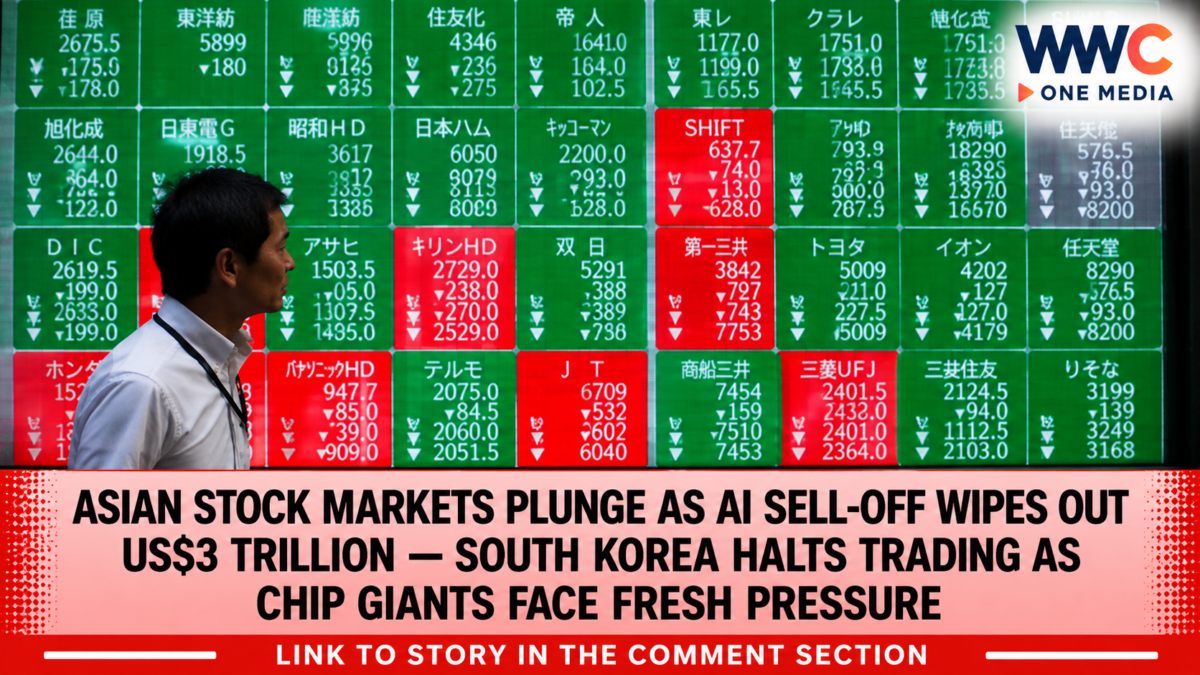
Asian stock markets suffered a sharp sell-off on Friday, November 6, as a brutal Wall Street rout spread across the region, sending South Korean shares into a steep decline and dragging Japan’s technology-heavy market lower.
The sell-off was driven by growing concerns that the artificial intelligence boom may be losing momentum. Investors are questioning whether technology giants can generate sufficient returns from the enormous sums they are spending on AI chips, data centres and supporting infrastructure.
The shock was intensified by the results of the US midterm elections, which gave Democrats greater political influence and raised concerns about tighter scrutiny of AI development and data-centre construction.
South Korea’s benchmark KOSPI plunged approximately 8.6% in early Friday trading, triggering a 20-minute trading halt. Japan’s Nikkei 225 fell around 5% in early trading, while investors also braced for losses in Taiwan, Hong Kong and mainland China.
The damage followed one of Wall Street’s worst trading sessions in more than a year. The Nasdaq Composite sank 5.5%, the S&P 500 dropped 4.4%, and approximately US$3 trillion in S&P 500 market value was erased.
The latest market turmoil raises a serious question for Asia: if the world’s biggest technology companies begin slowing their AI investments, how badly could the region’s semiconductor industry be affected?
South Korea’s KOSPI Plunges 8.6% as Trading Halt Is Triggered
South Korea became one of the hardest-hit markets as investors rushed to sell technology and semiconductor shares.
The KOSPI plunged 8.6% to 4,923.47 in early Friday trading, falling below the 5,000-point level for the first time in nine months.
The Korea Exchange triggered a 20-minute circuit breaker at 9:03am local time, temporarily halting stock and derivatives trading.
The selling hit some of South Korea’s most influential companies.
Samsung Electronics shares fell approximately 10%, while SK Hynix plunged around 13% in early trading.
Both companies are central to the global AI supply chain. Samsung is a major producer of memory chips and advanced semiconductor products, while SK Hynix has become a critical supplier of high-bandwidth memory used in AI computing systems.
The steep declines demonstrate how exposed South Korea’s stock market has become to investor expectations surrounding artificial intelligence.
The KOSPI’s performance has been closely linked to semiconductor demand, meaning any doubts about future AI spending can have an outsized effect on the broader benchmark.
Reuters reported that the sell-off followed the previous day’s sharp decline in US technology shares, while investors reassessed whether the rapid expansion of AI infrastructure could continue at its current pace. Reuters+1
Japan’s Nikkei Falls as Asian Technology Stocks Come Under Pressure
Japan also experienced heavy selling as the weakness in US semiconductor shares spread across the region.
The Nikkei 225 fell approximately 5% in early Friday trading, according to Reuters’ market report.
Japanese companies supplying semiconductor manufacturing equipment, testing systems and other technology infrastructure are particularly sensitive to changes in global chip investment.
The concern is not limited to companies producing AI processors.
The industry depends on an extensive supply chain involving equipment manufacturers, memory producers, component suppliers, data-centre operators and electricity providers.
If technology companies reduce or delay their infrastructure spending, the effects could reach businesses throughout that ecosystem.
The sell-off also affected broader Asian market sentiment, with investors watching Taiwan, Hong Kong and mainland China for signs of further weakness.
Bloomberg’s regional market report recorded an early 8.8% decline in South Korea’s KOSPI, a 5.1% fall in Japan’s Nikkei and a 2.3% decline in the MSCI Asia Pacific Index.
The exact percentages varied across reports because market snapshots were taken at different times during the volatile trading session.
Wall Street Loses US$3 Trillion as Nasdaq Suffers a 5.5% Collapse
The Asian sell-off followed a devastating session on Wall Street.
On Thursday, November 5, the S&P 500 fell 4.4% to 7,353.73, marking its worst daily performance since the April 2025 tariff-related market turmoil.
The Dow Jones Industrial Average dropped 3.4% to 51,523.06, while the Nasdaq Composite plunged 5.5% to 24,315.
The Nasdaq’s decline left it approximately 11.9% below its October record close, placing it in correction territory under the widely used definition of a 10% decline from a recent high.
The Philadelphia Semiconductor Index, which tracks major US-listed semiconductor companies, tumbled 12.2%.
Approximately US$3 trillion in S&P 500 market value was wiped out during the sell-off, according to Reuters.
The losses were particularly severe among companies associated with AI computing and data-centre expansion.
- Nvidia fell 9.3%.
- Advanced Micro Devices (AMD) plunged 17.3%.
- CoreWeave declined 9.8%.
- Dell Technologies suffered a steep decline.
- GE Vernova, a supplier of power infrastructure used by data centres, also fell.
The broad decline showed that investor anxiety was spreading beyond chip manufacturers to companies supplying the electricity, equipment and computing capacity needed to support AI systems. AP News+2
Why Investors Are Suddenly Questioning the Artificial Intelligence Boom
For much of the past several years, artificial intelligence has been one of the strongest drivers of global technology investment.
Companies such as Microsoft, Amazon, Alphabet, Meta and other major technology groups have committed enormous sums to building data centres, purchasing advanced processors and expanding cloud-computing capacity.
The expectation has been that demand for AI services will continue growing rapidly, creating substantial revenue opportunities for companies providing the necessary technology.
However, investors are now asking whether the financial returns will justify the extraordinary costs.
Building AI infrastructure requires expensive processors, memory systems, networking equipment, cooling facilities, electricity connections and specialised data-centre buildings.
These investments can take years to generate sufficient revenue.
The concern is that technology companies may be spending faster than customers are adopting paid AI services.
If the expected returns fail to materialise, companies could eventually slow their spending, postpone projects or reconsider expansion plans.
That would affect Asian suppliers that have benefited from the AI investment boom.
Reuters reported that market participants were increasingly questioning the return on investment from the enormous sums being committed to artificial intelligence.
The sell-off suggests investors are no longer willing to assume that every company connected to AI will automatically benefit from continued spending. The Wall Street Journal+2
US Midterm Election Results Add to AI Market Anxiety
The US midterm elections have become another important factor behind the market reaction.
Democrats made significant gains, taking control of Congress and raising the possibility of greater political scrutiny of the technology industry.
Investors are particularly concerned about the future of data-centre development.
Large AI facilities require substantial electricity, land, water and supporting infrastructure. Their construction has increasingly attracted opposition from communities concerned about rising utility costs, environmental effects and pressure on local resources.
Election results and local ballot initiatives have strengthened expectations that some projects could face additional regulatory hurdles.
Several states with important data-centre investment activity are now part of the political debate over how quickly AI infrastructure should expand.
However, it would be inaccurate to suggest that the election results automatically mean the US government will stop AI development.
The market reaction reflects investor expectations about possible policy changes, regulatory scrutiny and delays — not an enacted nationwide ban on data centres.
The uncertainty is nevertheless significant because US technology companies are among the biggest customers for Asian semiconductor manufacturers. The Washington Post+2
Qualcomm and Arm Earnings Add to Semiconductor Selling Pressure
Political uncertainty was not the only reason investors sold technology shares.
Concerns about corporate earnings and the ability of semiconductor companies to meet elevated expectations also contributed to the decline.
Qualcomm shares came under pressure after the company reported a weaker-than-expected outlook for smartphone chip sales.
Reuters reported that Qualcomm fell after missing Wall Street estimates for fourth-quarter smartphone chip sales, with sluggish demand and declining Apple-related revenue adding to concerns.
Arm Holdings also faced investor disappointment, adding to the pressure on semiconductor-related shares.
The results reinforced the idea that strong interest in AI does not automatically guarantee growth across every technology business.
Some companies depend on smartphone sales, consumer electronics and traditional computing markets, while others are more directly exposed to AI infrastructure.
Investors are increasingly distinguishing between businesses with demonstrable revenue growth and companies whose valuations depend heavily on expectations of future AI demand.
This distinction has become especially important after years of strong share-price gains across the technology sector. Fidelity+2
Asian Semiconductor Giants Face a Major Test
The latest sell-off is particularly concerning for South Korea, Taiwan and Japan because their technology industries are deeply integrated into global semiconductor supply chains.
South Korea is home to Samsung Electronics and SK Hynix, two major memory-chip producers.
Taiwan is central to advanced semiconductor manufacturing, with Taiwan Semiconductor Manufacturing Company (TSMC) playing a critical role in producing chips designed by global technology companies.
Japan supplies semiconductor manufacturing equipment, materials and specialised components.
These industries have benefited from the global expansion of AI computing.
But their dependence on international customers also exposes them to changes in investment plans made by US technology companies.
If hyperscalers reduce capital expenditure, semiconductor manufacturers and equipment suppliers could face slower order growth.
However, a decline in share prices does not prove that chip demand has already collapsed.
Many companies have long-term supply agreements, existing orders and investment commitments that may support near-term production.
The bigger uncertainty concerns whether demand will continue growing fast enough to justify current valuations and future factory expansion.
WWC ONE MEDIA previously examined this risk in Asian Chip Stocks Plunge as Amazon’s AI Spending Sparks Funding Fears — But Could the $2.1-Trillion Data Center Boom Be at Risk?.
The pressure on China’s technology sector also provides a warning about how quickly investor enthusiasm can reverse. Read China Warns AI Investment Is Becoming Too Concentrated — But Is the Bigger Risk a New Tech Bubble?.
China’s AI Stock Crash Shows the Risks of an Overheated Technology Market
The latest Asian sell-off comes after a major correction in China’s AI and semiconductor shares.
AsiaOne reported in October that China’s STAR 50 index, which includes leading technology and semiconductor companies, had lost approximately 40% of its value in less than four months.
The decline wiped out an estimated US$480 billion in market capitalisation.
The Chinese market’s reversal reflected concerns about high valuations, uncertainty over AI demand and restrictions affecting technology exports.
It also exposed the risks of concentrating too much investment in a relatively small group of technology companies.
China’s experience is relevant to the wider market because it demonstrates that enthusiasm for artificial intelligence can coexist with substantial financial risk.
Even companies operating in industries with promising long-term growth prospects can experience severe share-price corrections when investors believe expectations have become excessive. AsiaOne+1
Big Tech’s Massive AI Spending Is Becoming a Wall Street Problem
The scale of AI investment is another reason investors are becoming more cautious.
Amazon, Alphabet, Microsoft, Meta and Oracle are among the companies committing hundreds of billions of dollars to AI infrastructure.
The spending covers data centres, advanced processors, networking equipment, cloud capacity and electricity infrastructure.
While these investments may create long-term competitive advantages, they also require significant financing.
Companies must demonstrate that the additional infrastructure can generate sufficient revenue and operating profit.
If borrowing costs remain high or customers take longer to adopt AI services, the financial returns may disappoint investors.
WWC ONE MEDIA previously examined the scale of this spending in Big Tech’s $750-Billion AI Gamble Shakes Wall Street as Core Businesses Slow — But Will the Spending Ever Pay Off?.
The latest market reaction suggests that investors are increasingly focused on the financial consequences of the AI race rather than simply its technological possibilities.
Singapore and the Philippines Could Feel the Effects of a Wider Technology Sell-Off
The market turmoil also matters for Southeast Asia.
Singapore is a major financial centre with exposure to international technology investment, global funds and regional business activity.
Its stock market has already experienced pressure from concerns about bank earnings and valuations.
A prolonged decline in global technology shares could influence investor sentiment toward regional equities, particularly companies with exposure to data centres, electronics and semiconductor supply chains.
WWC ONE MEDIA recently reported on Singapore’s market weakness in Singapore Stocks Near 10% Correction as UOB Profit Miss Sparks Bank Selloff — But Could DBS and OCBC Trigger an Even Bigger Market Crash?.
The Philippines could also experience indirect effects.
A prolonged slowdown in global technology investment could affect electronics exports, semiconductor-related manufacturing and business-process outsourcing companies that serve international clients.
However, the impact will depend on the duration of the market downturn and whether technology companies actually reduce investment and hiring.
A stock-market sell-off alone does not establish that the Philippine economy is entering a downturn.
Investors Turn Toward Safer Assets as Market Volatility Surges
As investors moved away from technology shares, demand for safer assets increased.
US Treasury bonds were positioned to gain in Asian trading, while the US dollar weakened against traditional safe-haven currencies such as the Japanese yen and Swiss franc, according to Reuters’ market report.
Bond prices generally rise when investors seek safety, although their movements also depend on interest-rate expectations and inflation.
The shift reflects a broader reassessment of risk.
For much of the AI boom, investors were willing to pay high valuations for companies expected to benefit from future technological growth.
The latest decline suggests that some are now prioritising capital preservation over aggressive exposure to high-growth technology stocks.
That does not necessarily mean investors have abandoned AI.
Rather, the market appears to be demanding stronger evidence that enormous investments will translate into sustainable profits.
Is the AI Boom Ending — or Is This a Necessary Market Correction?
The latest sell-off has revived debate about whether artificial intelligence stocks have entered a deeper correction or whether the market is simply adjusting after an extraordinary rally.
There are reasons for caution.
High valuations, rising financing costs, regulatory uncertainty and questions about AI profitability could continue weighing on technology shares.
At the same time, demand for advanced computing, memory and data-centre infrastructure remains an important long-term investment theme.
A correction does not automatically mean the underlying technology has failed.
The key issue is whether companies can generate enough revenue to justify the capital being invested.
If AI adoption continues expanding and customers pay for increasingly valuable services, semiconductor and infrastructure suppliers could eventually recover.
But if spending slows before those investments produce sufficient returns, some businesses may face weaker growth and lower valuations.
The market is now attempting to distinguish between companies with sustainable AI-related earnings and those whose share prices have risen mainly on expectations.
Asia’s Stock Market Rout Sends a Warning to the Global AI Industry
Friday’s market turmoil demonstrates how closely Asian financial markets are connected to developments on Wall Street.
South Korea’s KOSPI suffered a dramatic early-session decline, Japan’s Nikkei came under heavy pressure, and semiconductor stocks faced another wave of selling.
The US market’s US$3 trillion loss and Nasdaq’s 5.5% drop intensified concerns that the AI investment boom may be entering a more demanding phase.
The immediate trigger was a combination of political uncertainty, regulatory concerns, disappointing technology-sector signals and questions about whether enormous infrastructure investments can deliver adequate returns.
For Asia’s chipmakers, the stakes are particularly high.
The region has benefited enormously from the global AI race, but it is also exposed to any slowdown in spending by the world’s biggest technology companies.
The next earnings reports, capital-expenditure decisions and government policy developments will help determine whether the current sell-off becomes a temporary shock or a deeper repricing of the AI industry.
The technology revolution may still be advancing — but investors are making it clear that they want profits, not promises.