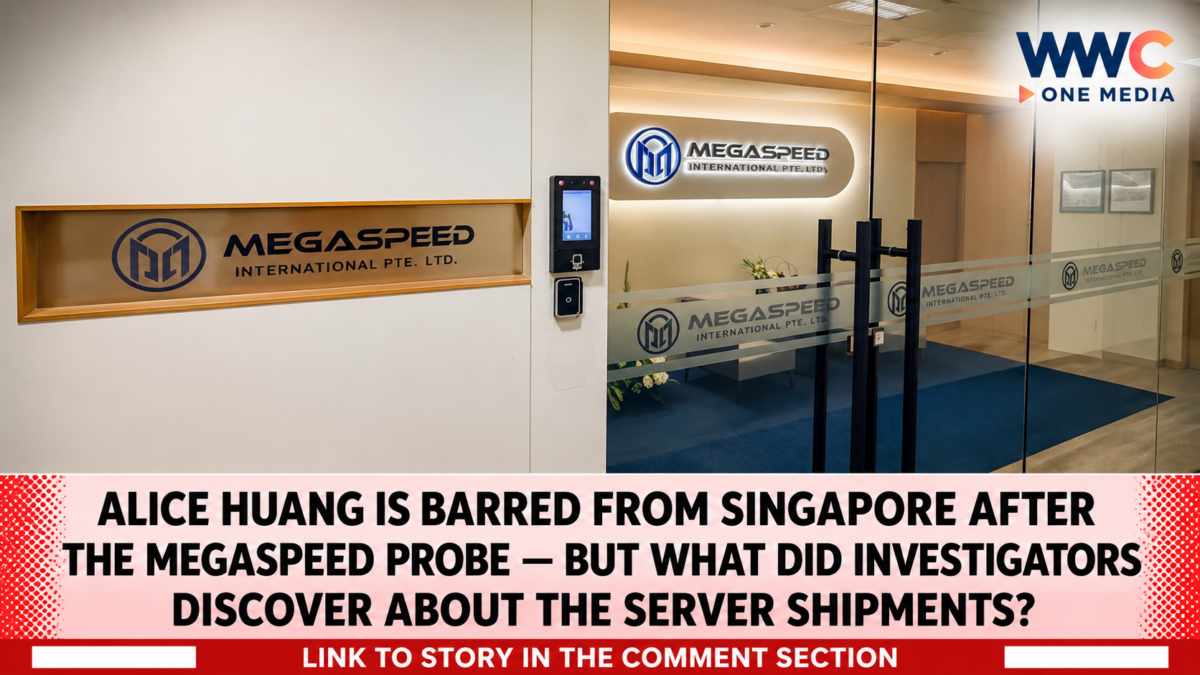
Singapore has confirmed that Chinese businesswoman Alice Huang, a former senior executive of Singapore-based cloud computing company Megaspeed International, has been barred from re-entering the country after authorities concluded that she knowingly provided inaccurate information during an investigation.
The Ministry of Home Affairs (MHA) disclosed the decision on November 12, 2026, explaining that Huang received a stern warning after investigators assessed that she had attempted to downplay her role at Megaspeed.
The announcement adds a significant new development to the controversy surrounding Nvidia, its former chief executive Jensen Huang and allegations involving the possible diversion of advanced artificial intelligence chips to China.
But Singapore made an important distinction: Alice Huang was not investigated for espionage. The local investigation focused on suspected offences involving potentially false declarations related to server purchases and exports.
Authorities also said there was insufficient evidence to establish that she had committed the suspected declaration offences. She was not charged in connection with those suspicions.
Why Singapore Barred Alice Huang From Returning
According to the MHA, the Singapore Police Force and Singapore Customs began an independent investigation in February 2025 into several companies and their key officers, including Megaspeed International.
The investigation concerned suspected false declarations involving the purchase of physical servers and other related offences.
Huang, also known as Huang Le, was investigated because she was then Megaspeed’s chief executive, chairperson and one of its key controllers. She was a Hong Kong resident and was not based in Singapore.
On June 24, 2025, the US Commerce Department’s Bureau of Industry and Security conducted a voluntary post-shipment verification at Megaspeed, with Huang present. Singapore said this was the first time it became aware of US interest in the company and Huang.
Police interviewed her that day and impounded her passport under Singapore’s Criminal Procedure Code to ensure she remained available for questioning.
After reviewing the evidence, the police and Attorney-General’s Chambers concluded in February 2026 that there was insufficient evidence to establish that Huang had committed the suspected offences involving inaccurate declarations.
However, investigators separately assessed that she had knowingly provided inaccurate information to police in an attempt to minimise her involvement in Megaspeed.
She was consequently issued a stern warning and barred from re-entering Singapore. Her passport was returned on February 26, 2026, and she left the country that same day.
A stern warning is not a criminal conviction or a court-imposed prison sentence. The decision to bar her from returning is an immigration measure announced by Singapore authorities.
The Server Shipments That Triggered the Investigation
The investigation centres on physical servers purchased by companies under scrutiny and exported through Singapore to Malaysia without entering Singapore’s domestic market.
Authorities were examining whether the equipment was subsequently routed from Malaysia to another destination, contrary to the declarations made in Singapore.
This matters because advanced computing servers can contain powerful Nvidia processors used to train and operate artificial intelligence systems.
The United States has imposed export restrictions on certain high-performance AI chips to limit China’s access to technology considered strategically sensitive.
Singapore, however, stressed that its own investigation was conducted independently and was not initiated at the request of another country.
The MHA explained that investigators needed information from other jurisdictions to verify the companies’ declarations and establish where the equipment ultimately went.
One important source of information was Supermicro, a US-based server supplier.
Singapore said police and the Attorney-General’s Chambers raised concerns about Supermicro’s limited cooperation with US authorities in July 2025. From September that year, Singapore repeatedly sought assistance from the US Department of Justice and the Federal Bureau of Investigation.
Despite those requests, the MHA said Singapore had received only limited information or assistance relating to the company.
Without the necessary records, investigators said they could not establish whether Huang had committed the suspected declaration offences.
Six Other Individuals Remain Under Investigation
Although Huang was not charged over the suspected server-declaration offences, the wider Megaspeed investigation remains active.
The MHA confirmed that investigations into Megaspeed and six other individuals are ongoing. None of those six individuals had been in Singapore since the investigation began in February 2025.
The ministry also disclosed that Singapore had charged four individuals and four companies in court between February 2025 and July 2026 in separate cases involving server-related offences.
Some of those charges involved alleged fraud by false representation. The relevant offences can carry imprisonment terms of up to 20 years.
These separate prosecutions should not be confused with Huang’s case. The ministry did not say that she was among those charged.
The distinction is important because the investigation into Megaspeed involves several companies and individuals, and each person’s potential responsibility must be assessed separately.
How the Case Became Connected to Nvidia CEO Jensen Huang
Alice Huang became internationally prominent after reports examined her relationship with Jensen Huang, Nvidia’s co-founder and former chief executive.
The two share the same surname but are not related.
The New York Times reported that US intelligence officials suspected Alice Huang of having connections to Chinese intelligence and raised concerns about her relationship with the Nvidia chief.
Those allegations have not been established through a public criminal finding. China has rejected the espionage claims, while Reuters has reported that it could not independently verify the intelligence allegations.
Jensen Huang acknowledged being unfaithful to his wife and apologised to his family and Nvidia employees. His admission did not establish that he knowingly participated in espionage or illegal semiconductor transfers.
The Singapore government also specifically clarified that Alice Huang was not investigated for espionage in Singapore.
The distinction is essential: Singapore’s investigation concerned suspected domestic offences involving server declarations, while the intelligence allegations originated from separate reporting about US concerns.
WWC ONE MEDIA has followed the international controversy in its report on Alice Huang’s reported presence in Beijing as the Nvidia chip controversy intensified.
Nvidia’s Business Relationships Face More Scrutiny
The controversy has also placed renewed attention on the complex international supply chain behind advanced AI computing.
Megaspeed is a Singapore-based cloud computing company that has been identified as an Nvidia business partner. Companies operating cloud infrastructure can purchase powerful processors and provide computing services to customers without those customers owning the hardware themselves.
That business model is legitimate, but it can create complicated questions when equipment involves processors subject to export restrictions.
US authorities have reportedly examined whether overseas intermediaries and data-centre arrangements could have enabled restricted Nvidia chips to reach customers in China.
Reuters has reported on Megaspeed’s corporate background, its connections to the AI computing sector and shipments involving Nvidia hardware. The presence of particular processors in overseas shipments does not, by itself, establish that export-control violations occurred.
Megaspeed has previously denied allegations that it illegally diverted restricted chips.
WWC ONE MEDIA has also examined the wider issue in its report on the alleged Chinese intelligence links involving Alice Huang and the potential scrutiny facing Singapore’s AI data-centre industry.
Another report explored the questions surrounding Nvidia’s legal department and a US investigation into suspected AI chip diversion.
These reports concern allegations and investigations, not established findings that Nvidia or its executives knowingly participated in illegal chip transfers.
Singapore Says It Will Not Allow Its Business Hub to Be Misused
The MHA used the announcement to reinforce Singapore’s position as an international business and trading centre.
Singapore does not enforce unilateral export controls imposed by other countries. However, companies operating in the country are expected to consider those regulations when conducting international business.
The government said it would not allow businesses to use Singapore as a route to circumvent other countries’ export restrictions through fraudulent or dishonest practices.
The ministry also emphasised that Singapore would conduct its own investigations according to local laws and the evidence available, while cooperating with foreign authorities where appropriate.
The statement follows earlier clarification from the government rejecting claims that Singapore officials had investigated Alice Huang over alleged Chinese intelligence connections.
WWC ONE MEDIA previously covered China’s rejection of the allegations involving Jensen Huang and the wider Nvidia controversy.
What Happens Next for Alice Huang and Megaspeed?
For Alice Huang, Singapore’s latest announcement establishes that she has been barred from returning after receiving a stern warning. It does not amount to a criminal conviction for the suspected server-declaration offences, which authorities said could not be established with sufficient evidence.
For Megaspeed and the six other individuals still under investigation, the legal process remains unresolved.
Investigators may still seek information from foreign authorities and examine records relating to the movement of servers and their eventual destinations.
The broader controversy involving Nvidia also remains separate and unresolved. Reports about possible intelligence links, chip diversion and the relationship between Alice Huang and Jensen Huang have raised serious questions, but allegations must not be treated as proven facts.
Singapore’s message is clear: companies operating within its borders must not use the country’s business environment to facilitate fraud or dishonest practices.
The bigger question now is whether investigators will obtain the missing information needed to establish where the servers went—and whether the wider international chip controversy will produce further legal or regulatory action.