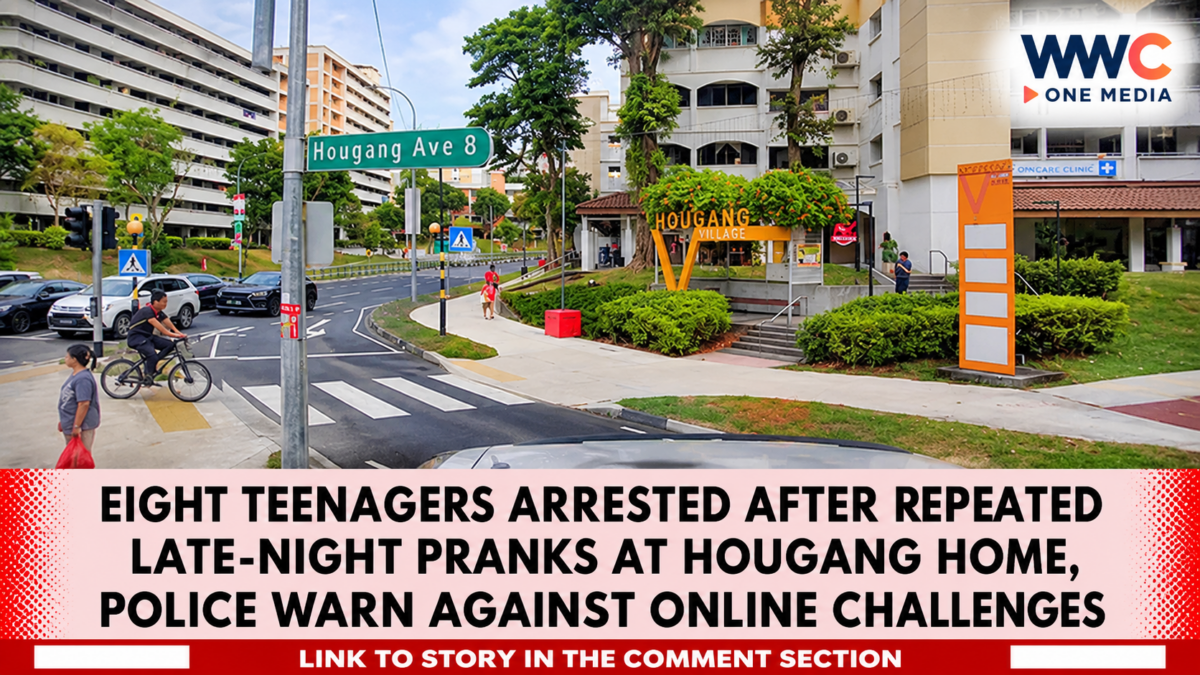
Eight teenagers aged between 12 and 15 have been arrested in Singapore after allegedly carrying out repeated late-night pranks at a residential unit along Hougang Avenue 8, prompting police to warn that online challenges can cross the line into criminal behaviour.
The Singapore Police Force said it received several reports of public nuisance involving the same residential unit between September and November 2026.
Preliminary investigations found that the teenagers had allegedly participated in a prank publicised online. On multiple occasions, they reportedly visited the home late at night, knocked on its doors and windows, then ran away.
The incidents allegedly caused distress and annoyance to the occupants and their neighbours.
The eight male teenagers were arrested on November 12. Four other male teenagers are assisting with investigations, bringing the number of youths currently being investigated to 12.
The case has renewed attention on the consequences of online pranks, particularly when participants target private homes and disrupt residents who may be trying to sleep.
CCTV and Police Enquiries Help Identify the Teenagers
Officers from the Ang Mo Kio Police Division identified the teenagers through ground enquiries and images obtained from closed-circuit television cameras.
The police are continuing their investigations and working to identify other individuals who may have participated.
Authorities have not publicly disclosed the identity of the occupants, how many times the group allegedly visited the property or whether the prank was recorded and circulated on a particular social media platform.
The available police information also does not establish that every person involved in the online prank has been identified.
The investigation remains ongoing, and the teenagers are being treated as suspects rather than convicted offenders.
What Penalty Could the Teenagers Face?
All 12 teenagers are being investigated for suspected public nuisance.
Under Section 290 of Singapore’s Penal Code, a person convicted of public nuisance may face a fine of up to S$2,000. Where the offender knew that the conduct would cause, or would probably cause, common injury, danger or annoyance to the public or people living nearby, the penalty can include imprisonment of up to three months, a fine of up to S$2,000, or both.
The precise outcome would depend on the evidence, the circumstances and the legal process. The fact that the teenagers have been arrested does not mean they have been found guilty.
The police have warned that they take a serious view of conduct that causes distress and annoyance to members of the public.
They also urged people to act responsibly and avoid participating in online pranks or challenges that could constitute criminal offences.
Why Online Pranks Can Become a Serious Problem
Online challenges can spread quickly because participants may be encouraged by views, likes, comments and the prospect of viral attention.
But an activity that appears entertaining to the people recording it can have very different consequences for those being targeted.
Repeatedly knocking on a stranger’s door or windows late at night can frighten residents, disturb their sleep and make them feel unsafe in their own homes.
The problem can become more serious when a prank involves repeated visits, intimidation, property interference or conduct that causes a public disturbance.
Singapore has seen other incidents involving young people and disruptive behaviour in shared spaces.
In a separate case, a confrontation between a boy and a security guard over a bicycle at Downtown East attracted attention after videos circulated online. WWC ONE MEDIA covered the incident in its report on the Downtown East bicycle confrontation and why police were called.
Another incident involving teenagers cycling along Somerset Road without helmets or apparent safety equipment also prompted questions about youth behaviour and public safety. Read WWC ONE MEDIA’s report on teen cyclists spotted riding across Somerset Road without helmets or lights.
These incidents are separate from the Hougang investigation, but they illustrate why authorities continue to emphasise responsible conduct in public places.
Singapore Has Also Taken Action Over Other Pranks That Cause Public Alarm
The Hougang case is not the only recent incident in which authorities have warned that something presented as a joke can trigger a serious response.
In a separate incident at Woodlands Checkpoint, a man was investigated after allegedly claiming that a bomb had been found in his vehicle. Such statements can prompt security checks and divert resources even when the claim is later found to be false.
WWC ONE MEDIA reported on the Woodlands Checkpoint bomb claim and the police investigation.
Singapore has also faced concerns over groups of young cyclists occupying multiple lanes on busy roads. A viral video involving nearly 50 cyclists and e-bike riders prompted questions about road safety and compliance with active mobility rules. WWC ONE MEDIA examined the footage in its report on the large group of teenage cyclists in Singapore’s CBD.
The circumstances differ, and none of these separate incidents establishes wrongdoing by the Hougang teenagers. They nevertheless show how seemingly entertaining or attention-seeking behaviour can affect other people and attract police or regulatory attention.
Police Urge Young People to Think Before Joining Online Challenges
The police warning highlights a broader responsibility for people who encounter viral pranks online.
Sharing, copying or participating in a challenge does not automatically make it harmless. What matters is the conduct involved, its impact on others and whether it breaches the law.
Parents and guardians also have an important role in explaining that filming a prank or joining a group does not remove personal responsibility for what happens.
For residents, repeated disturbances at home can be particularly distressing because a person’s home should be a place where they can feel secure.
The Hougang investigation is a reminder that online popularity is not a defence when an activity causes real-world harm.
With eight teenagers arrested, four others assisting police and investigators still looking for possible additional participants, the case remains far from over.
The central question is whether the investigation will uncover more people involved—and whether the incident will prompt other young people to reconsider the risks before turning a late-night prank into a police matter.