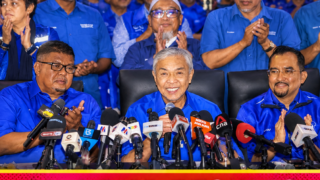
Barisan Nasional (BN) and Perikatan Nasional (PN) secured a combined 24 of Melaka’s 28 state assembly seats in the Nov. 14, 2026 election, giving their political partnership a two-thirds majority in the state legislature. BN chairman Ahmad Zahid Hamidi subsequently announced that the alliance would nominate incumbent Chief Minister Ab Rauf Yusoh to continue leading the state government. umno-online.my+1
The result gives the two coalitions a strong position in the Melaka State Legislative Assembly. But the bigger test begins after the campaign: whether their cooperation can translate into stable administration, effective public services and delivery of the commitments presented to voters.
How the Melaka election reshaped the assembly
The published result breakdown gives BN 21 seats, PN three and Pakatan Harapan (PH) four. Together, BN and PN hold 24 seats in the 28-member assembly, comfortably exceeding the 19 seats needed for a two-thirds majority. umno-online.my+1
The result also means BN emerged as the largest political force in the state legislature, while PN secured a smaller but significant position within the governing partnership. PH, meanwhile, will occupy four seats and provide an opposition presence in the assembly.
The distinction between the two coalition partners matters. BN won most of the seats, but PN’s three victories also contributed to the combined majority. Their arrangement therefore has an electoral outcome that both sides can point to, even though their respective strengths in the assembly are not equal.
For voters, the seat distribution determines who has the numbers to govern. It does not, by itself, guarantee that the new administration will perform well or that every campaign promise will be fulfilled.
Zahid’s message after the result
Zahid described the outcome as a mandate reflecting public confidence in the record, stability and development direction offered by BN and PN. In his post-election remarks, he also said the partnership between the two coalitions would be strengthened as they work towards forming a more stable state government. umno-online.my
That statement is important because the election was not simply a contest between individual candidates. It also tested whether voters would accept the political cooperation between BN and PN at state level.
The chairman’s interpretation, however, should be treated as a political assessment rather than a definitive explanation of voter behaviour. Election results show which candidates won and how seats were distributed; they do not establish that every voter supported the same coalition arrangement or shared the same priorities.
The public will ultimately judge the alliance through its decisions in office, not only through the language used on victory night.
Ab Rauf is the alliance’s choice to lead
Following the result, Zahid announced that BN and PN had agreed to nominate Ab Rauf as their candidate for chief minister. The announcement was made at the BN operations centre at the Melaka International Trade Centre. umno-online.my
The choice signals continuity in the state’s leadership rather than an immediate change at the top. It also gives the alliance a clear proposed leadership arrangement as it moves from campaigning to government formation.
Ab Rauf’s nomination is a political decision by the two coalitions. The formal appointment process remains a separate constitutional step involving the state’s Yang di-Pertua Negeri.
The distinction matters because a party or coalition announcement of its preferred candidate is not the same thing as the formal completion of an appointment. Readers should look for the official announcement confirming the appointment and the administration’s formation.
Why the alliance matters beyond Melaka
The result is also relevant to the wider relationship between Malaysia’s political parties. BN and PN have distinct political identities and organisational structures, but their cooperation in Melaka has produced a combined legislative majority.
This development follows a period of political repositioning ahead of Malaysia’s next general election. WWC previously examined UMNO’s national political strategy and its position within the federal administration in its report on Zahid’s comments about bringing GE16 forward while remaining in Anwar’s government.
The Melaka outcome may give party leaders additional material when assessing future electoral cooperation. However, a state-level result should not automatically be treated as a forecast of national voting behaviour. General elections involve different constituencies, candidates, issues and political calculations.
The result also needs to be considered alongside the challenges facing PN as an organisation. WWC has previously covered the suspension affecting Perikatan Nasional and the coalition’s dispute over its organisational status. That background is relevant because successful electoral cooperation does not remove the need for a coalition to maintain internal organisation and political agreement.
What the opposition’s four seats mean
PH secured four seats, leaving it with a smaller representation than the combined BN–PN bloc. Its role in the assembly will therefore be different from that of the governing partnership.
A smaller opposition does not automatically mean that scrutiny becomes less important. Legislative debate, questions about public spending, examination of government programmes and constituency representation remain essential parts of state government.
The four PH representatives will have to decide how to use their position to scrutinise the administration and raise concerns affecting their constituencies. Their influence will depend not only on the number of seats they hold but also on the quality of their participation in legislative proceedings.
For the governing alliance, the presence of an opposition bloc also means that policy decisions and public commitments will remain open to political examination.
What happens next
The immediate priority is the formal establishment of the state government and confirmation of its leadership. After that, attention will turn to the administration’s policy agenda, its legislative priorities and how it intends to carry out its commitments.
The BN–PN partnership will also need to maintain cooperation after the election. Campaign alliances can be held together by a shared objective, but governing requires decisions on budgets, public services, development priorities and the distribution of responsibilities.
For Melaka residents, those practical matters will be more important than the celebratory atmosphere surrounding the result. The election has provided the alliance with a strong legislative position. Whether that becomes a successful governing record will depend on what it does with the mandate.
Frequently asked questions
Who won the 2026 Melaka state election?
BN won 21 seats, PN won three and PH won four, giving BN and PN a combined total of 24 seats.
How many seats are needed for a two-thirds majority in Melaka?
A two-thirds majority in the 28-seat assembly requires 19 seats. The BN–PN partnership secured 24.
Who did BN and PN nominate as Melaka chief minister?
BN chairman Ahmad Zahid Hamidi announced incumbent Chief Minister Ab Rauf Yusoh as the alliance’s nominee.
How many seats did Pakatan Harapan win?
PH won four seats in the state election.
Does the result determine Malaysia’s next general election?
No. The Melaka election determines representation in the state assembly. It does not determine the result of Malaysia’s next federal general election.