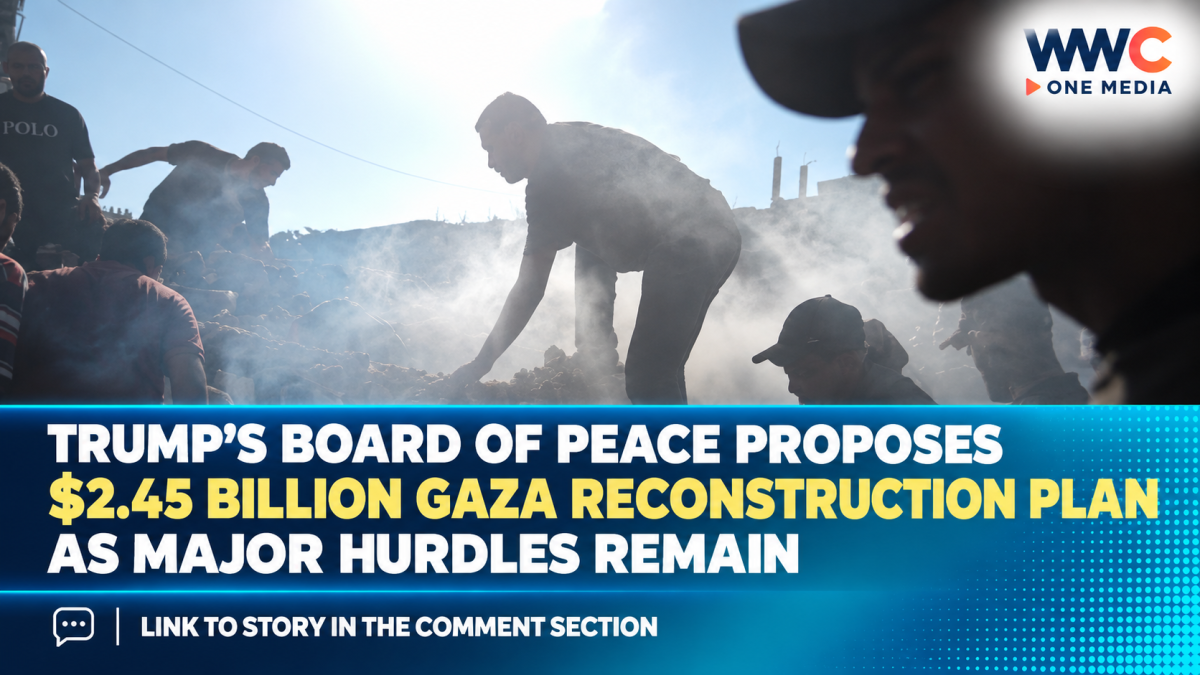
The US-backed Board of Peace has unveiled a six-month, US$2.45 billion reconstruction and governance plan for Gaza, proposing 66 projects covering infrastructure, education, health, economic development, digital services and security as efforts to implement a broader ceasefire framework continue to face major obstacles.
The proposal was presented on September 23 on the sidelines of the United Nations General Assembly in New York. The initiative is intended to provide an initial roadmap for rebuilding the war-damaged territory while encouraging international donors to provide funding.
The scale of the challenge, however, is far greater than the first-stage package. The Board of Peace estimates that physical reconstruction will require about US$35.2 billion over the medium term, followed by another US$71.4 billion in spending over the subsequent decade. That puts the longer-term reconstruction requirement at more than US$106 billion.
The six-month program covers six broad areas: infrastructure development, human development, economic acceleration, digital transformation, legal affairs, and peace and security. The plan is being presented as an initial phase rather than a complete reconstruction program.
Among the biggest challenges is funding. The proposal depends heavily on international donors at a time when governments and institutions are being asked to commit enormous sums to a territory where security and political arrangements remain unsettled.
The Board of Peace is also facing difficulties in translating the wider ceasefire framework into concrete action. The plan calls for further Israeli military withdrawals, the disarmament of Hamas, deployment of an international stabilization force and the establishment of an interim Palestinian administration.
Those steps have not fully materialized. According to the latest reporting, Israel still controls roughly 60% of Gaza, Hamas has not surrendered its weapons, and the proposed international force and interim government have yet to begin operating inside the territory. Reconstruction on the ground has therefore remained largely stalled.
Nickolay Mladenov, the Board of Peace’s high representative, has said progress is closely tied to Hamas disarmament while also pressing Israel to reduce its military presence. US Middle East envoy Steve Witkoff has acknowledged that the ceasefire has not been perfect but argued that it continues to provide a basis for moving forward.
The security component is particularly significant. US Gen. Jasper Jeffers, who commands the planned international stabilization force, has outlined a phased approach to demilitarizing Gaza. The first deployment is expected to involve troops from Kosovo and Morocco, followed by personnel from Albania and Kazakhstan, according to the Associated Press.
The proposal comes as humanitarian needs remain enormous. Many Palestinians continue to live in temporary shelters or damaged homes, while rebuilding essential infrastructure such as housing, healthcare facilities, schools, water systems and roads will require sustained access to Gaza and large quantities of construction materials.
International support is also still far below the amount needed for a full recovery. A senior European Union official said this week that only about €1 billion had been raised toward the much larger reconstruction requirement estimated by the UN, World Bank and European Union.
The Board of Peace’s blueprint therefore represents a detailed starting point, but not yet a guarantee that reconstruction will begin at scale. Its success depends on several unresolved issues moving simultaneously: security, Hamas disarmament, Israeli withdrawals, governance, humanitarian access and international financing.
The bigger question now is whether the $2.45 billion first phase can move from a detailed blueprint into actual reconstruction while the political and security disputes surrounding Gaza remain unresolved.