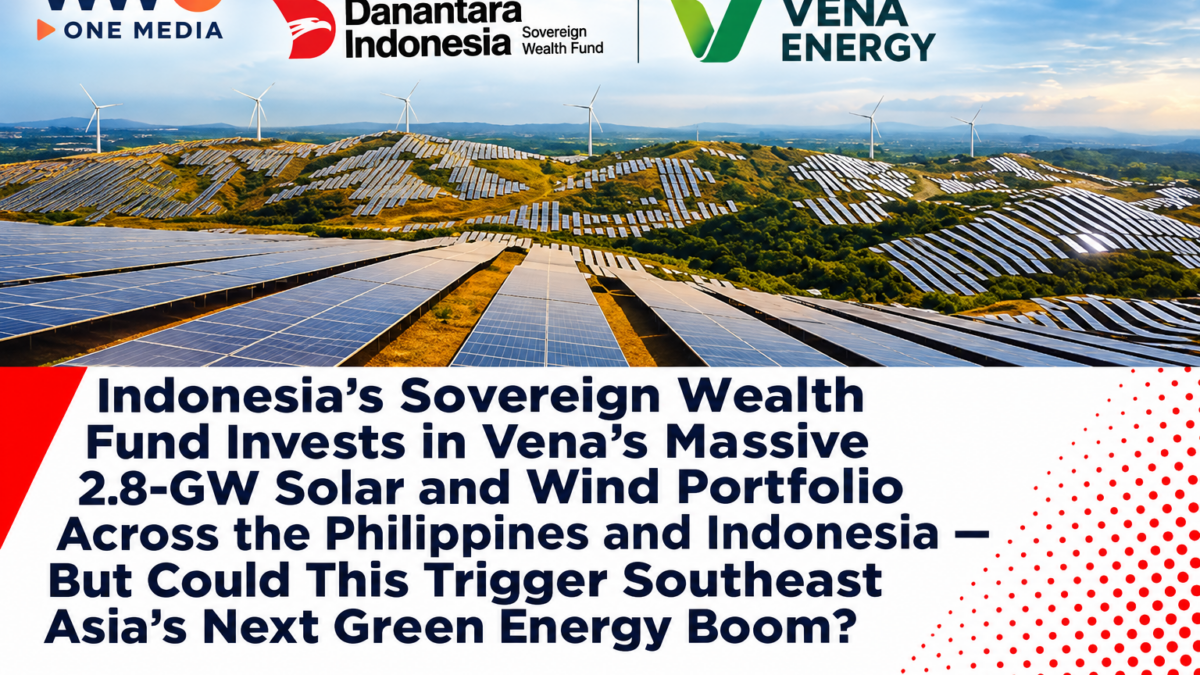
MANILA, PHILIPPINES / JAKARTA, INDONESIA — November 11, 2026 | WWC ONE MEDIA | Philippine Business, Renewable Energy, Investments and Southeast Asian Markets
A major Indonesian sovereign investment fund is entering the Philippine renewable energy market through a partnership with Singapore-based Vena Group, securing an undisclosed interest in a 2.8-gigawatt portfolio of solar and wind projects across the Philippines and Indonesia.
The transaction, announced on November 11, brings Indonesia Investment Authority (INA) into a renewable energy platform supported by some of the world’s largest institutional investors, including BlackRock’s Global Infrastructure Partners.
The agreement comes at a pivotal moment for Philippine clean energy development.
Vena Energy, the renewable energy arm of Vena Group, is pursuing approximately ₱245 billion in Philippine investments, involving around 2.6 GW of capacity already under construction or covered by contracts.
The investment also reflects a growing trend among Asian renewable energy developers: bringing sovereign wealth funds, pension institutions and development finance organizations into projects to support future construction.
But behind the billion-peso expansion plans lies a critical detail.
Neither INA nor Vena disclosed the investment amount, the size of INA’s ownership stake or the exact Philippine projects included in the new transaction.
The partnership could strengthen access to long-term capital, but its direct financial contribution to individual Philippine power projects remains unknown.
With international investors increasingly seeking opportunities in Southeast Asia’s electricity transition, could this partnership accelerate Vena’s enormous Philippine renewable energy program—or will financing demands, grid constraints and construction risks determine how much of the promised capacity actually reaches consumers?
Indonesia Investment Authority Enters Vena’s 2.8-GW Renewable Energy Portfolio
Indonesia Investment Authority has invested in a portfolio of renewable energy projects developed by Vena Group in Indonesia and the Philippines.
The combined portfolio represents approximately 2.8 GW of solar and wind capacity across different stages of development.
It includes operating facilities, projects under construction, contracted developments and assets still in the development pipeline.
This distinction is important.
A portfolio containing 2.8 GW of capacity does not mean all 2.8 GW is already producing electricity.
Some facilities may already generate revenue, while others will require additional investment, permits and construction before reaching commercial operation.
For INA, the investment provides exposure to a diversified regional renewable energy platform.
For Vena Group, the partnership introduces another institutional investor to help support its ongoing expansion.
INA chief executive Oki Ramadhana said the fund evaluates investment opportunities based on their commercial merits while maintaining strategic relevance to Indonesia.
The partnership combines investments in Indonesia with exposure to renewable energy projects elsewhere in Southeast Asia.
However, the companies have not publicly disclosed the transaction’s valuation, ownership percentage or detailed investment structure.
Any claim that INA invested a specific number of billions of pesos or acquired a controlling interest would therefore be unsupported.
BlackRock’s Infrastructure Platform Is Among Vena’s Backers
Vena Group’s institutional ownership is an important part of the story.
The Singapore-based company is supported by Global Infrastructure Partners (GIP), now part of BlackRock, alongside the Canada-based Public Sector Pension Investment Board and China Investment Corporation.
GIP became part of BlackRock following the asset manager’s acquisition of the infrastructure investment firm.
Vena, previously known as Equis Energy, has developed into a major renewable energy platform in Asia-Pacific.
Its activities span solar power, onshore and offshore wind, and energy storage.
The company also operates Vena Nexus, a digital infrastructure business.
However, INA’s latest investment should not be described as BlackRock directly purchasing additional Philippine solar farms.
The announced transaction concerns INA’s participation in Vena’s renewable portfolio.
Existing institutional ownership provides context, but it does not establish the precise ownership or financing arrangements of the newly announced investment.
Vena’s ₱245-Billion Philippine Expansion Raises the Stakes
The investment comes just weeks after Vena Energy presented its major Philippine expansion plans to President Ferdinand Marcos Jr.
During a meeting in Singapore on October 11, Vena executives discussed a planned investment program valued at approximately ₱245 billion.
The Department of Trade and Industry subsequently reported that Vena was advancing about 2.6 GW of Philippine capacity under construction or contract.
The company has operated in the Philippines since 2014.
According to the DTI, it already had approximately 0.9 GW of operational capacity, including solar facilities in Ilocos Norte and Negros Occidental.
A further 1.3 GW was under construction, while another 1.3 GW was contracted.
These figures indicate significant potential growth in the company’s Philippine generation portfolio.
But they should not be confused with the separate 2.8-GW regional portfolio associated with INA’s investment.
The datasets may overlap, and the complete list of projects involved in the INA transaction has not been disclosed.
For Philippine policymakers, Vena’s investment program represents an opportunity to expand domestic electricity supply and attract further international infrastructure financing.
For investors, the key questions concern how much capital has been committed, which projects are moving toward completion and whether the resulting power can be delivered economically to customers.
Why Sovereign Wealth Funds Are Investing in Philippine Renewable Energy
Renewable energy development is capital-intensive.
Large utility-scale solar and wind projects require substantial upfront spending on equipment, engineering, construction, land arrangements and grid connections.
Developers often need financing well before a project produces its first commercial electricity revenue.
Sovereign wealth funds can provide longer-term institutional capital that may be better suited to infrastructure projects with extended operating lives.
For INA, the opportunity is to participate in assets with potential long-term returns while supporting Indonesia’s strategic interest in cleaner energy infrastructure.
For Vena, introducing another institutional partner may reduce the amount of capital it must provide alone.
This strategy is especially relevant to companies building projects across multiple countries.
Instead of keeping the entire equity interest in every facility, a developer may sell minority stakes to outside investors while continuing to manage and operate the projects.
The approach can release capital for additional construction.
However, it can also change how future profits are distributed among shareholders.
The commercial benefits will depend on the financial terms, ownership rights and performance of the underlying assets.
Vena Uses Its Green Fund Partnership Strategy to Attract Investors
The new arrangement extends Vena’s Green Fund Partnership strategy.
The company began using the model in Japan in 2019 and announced plans in August 2025 to expand it across North Asia-Pacific and Southeast Asia.
The idea is to allow long-term institutional investors to acquire interests in selected renewable energy portfolios.
Vena can then use capital released through those transactions to support construction programs and pursue new development opportunities.
Vena Group chief executive Nitin Apte described Indonesia and the Philippines as important markets for the region’s energy transition.
The company intends to combine INA’s institutional investment perspective with Vena’s development, construction and operating capabilities.
This structure is not unique to Vena.
Other renewable energy developers are increasingly using strategic partnerships to fund growth.
Both arrangements illustrate how developers can share ownership and financial requirements with institutional partners.
But the ACEN and Vena transactions are separate deals with different assets and terms.
Indonesia’s Tolo Wind Farm Is Among the Regional Assets
One of the identified Indonesian assets is the 72-MW Tolo Wind Project in Jeneponto, South Sulawesi.
The wind facility illustrates the operating infrastructure included in Vena’s regional investment platform.
Unlike an early-stage development project, an operating wind farm has already passed key construction and commissioning milestones.
That can provide institutional investors with exposure to an asset with an operating history.
However, actual revenue and investment returns still depend on electricity production, operating costs, maintenance and contractual arrangements.
The Tolo Wind Project’s inclusion does not establish that it accounts for any particular percentage of the new investment’s value.
The companies have not published a complete asset-by-asset transaction breakdown.
Nor have they identified every Philippine project covered by INA’s investment.
Pangasinan Is Becoming a Major Solar Power Investment Hub
Vena’s Philippine expansion includes major developments in Pangasinan.
In July 2026, the company reached financial close on the 500-MWp Ixus Bugallon Solar Power Project.
The development is located beside Vena’s existing 550-MWp Bugallon Solar Power Project.
Once Ixus Bugallon is completed, the two projects would represent approximately 1,050 MWp of combined solar capacity at the site.
The new project secured around US$310 million in senior debt financing from eight international banks.
The lenders include BNP Paribas, Crédit Agricole, DBS, ING, Intesa Sanpaolo, MUFG, Standard Chartered and Sumitomo Mitsui Banking Corporation.
The financing illustrates the scale of international capital already supporting Vena’s Philippine operations.
But it is important to distinguish the July bank-financing transaction from INA’s November investment.
The US$310 million is a disclosed debt facility for Ixus Bugallon, not the undisclosed purchase price of INA’s stake in the regional portfolio.
The two transactions should not be treated as interchangeable.
Norway and Denmark Are Also Investing in Vena’s Philippine Solar Projects
On October 16, Vena announced another major institutional partnership.
Norfund, Norway’s development finance institution, and Impact Fund Denmark agreed to acquire a combined 49% equity interest in the Ixus Bugallon project.
The transaction remains subject to the Philippine Competition Commission’s approval and other customary closing conditions.
Under Vena’s projections, the solar facility could eventually generate enough electricity to cover the equivalent annual needs of approximately 650,000 Philippine households.
The company also estimates that the project could avoid approximately 570,000 tonnes of carbon dioxide emissions annually.
These are forward-looking estimates, not measured annual results from a fully operational facility.
The announced investment provides another example of how Vena is attracting institutional capital into Philippine renewable developments.
However, the Norwegian-Danish transaction must not be confused with INA’s latest investment.
Norfund and Impact Fund Denmark have identified a specific project and combined ownership stake.
INA’s November deal covers a broader regional portfolio, and the exact Philippine assets and ownership percentage remain undisclosed.
The separate arrangements show that Vena is expanding its network of international capital partners.
Philippine Renewable Energy Competition Is Intensifying
Vena’s latest investment comes as other major companies accelerate renewable energy development in the Philippines.
Ayala-led ACEN continues financing solar, wind and energy storage projects across Asia-Pacific.
In related reporting, WWC ONE MEDIA examined ACEN’s approximately ₱3.5-billion loan facility with ING Bank to support renewable energy investments.
Other developers are pursuing additional capacity through green bonds, bank loans and strategic equity transactions.
Alternergy Holdings Corporation, for example, is preparing a proposed ₱10-billion green bond program to help finance a new portfolio of solar, wind and battery projects.
These transactions demonstrate growing interest in financing Philippine renewable infrastructure.
But they also show how much capital developers must raise before projects can deliver electricity.
Competition for financing, engineering resources, suitable land and grid connections may become increasingly important as the project pipeline expands.
A Bigger Renewable Portfolio Does Not Automatically Mean Cheaper Electricity
The Philippines has established a target of increasing renewable energy’s share of electricity generation to 35% by 2030 and 50% by 2040.
Additional investment in solar and wind generation can support progress toward those goals.
Renewable energy projects can also diversify the country’s electricity supply and reduce dependence on imported fossil fuels over time.
However, a larger generation portfolio does not automatically guarantee lower monthly electricity bills.
Retail power prices depend on multiple factors, including financing costs, power supply contracts, transmission expenses, distribution charges and market conditions.
Solar and wind generation also depend on weather conditions.
Battery storage, flexible generation resources and adequate transmission infrastructure may be necessary to maintain reliable electricity supply as renewable capacity expands.
For Vena’s Philippine projects, the eventual economic contribution will depend on how effectively the new facilities are constructed, connected and operated.
The announcement does not contain a new tariff commitment or a verified estimate of consumer electricity-bill savings.
It would therefore be premature to claim that INA’s investment will immediately reduce power prices.
The Philippine Electricity Grid Could Become the Next Major Challenge
An expanding renewable energy portfolio creates additional demands on the country’s transmission network.
Many large solar and wind installations are located outside major urban demand centers.
Electricity generated in these areas must be transported through the grid before it can reach customers.
The Philippine Department of Energy has been processing a substantial pipeline of power projects seeking technical assessments and potential grid connections.
According to Department of Energy data, projects representing more than 17.8 GW of generating and storage capacity received endorsements for system impact studies during the first half of 2026.
A system impact study endorsement does not guarantee construction approval or grid connection.
Developers must still complete technical, regulatory and commercial requirements.
For Vena, these challenges could influence how quickly its planned investments translate into operating electricity capacity.
Southeast Asia Is Attracting Larger Cross-Border Energy Investments
The INA–Vena partnership reflects a broader trend toward regional infrastructure investments.
Renewable developers are increasingly operating across multiple countries, while institutional investors seek diversified exposure to long-term energy assets.
Indonesia and the Philippines both have significant renewable energy resources, but they also face growing electricity demand and infrastructure investment needs.
Cross-border investment partnerships can provide developers with access to capital that might otherwise be unavailable through domestic financing alone.
Such arrangements can also help institutions diversify their holdings across regulatory systems and electricity markets.
However, regional diversification creates additional complexity.
Currency movements, national regulations, construction conditions and power-market structures differ between countries.
Investors must therefore evaluate each asset on its own merits.
A regional portfolio can offer broader exposure, but it does not eliminate commercial or operational risk.
International Investment Also Highlights Offshore Wind Ambitions
The growing interest in Southeast Asian renewable energy extends beyond traditional solar farms.
Philippine companies are beginning to pursue larger offshore wind opportunities.
That project remains in the assessment and development phase.
No binding construction financing package has been announced under the reported cooperation agreement.
The development is separate from Vena’s regional portfolio and INA’s new investment.
Nevertheless, it illustrates the scale of future renewable energy opportunities being explored in the Philippines.
Offshore wind projects can require substantial investment in specialized engineering, marine construction and transmission infrastructure.
For investors, the potential returns must justify these additional requirements.
Is Vena Preparing for a Bigger Ownership Restructuring?
The latest INA transaction also comes against a backdrop of broader changes involving Vena’s institutional investors.
In February 2025, Reuters reported that Global Infrastructure Partners had appointed financial advisers to explore selling a controlling stake in Vena Energy.
The potential transaction was reportedly valued at as much as US$10 billion.
Earlier reports had suggested even higher valuations during preliminary discussions.
However, these were estimates associated with possible ownership transactions, not confirmed prices paid for completed acquisitions.
The INA investment should not be described as the completion of the previously reported controlling-stake sale.
The companies did not announce such an outcome.
Vena also completed the sale of its Indian renewable energy platform, including approximately 1 GW of operational capacity, to Inox Neo Energies in August 2026.
Taken together, the transactions demonstrate a company actively reshaping its portfolio and financing arrangements.
But the precise effect on Vena’s overall valuation and shareholder structure cannot be determined from the newly disclosed INA partnership alone.
Five Major Questions Investors Should Watch
1. How much did INA invest?
The investment value has not been disclosed.
2. What ownership percentage did INA acquire?
The companies have not announced the equity stake or final portfolio valuation.
3. Which Philippine assets are included?
The overall portfolio covers projects in both countries, but the detailed Philippine asset list remains unavailable.
4. How quickly will the projects reach operation?
The 2.8-GW portfolio includes both operating and non-operating assets.
5. Will institutional capital accelerate Vena’s Philippine expansion?
The company’s financing strategy is intended to release capital for future construction, but the direct impact of this particular transaction has not been quantified.
The Bottom Line: Foreign Investors Are Betting on Philippine Renewable Energy
Indonesia Investment Authority’s investment in Vena Group marks another milestone in Southeast Asia’s expanding renewable energy market.
The transaction provides the Indonesian sovereign wealth fund with exposure to a 2.8-GW solar and wind portfolio spanning Indonesia and the Philippines.
For Vena, it strengthens a financing strategy designed to bring institutional investors into renewable projects while retaining operational involvement and creating capacity for further development.
The announcement also comes as the company pursues a separate ₱245-billion Philippine investment program involving approximately 2.6 GW of capacity under construction or contract.
Large-scale solar projects in Pangasinan, additional international financing partnerships and broader regional development plans demonstrate how significant the company’s ambitions have become.
But major details remain unresolved.
The amount invested by INA has not been disclosed.
The ownership stake is unknown.
And the specific Philippine projects included in the transaction have not been identified publicly.
The key commercial test will be whether investment partnerships translate into completed facilities, reliable electricity generation and sustainable financial returns.
Indonesia’s sovereign wealth fund has joined Vena’s 2.8-GW renewable energy platform as international institutions increasingly invest in Southeast Asia’s energy transition. But with Vena pursuing ₱245 billion in Philippine expansion plans and the financial terms of the new deal still undisclosed, could the partnership unlock the next major wave of solar and wind development—or will the biggest challenge be turning ambitious investment announcements into power plants that actually generate electricity?