Britain Offers Millions £100 in Energy Relief as Inflation Threatens to Hit 4.4% — But Can Andy Burnham’s Government Escape the £3 Trillion Debt Trap?
LONDON, UNITED KINGDOM — November 11, 2026
Britain is offering millions of households financial relief from soaring energy costs, but the government’s latest economic outlook suggests that the country’s cost-of-living crisis could become even more difficult to control.
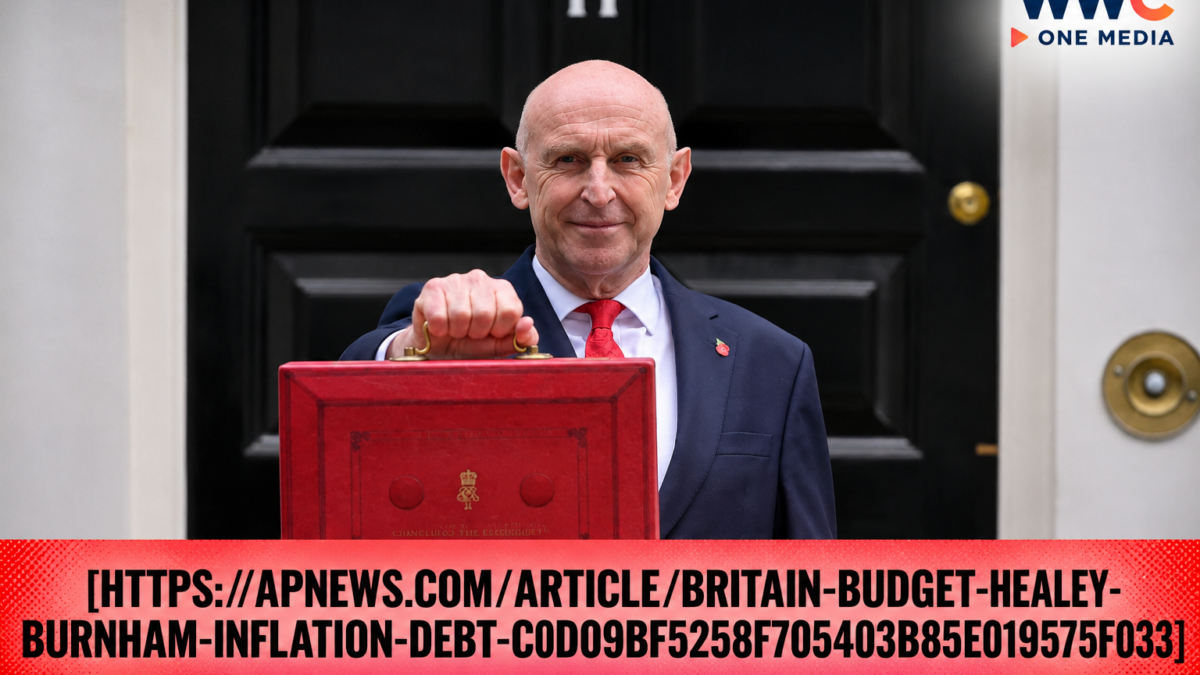
Chancellor of the Exchequer John Healey announced a package of energy assistance, tax changes and business support in his first Budget under Prime Minister Andy Burnham on October 28. The measures aim to give households breathing room as higher oil and gas prices, inflation and borrowing costs put pressure on family finances.
The package includes a one-off £100 Household Energy Payment for eligible households in England, an extension of electricity VAT relief, plans to remove domestic gas standing charges and a temporary increase in taxes on major banks.
However, the relief arrives against a troubling economic backdrop.
Britain’s public debt has exceeded £3 trillion, while the government expects to spend approximately £14 billion more on debt interest during the 2026–27 financial year than previously forecast.
And the outlook has become more concerning.
On November 11, the National Institute of Economic and Social Research (NIESR) warned that UK inflation could reach 4.4% in February 2027 and remain above the Bank of England’s 2% target until late 2030.
The warning raises a difficult question for Burnham’s government: Can Britain protect households from rising energy costs without creating an even bigger financial burden for taxpayers and future generations?
£100 Energy Payment Targets Up to 20 Million Households
One of the most visible announcements in Healey’s Budget is a £100 payment designed to help households manage higher energy bills.
The government plans to provide the one-off Household Energy Payment from January 2027 to eligible households in council tax bands A to D in England.
The scheme is expected to reach up to 20 million households and is backed by a £2.6 billion funding package.
The payment is intended to help families facing higher electricity and heating expenses as international energy markets remain under pressure.
The devolved administrations in Scotland, Wales and Northern Ireland will receive funding through the Barnett formula, allowing them to determine comparable support for their own residents.
That distinction matters: the £100 payment is not automatically guaranteed to every household across the United Kingdom. Eligibility and delivery arrangements depend on the relevant government.
The Treasury is presenting the measure as immediate cost-of-living assistance, but the wider challenge is whether a one-time payment can meaningfully offset energy costs that remain elevated over several months.
For households already dealing with higher food prices, mortgages and transportation expenses, £100 may provide temporary relief without resolving the underlying affordability problem.
Gas Standing Charges Could Disappear, but Bills Will Still Depend on Usage
Healey also announced plans to remove standing charges on domestic gas bills.
Standing charges are fixed daily fees that households pay regardless of how much gas they consume.
The government has asked energy regulator Ofgem to abolish domestic gas standing charges in Great Britain by the end of 2027 or as soon as possible afterward.
The change could benefit households that use relatively little gas because they would no longer face the same fixed daily charge.
However, removing standing charges does not mean gas becomes free.
The associated costs are expected to be recovered through the price consumers pay for each unit of energy. This means households with higher gas consumption could face higher unit rates.
The government is also extending the temporary zero rate of VAT on qualifying domestic electricity supplies until July 2027.
According to the Treasury, this extension is expected to reduce the annual energy price cap by approximately £50 in April 2027.
Taken together, the measures are intended to reduce some of the pressure on household energy bills while Britain works toward longer-term energy reforms.
But their actual impact will depend on future wholesale energy prices, household consumption and how suppliers adjust their tariffs.
Higher Bank Taxes Will Help Finance Household Support
The government is also asking major banks to contribute more toward the cost of household assistance.
Healey announced that the Bank Corporation Tax Surcharge will temporarily increase from 3% to 6%.
The change will take effect from January 1, 2027, and remain in place until March 31, 2028.
The government expects the higher surcharge to help finance the energy payment and other cost-of-living measures.
The decision reflects the administration’s argument that banks should contribute more after benefiting from higher interest rates.
However, the policy also raises questions about the potential impact on the financial sector.
Banks may absorb some of the additional tax through lower profits, but the eventual effects on lending, investment and financial services will depend on market conditions and individual business decisions.
Healey has also introduced higher taxes on certain gambling-machine takings and changes affecting online marketplaces, savers and property income.
The Budget therefore combines household assistance with a wider effort to raise revenue without relying entirely on additional government borrowing.
WWC ONE MEDIA previously examined the banking-tax debate in its coverage of UK Chancellor John Healey’s proposed tax changes for banks ahead of the October Budget.
Britain’s £3 Trillion Debt Burden Leaves Little Room for Mistakes
Behind the household assistance is a much larger financial problem.
The United Kingdom’s public debt has surpassed £3 trillion, creating a substantial challenge for the Treasury as it attempts to balance public spending, economic support and fiscal stability.
The debt burden is especially difficult because higher interest rates and inflation can increase the cost of servicing government liabilities.
According to the October Budget forecasts, debt-interest spending is expected to be approximately £14 billion higher in 2026–27 than in the previous forecast.
The Office for Budget Responsibility’s October outlook places central government debt-interest spending at approximately £123.9 billion for that financial year.
The OBR also expects public sector net debt to reach around 96% of GDP in 2026–27, rising to approximately 97% in 2028–29 before easing slightly.
These figures illustrate why the government cannot simply increase financial assistance every time energy prices rise.
More borrowing can increase future interest payments, leaving less money available for public services, infrastructure, healthcare and other priorities.
The problem becomes more serious when economic growth is weak and tax revenues fail to expand quickly enough.
For Healey, the challenge is to support households today without making the government’s long-term debt position more difficult to manage.
UK Inflation Could Reach 4.4% in February 2027
The latest inflation warning has added another layer of uncertainty to Britain’s economic outlook.
On November 11, Reuters reported that the National Institute of Economic and Social Research expects UK inflation to peak at 4.4% in February 2027.
That is higher than the institute’s previous forecast of 3.8%.
The think tank expects inflation to remain above the Bank of England’s 2% target through 2027, 2028 and 2029, returning to the target only in late 2030.
NIESR attributed the worsening outlook partly to second-round effects from the Iran war, including the possibility that higher energy costs could feed into wages and other prices.
This matters because inflation is not limited to the amount households pay for electricity or petrol.
When businesses face higher energy, transportation and operating expenses, some of those costs can eventually be reflected in the prices of goods and services.
If workers then demand higher wages to compensate for increased living costs, businesses may face another round of cost pressure.
The result can make inflation more persistent even after the original energy-price shock begins to ease.
The NIESR warning is not a guarantee that inflation will reach 4.4%. It is an economic forecast based on current assumptions and remains subject to changes in energy markets and domestic economic conditions.
Nevertheless, it signals that the cost-of-living challenge may last longer than the government originally hoped.
Economic Growth Is Expected to Slow Despite the Budget Measures
Britain’s growth outlook also remains fragile.
The Office for Budget Responsibility expects real GDP growth to slow from approximately 1.25% in 2026 to 1% in 2027.
The downgrade reflects the impact of higher energy prices and borrowing costs on economic activity.
Higher household expenses can leave consumers with less money for discretionary spending.
Businesses may also delay investment, hiring or expansion when financing becomes more expensive and future demand is uncertain.
The government has announced measures intended to encourage investment and support British businesses, including additional funding for business and infrastructure lenders.
However, short-term assistance does not automatically create stronger productivity or sustained economic growth.
The longer-term challenge is to increase investment, improve infrastructure, strengthen business confidence and reduce Britain’s exposure to volatile imported energy.
WWC ONE MEDIA has previously examined the relationship between rising prices and government finances in its report on the potential £9 billion revenue boost facing Chancellor John Healey amid Britain’s wider tax and spending pressures.
Bank of England Faces a Difficult Inflation Decision
The Bank of England faces a complicated policy environment.
If inflation remains elevated, policymakers may need to keep interest rates higher for longer or consider further tightening.
Higher interest rates can help reduce demand and prevent inflation expectations from becoming entrenched.
But they also make mortgages, business loans and government borrowing more expensive.
That creates a difficult trade-off.
If the Bank raises rates too aggressively, it could weaken consumer spending and business investment.
If it allows inflation to remain elevated for too long, households could face a prolonged period of reduced purchasing power.
The November 11 NIESR forecast adds pressure to this debate because it suggests that inflation may remain above target for several more years.
However, the think tank’s forecast should not be confused with an official Bank of England decision. Monetary policy will depend on incoming inflation, employment, wage and economic-growth data.
For British households with mortgages or other variable-rate borrowing, the direction of interest rates remains particularly important.
Energy Prices and the Iran War Continue to Shape Britain’s Economic Outlook
Britain’s exposure to international energy markets is another major risk.
The conflict involving Iran has contributed to higher oil and gas prices and uncertainty surrounding energy supply routes, including the Strait of Hormuz.
As a net importer of energy, the United Kingdom is vulnerable to increases in international prices.
Higher wholesale energy costs can affect household bills directly and raise operating expenses for businesses.
They can also influence transportation, manufacturing, food distribution and other parts of the economy.
The OBR has warned that a more sustained increase in energy prices could push government borrowing significantly above its central forecast.
Its October outlook estimated that a higher and more persistent energy-price path could add approximately £17 billion to borrowing in 2027–28 compared with the central scenario.
This demonstrates why the government’s energy-relief measures cannot be separated from its broader fiscal strategy.
A prolonged energy shock could simultaneously increase household expenses, weaken economic growth and raise the government’s debt-interest bill.
WWC ONE MEDIA has also examined how international price pressures are affecting other economies, including its coverage of Europe’s inflation outlook and the risk of further European Central Bank interest-rate increases.
What the Budget Means for British Workers and Businesses
The measures announced by Healey will affect different groups in different ways.
Households: Eligible households in England’s council tax bands A to D are expected to receive a one-off £100 energy payment from January 2027. Electricity VAT relief is also being extended.
Low gas users: The planned removal of gas standing charges could reduce fixed daily costs, although unit prices may change to recover those costs.
Banks: Major banks will face a temporary increase in the corporation tax surcharge from 3% to 6%.
Small businesses: Retail, hospitality and leisure businesses will receive changes to business-rate relief, intended to reduce pressure on high streets.
Workers: Minimum wage rates are scheduled to increase by 3.9% in April 2027.
Property owners and savers: Changes to taxation of property and savings income could increase tax bills for some individuals.
The overall effect will depend on household circumstances, income, energy consumption and the details of the relevant tax rules.
For many families, the immediate question is whether the energy assistance will be enough to offset rising living expenses.
For businesses, the concern is whether higher operating costs and taxes will discourage investment or hiring.
For the government, the central issue is whether the measures can provide relief without undermining fiscal credibility.
Can Andy Burnham’s Government Balance Household Relief and Britain’s Debt Crisis?
Healey’s first Budget under Andy Burnham is an attempt to address several problems at once: expensive energy, strained household finances, weak growth and a growing government debt burden.
The £100 energy payment, extended electricity VAT relief and planned removal of gas standing charges offer practical assistance.
But the measures do not eliminate the economic pressures behind the cost-of-living crisis.
The government’s own forecasts show that debt-interest spending remains substantial, economic growth is expected to slow and public debt is projected to remain close to 97% of GDP over the coming years.
The latest NIESR warning makes the challenge even more serious.
If inflation reaches 4.4% in February 2027 and remains above the Bank of England’s target until late 2030, households and businesses could face a much longer period of financial uncertainty.
Britain’s government will need more than one-off payments to restore confidence. It will need sustained economic growth, a more resilient energy system, credible public finances and policies that help wages keep pace with living costs.
For now, Healey has offered families some breathing space.
But with inflation risks rising, borrowing costs elevated and public debt above £3 trillion, the bigger test is only beginning.