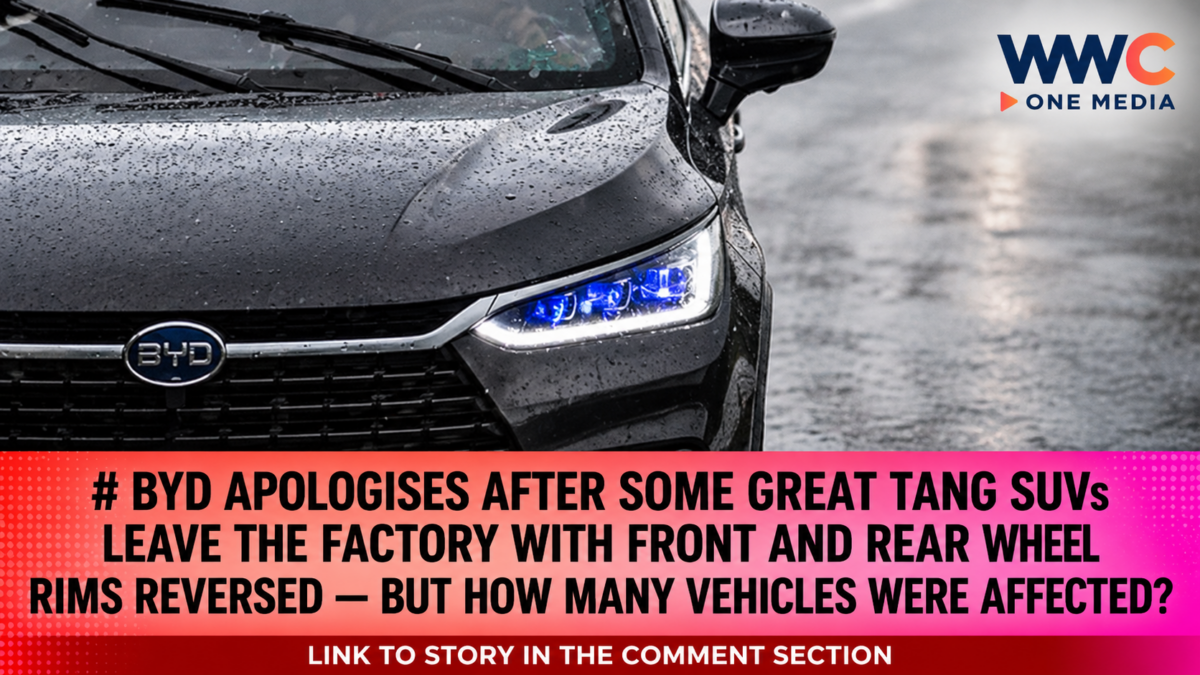
BEIJING, CHINA — One of the world’s largest electric-vehicle manufacturers is facing fresh questions about quality control after BYD admitted that some of its Great Tang electric SUVs were fitted with front and rear wheel rims in the wrong positions.
The Chinese automaker apologised on November 11 after investigating customer complaints about the assembly error, which was traced to a supplier’s coding-entry mistake.
BYD insists that its testing found no impact on vehicle handling and no driving safety risk. However, the incident has raised questions about how such a basic production error passed through the company’s manufacturing and inspection processes.
The company has promised affected owners free inspections and professional wheel-rim adjustments, while also taking steps to prevent the mistake from happening again.
But one important detail remains unanswered: BYD has not disclosed how many vehicles were affected.
HOW DID BYD’S GREAT TANG SUV GET ITS WHEELS INSTALLED THE WRONG WAY?
The problem involves the front and rear wheel-rim assemblies of some BYD Great Tang electric SUVs, also referred to as the Da Tang.
The vehicle uses a staggered wheel configuration on the relevant version, meaning the front and rear wheels have different specifications.
According to automotive publication CnEVPost, the affected configuration uses narrower 8J rims with 255/50R20 tyres at the front and wider 9J rims with 275/45R20 tyres at the rear.
Some vehicles reportedly left production with the front and rear rim positions reversed.
This is not simply a cosmetic issue involving different-looking wheels.
Rim width and tyre specifications are designed to work together according to the vehicle’s engineering requirements. Installing components in the wrong positions can prompt legitimate questions about tyre fitment, wear and driving performance.
The problem first gained attention after owners posted complaints online and raised concerns about the incorrect installation.
Some owners questioned whether the configuration could cause abnormal tyre wear or compromise driving safety.
BYD subsequently acknowledged the assembly error and announced corrective measures.
BYD BLAMES A SUPPLIER’S CODING ERROR
In its November 11 statement, BYD said its investigation traced the problem to an incorrect coding entry by its wheel-rim subassembly supplier.
The company identified the supplier as Hubei Boyu Industrial Co Ltd, according to CnEVPost’s report on the announcement.
The coding mistake resulted in incorrect installation of the front and rear wheel-rim assemblies on some vehicles.
BYD said it immediately began investigating the affected production and correcting the relevant coding to prevent the same error from appearing in subsequent batches.
The supplier has also introduced additional visual inspection and error-prevention measures on its production line.
These steps are intended to reduce the possibility of incorrect components being assembled during manufacturing.
BYD apologised to affected owners, acknowledging the inconvenience caused by the mistake.
However, the incident also raises a broader manufacturing question: How did an error involving two different wheel specifications make it through the production and quality-control process?
BYD SAYS THE ERROR DOES NOT CREATE A SAFETY RISK
Despite the complaints, BYD maintains that the affected vehicles remain safe to drive.
The automaker said it conducted dedicated testing after investigating the issue and found that the reversed wheel-rim installation did not affect vehicle handling or create a driving safety risk.
That is an important distinction.
The company has acknowledged a genuine assembly defect, but it has not announced that the affected vehicles have experienced a confirmed pattern of crashes or loss of control.
Earlier reports from owners raised concerns about possible abnormal tyre wear and handling problems. Those concerns prompted the investigation, but they should not be treated as proof that every affected vehicle experienced those problems.
BYD’s safety assessment is the company’s stated finding. Independent verification of the testing results has not been established in the reporting available at publication.
For vehicle owners, the most important step is to have the affected assembly inspected and corrected by an authorised service centre rather than relying solely on online assurances.
WHAT BYD IS OFFERING AFFECTED OWNERS
BYD has outlined several measures to address the problem.
Affected owners will be invited to visit local service centres for:
- Free vehicle inspections.
- Professional adjustment or replacement of incorrectly positioned wheel rims.
- A loan vehicle or reimbursement of transportation expenses while repairs are carried out, according to Caixin Global’s report.
- A restart of the affected vehicle’s full-vehicle warranty from November 11.
The warranty commitment is particularly important because it gives affected owners renewed coverage following the correction.
The company has not publicly disclosed the total number of affected vehicles or provided a complete production-batch breakdown in the reports reviewed.
Owners should therefore wait for official notification and confirm their vehicle’s status with BYD rather than assuming that every Great Tang SUV is affected.
WHY THIS IS A BIGGER ISSUE FOR BYD’S QUALITY CONTROL
The timing of the incident is significant.
BYD has been expanding its international presence while competing aggressively in China’s increasingly crowded electric-vehicle market.
Its Great Tang SUV is part of the company’s push into larger, higher-priced vehicles.
The model launched in China in June 2026, with prices starting at approximately 239,900 yuan, according to CnEVPost. The publication reported that the model recorded around 14,000 sales in October.
That makes quality control particularly important.
Consumers purchasing premium electric SUVs expect more than advanced batteries, long driving ranges and digital features. They also expect basic manufacturing components to be installed correctly.
A wheel-rim assembly mistake may appear small compared with a battery or braking-system defect, but it can still undermine confidence in a vehicle manufacturer’s production standards.
The incident also comes as China’s automotive industry faces increased regulatory attention over manufacturing quality, durability and vehicle safety.
For BYD, the challenge is not simply correcting the affected vehicles. It is demonstrating that its supplier oversight and production inspection systems can prevent similar mistakes from reaching customers.
WWC ONE MEDIA previously examined a more serious BYD safety issue in BYD Recalls 183,211 Cars in China Over Brake-Pedal Defect — Here’s the Risk Drivers Need to Know.
That September recall involved selected older Qin and Tang vehicles manufactured between 2014 and 2022. China’s market regulator said certain brake-pedal stopper components could deteriorate or detach, potentially leaving brake lights illuminated when the driver was not pressing the pedal.
The two incidents involve different components, different production issues and separate corrective actions. They should not be confused as one defect.
Nevertheless, both demonstrate why vehicle quality assurance remains a critical issue for major automakers.
CHINA’S EV INDUSTRY FACES GROWING QUALITY AND COMPETITION PRESSURE
BYD’s latest assembly error arrives at a time when China’s electric-vehicle industry is facing pressure from intense competition, pricing battles and increasingly demanding consumers.
The country’s automakers are competing not only on vehicle prices but also on battery technology, driving range, software, charging speeds and manufacturing efficiency.
As companies increase production and expand into international markets, supplier quality and manufacturing consistency become increasingly important.
China’s growing automotive export industry is also attracting greater attention from foreign governments.
WWC ONE MEDIA examined the wider commercial pressures in China’s 7-Million-Car Export Boom Puts BYD and Chery on Global Collision Course — But Could Tariffs and Hidden Costs Crush Their Profits?.
The report explored how Chinese manufacturers are expanding overseas while dealing with trade barriers, rising transportation costs and fierce competition.
For companies such as BYD, international growth creates opportunities, but it also increases the importance of maintaining consistent product standards across markets.
A manufacturing mistake that attracts attention in China can quickly become an international reputational issue when a brand is selling vehicles across multiple regions.
COULD THE INCIDENT AFFECT BYD’S INTERNATIONAL EXPANSION?
The wheel-rim problem has not been reported as a global recall, and there is no evidence that BYD has announced that the same issue affects vehicles sold in every overseas market.
The reported problem concerns some Great Tang vehicles in China.
However, the incident is relevant to international customers because it raises questions about supplier management, production inspection and the effectiveness of quality-control systems.
BYD is already expanding its presence in Southeast Asia and Europe, where Chinese electric vehicles are competing with established international brands.
In the Philippines, the company’s growth has been particularly notable.
WWC ONE MEDIA reported in BYD Philippines Nearly Doubles Sales to 28,399 Units — But One Type of Vehicle Is Driving Almost 80% of the Boom that BYD Cars Philippines recorded 28,399 vehicle sales from January to August 2026, a 99% increase compared with the same period in 2025.
That growth illustrates why maintaining customer confidence is important as the brand attracts more buyers.
The company is also facing wider scrutiny of its connected-vehicle technology in overseas markets.
In Europe, 14 lawmakers called for an investigation into potential security risks associated with Chinese connected vehicles, including BYD models.
WWC ONE MEDIA covered the debate in EU Lawmakers Demand Security Probe Into BYD Cars — Could Chinese Electric Vehicles Face Restrictions Across Europe as Spying Fears Intensify?.
That controversy is separate from the wheel-rim assembly issue. It concerns data protection and national-security questions, not a mechanical defect.
Together, however, these developments illustrate the increasingly complex challenges facing Chinese automakers as they seek to build trust in international markets.
WHAT GREAT TANG OWNERS SHOULD DO NOW
Owners who suspect that their vehicles may be affected should contact an authorised BYD service centre and ask whether their vehicle is covered by the company’s inspection programme.
They should not attempt to reposition the wheel assemblies themselves.
A professional inspection can confirm whether the correct rim and tyre specifications are installed in the correct positions.
Affected owners should also ask for written confirmation of any corrective work, the warranty arrangements and any available transportation assistance.
The fact that BYD says the issue does not affect driving safety should not discourage owners from following the company’s inspection instructions.
THE BIGGER QUESTION: CAN BYD PREVENT ANOTHER SUPPLIER MISTAKE?
BYD has acknowledged the error, identified a supplier-related cause and promised free corrective work for affected owners.
Those measures are important, but the company’s response will ultimately be judged by how effectively it identifies every affected vehicle and prevents similar mistakes from recurring.
The undisclosed number of affected SUVs also leaves an important question unanswered.
For now, BYD says its testing found no safety risk, and it has committed to correcting the assembly problem without charging affected owners.
But as the company expands its presence in some of the world’s most competitive automotive markets, consumers will be watching more closely than ever.
The real test for BYD may not be how quickly it apologises for a wheel-rim mistake — but whether it can prove that the same kind of error will not happen again.