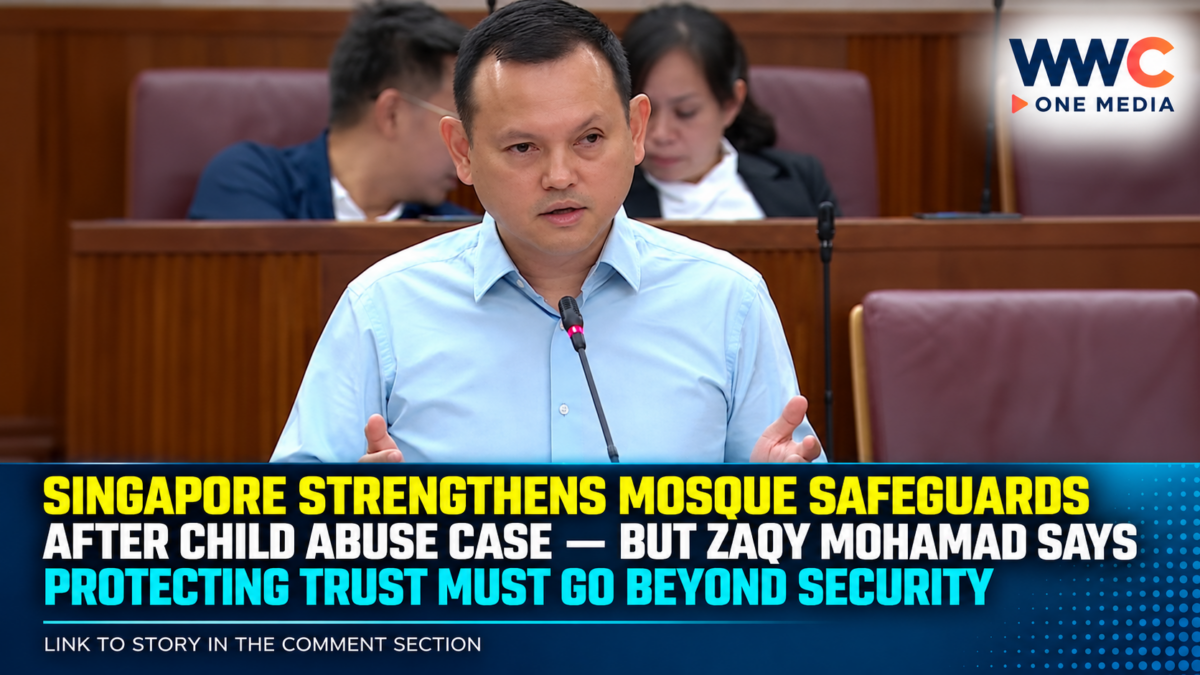
SINGAPORE — Singapore is introducing a new wave of reforms across its mosque network, with stronger religious guidance, child-protection safeguards and expanded support for families. Acting Minister-in-charge of Muslim Affairs Zaqy Mohamad announced the initiatives following a disturbing child sexual abuse case involving an unaccredited religious mentor. But the bigger challenge is not simply increasing security: Singapore must ensure that mosques remain safe, welcoming places where families and young people can seek trusted guidance without fear.
Singapore’s Islamic Religious Council, MUIS, is preparing to reshape how mosques provide religious guidance, spiritual care and community support.
The initiatives were unveiled on Saturday, October 10, during the One Mosque Sector Townhall, attended by approximately 350 mosque and Qaryah leaders and officers.
The reforms include appointing four district-level Mufti Associates, creating a structured Islamic Spiritual Care and Guidance framework, training religious officers and expanding community outreach.
The announcements come amid heightened scrutiny of child protection in religious settings.
A criminal case involving the abuse of two young boys exposed serious concerns about how informal religious activities are monitored.
While MUIS has already announced stronger patrols and CCTV monitoring, officials now want a broader approach that addresses leadership, professional standards, reporting procedures and family support.
The objective is to strengthen public confidence while preserving the community role of mosques.
Zaqy Mohamad Warns That Trust Must Be Protected
Speaking at the townhall, Zaqy emphasized that mosques occupy a special place in the lives of Singapore’s Muslim community.
They are places for worship, religious education, family activities and community relationships.
That makes trust essential.
He acknowledged the pain caused when the confidence of children and families is violated in religious spaces.
His message was that stronger safeguards are necessary, but they should not transform mosques into inaccessible institutions.
The challenge is to maintain openness while ensuring people understand appropriate boundaries and know how to report concerns.
Zaqy also stressed that implementing safeguards matters as much as writing policies.
A framework cannot protect children if staff, volunteers and religious teachers do not understand or follow it.
Child Abuse Case Prompts Stronger Safeguards
The review follows the conviction of a 37-year-old self-styled religious mentor who sexually abused two young boys, with some offending involving a mosque.
In August 2026, the offender received a sentence of 27 years and 10 months’ imprisonment and 24 strokes of the cane.
Zaqy previously clarified that the offender was not a mosque employee, volunteer or accredited religious teacher under Singapore’s Asatizah Recognition Scheme.
The individual was also not conducting an officially organized or approved religious class at the mosque.
These distinctions are important because the case raised questions about informal religious activities rather than establishing that the mosque had formally appointed the offender to teach.
Following the case, MUIS strengthened security measures, including patrols and CCTV monitoring.
It also moved to review how children and young people are protected during informal gatherings.
The objective is to identify risks earlier and ensure that warning signs receive an appropriate response.
Four Mufti Associates to Support Singapore’s Mosque Districts
A central initiative is the appointment of four District Office of Mufti Associates.
They will serve Singapore’s four mosque districts: north, south, east and west.
Their role is to provide more localized religious guidance and mentor Mosque Religious Officers.
They will also serve as an important connection between neighborhood mosques and the Office of the Mufti.
This structure is intended to help mosque officers respond more effectively to religious questions and emerging community concerns.
MUIS’s Religious Content and Guidance unit will oversee standards and content development, while the district associates will help ensure guidance reaches individual mosques.
The appointments are an organizational initiative, not a plan to replace every mosque’s existing religious leadership.
The wider goal is to build a more coordinated system in which local officers can access trusted expertise when complex questions arise.
New Spiritual Care Framework Will Support Vulnerable Residents
MUIS is developing an Islamic Spiritual Care and Guidance framework to make spiritual support more consistent across the mosque network.
The framework is designed to help religious officers recognize people who may require additional support.
Potential needs include family difficulties, illness, bereavement, caregiving pressures, social isolation, rehabilitation and end-of-life concerns.
Religious officers and accredited religious teachers will receive training to provide suitable spiritual guidance and connect residents with relevant professional or community services.
The distinction between spiritual and professional care remains important.
The programme is intended to complement, rather than replace, treatment and assistance provided by qualified healthcare professionals, counsellors and social service agencies.
This could help mosques become more effective first points of contact for residents experiencing difficult life circumstances.
Twenty Religious Officers to Begin Training at Four Pilot Mosques
The first implementation phase will involve 20 Mosque Religious Officers.
They will receive structured training at four pilot mosques.
MUIS expects the pilot sites to be ready by the second quarter of 2027.
The initial phase will allow the council to evaluate the framework, identify problems and refine procedures before expanding successful approaches.
This is a planned rollout.
The announcement does not mean that every mosque already has a fully operational spiritual-care service under the new framework.
The phased approach also provides an opportunity to assess how well religious officers can identify residents needing additional assistance.
MUIS is working with PPIS, a Singapore Muslim women’s organization, on research into how mosques can better support seniors, families and young people facing social and personal challenges.
The findings are expected to inform the wider development of spiritual-care services.
Four Mosques Become Family Support Contact Points
Another major initiative focuses on strengthening assistance for Muslim families.
Four Family Development Officers have been deployed to:
- Al-Khair Mosque
- An-Nur Mosque
- Al-Falah Mosque
- Darul Ghufran Mosque
Working with AMP Singapore, the officers will strengthen the ARIF programme.
The initiative is expected to support more than 500 families by 2027.
Services will include parenting programmes, fathering support and marriage enrichment activities.
The four mosques will also function as first-stop centres for Muslim couples seeking assistance.
This could help families access relevant guidance earlier rather than waiting until difficulties become more serious.
However, the 500-family figure is a target, not the number of families already served through this new deployment.
Community Outreach Expands Beyond Mosque Buildings
MUIS also intends to expand its Qaryah networks, which connect local Muslim communities with religious and social activities.
These networks can reach residents who do not regularly participate in mosque-based programmes.
In western Singapore, Qaryah 2.0 has been reaching families living in rental housing estates.
The initiative seeks to connect residents with religious learning and community activities.
Another programme, QaryahKITA, has been introduced at five locations.
Later in 2026, Masjid Hasanah in Teban Gardens is expected to pilot Qaryah Emas, a programme intended to improve connections between seniors and their neighborhood mosque.
The initiatives reflect an effort to bring community support closer to people’s homes.
They also recognize that seniors, caregivers and families facing financial or social difficulties may find it challenging to participate regularly in activities held at centralized locations.
MUIS Collaboration Fund Supports Community Projects
The effort to strengthen community support already has a broader funding component.
According to MUIS’s official announcement, approximately S$400,000 has been committed through the Community Religious Life Collaboration Fund over the past year.
The funding supported 13 projects involving 17 mosques and at least 30 community partners.
These activities reached more than 3,500 beneficiaries and participants.
Programmes cover areas such as family support, senior well-being, youth development and capability building.
The figures illustrate the scale of existing cooperation between religious institutions and community organizations.
However, the funding should not be confused with a newly announced S$400,000 security budget.
It relates to collaborative community programmes across several service areas.
Safeguards Committee Begins Reviewing Religious Settings
The Committee to Strengthen Safeguards in Religious Settings has also begun its work.
According to Zaqy, it held its first meeting on Thursday, October 8.
The committee will engage religious teachers, madrasah personnel, parents, young people and children.
Its review will examine existing safeguards, identify weaknesses and develop recommendations.
Areas of concern include how misconduct is reported, whether boundaries are understood and whether warning signs are recognized promptly.
The Straits Times previously reported that the committee aims to submit recommendations by the end of 2026.
Importantly, officials are examining more than physical security.
The effectiveness of safeguarding also depends on training, supervision, organizational culture and whether individuals feel safe raising concerns.
The review is ongoing, and its final recommendations have not yet been issued.
Singapore Tightens Religious Education Registration Rules
The October 10 announcements follow separate regulatory changes that took effect on October 2, 2026.
Under the updated framework, individuals and organizations regularly providing Islamic instruction to 10 or more people must register with MUIS as Muslim Religious Schools.
The requirement can apply to instruction conducted in person or online.
MUIS expects approximately 50 individuals and organizations to register under the expanded rules.
Providers that meet the definition have until March 31, 2027, to submit registration applications under transitional arrangements.
The updated framework also strengthens professional standards for religious teachers.
New applicants seeking Tier 1 recognition under the Asatizah Recognition Scheme must generally hold at least a degree in Islamic Studies.
Existing recognized Tier 1 teachers are not automatically subjected to this new qualification requirement.
The reforms are designed to improve oversight and make it easier for families to identify recognized religious education providers.
They should not be confused with the separate spiritual-care pilot announced on October 10.
Why Safeguarding Cannot Depend on CCTV Alone
Physical security measures are useful, but they have limitations.
CCTV cameras and patrols can improve oversight in certain spaces.
However, protecting children also requires clear expectations about appropriate adult-child interactions, safe ways to report concerns and prompt responses when suspicious behavior is identified.
The earlier abuse case demonstrated why informal interactions require attention even when an individual is not officially affiliated with an institution.
The Straits Times previously reported that MUIS plans to introduce clearer reporting and escalation procedures, monitoring of informal activities and periodic safeguarding audits.
These changes are intended to strengthen accountability at different levels of mosque administration.
Their effectiveness will ultimately depend on implementation, staff training and consistent enforcement.
The existence of new procedures alone does not prove that all risks have been eliminated.
Balancing Security With Community Access
One of the most difficult issues facing religious and community institutions is how to improve safety without discouraging participation.
Mosques are not only venues for formal religious instruction.
They also provide spaces where people gather for worship, meet neighbors, seek advice and participate in community life.
Excessively restrictive arrangements could make some residents hesitant to seek help.
Weak oversight, meanwhile, could leave vulnerable individuals at risk.
MUIS is attempting to address both concerns by combining safeguarding reforms with more accessible guidance and family services.
That makes the initiative broader than a reaction to a single criminal case.
It is also an effort to improve how religious institutions respond to modern social needs.
What These Reforms Mean for Families
For parents and caregivers, the most immediate issue is knowing whether religious programmes and instructors are properly recognized.
MUIS maintains directories that members of the public can use to check accredited religious teachers and registered religious education providers.
Families can also benefit from understanding how to raise concerns about inappropriate behavior or unauthorized instruction.
The reforms may make professional guidance easier to access through district-level officers and mosque-based support programmes.
For residents experiencing grief, family difficulties or isolation, the planned spiritual-care framework could offer an additional connection to relevant services.
But the full impact will become clearer only after the pilot programmes are implemented and evaluated.
What Comes Next in 2027?
Several milestones are approaching.
The safeguards committee is working toward recommendations by the end of 2026.
The four spiritual-care pilot mosques are expected to be ready by the second quarter of 2027.
The ARIF programme aims to support more than 500 families by 2027.
The updated religious school registration framework also has a transitional application deadline of March 31, 2027.
Together, these developments will provide opportunities to evaluate whether the new measures improve accessibility, professional accountability and child protection.
Public confidence will depend on whether families can see that safeguards are consistently applied and that concerns are taken seriously.
The Bigger Picture: Restoring Trust Through Accountability and Care
Singapore’s mosque-sector reforms represent an important effort to strengthen both community support and institutional safeguards.
The initiatives include four district Mufti Associates, a spiritual-care framework, trained religious officers and expanded assistance for families.
They also follow a serious child abuse case that exposed concerns about the supervision of informal religious activities.
The government and MUIS are now seeking to ensure that children can learn safely while families continue to access trusted religious guidance.
The reforms are ambitious, but their effectiveness has not yet been demonstrated.
Singapore is strengthening safeguards and expanding services across its mosque network, with new measures targeting children, families, seniors and vulnerable residents.
But the real challenge will be whether stronger policies translate into a lasting culture of accountability without weakening the openness that makes mosques important community institutions.
As the first pilots and committee recommendations approach, the next test will be whether Singapore can rebuild confidence through practical protections, trusted leadership and support that reaches those who need it most.