
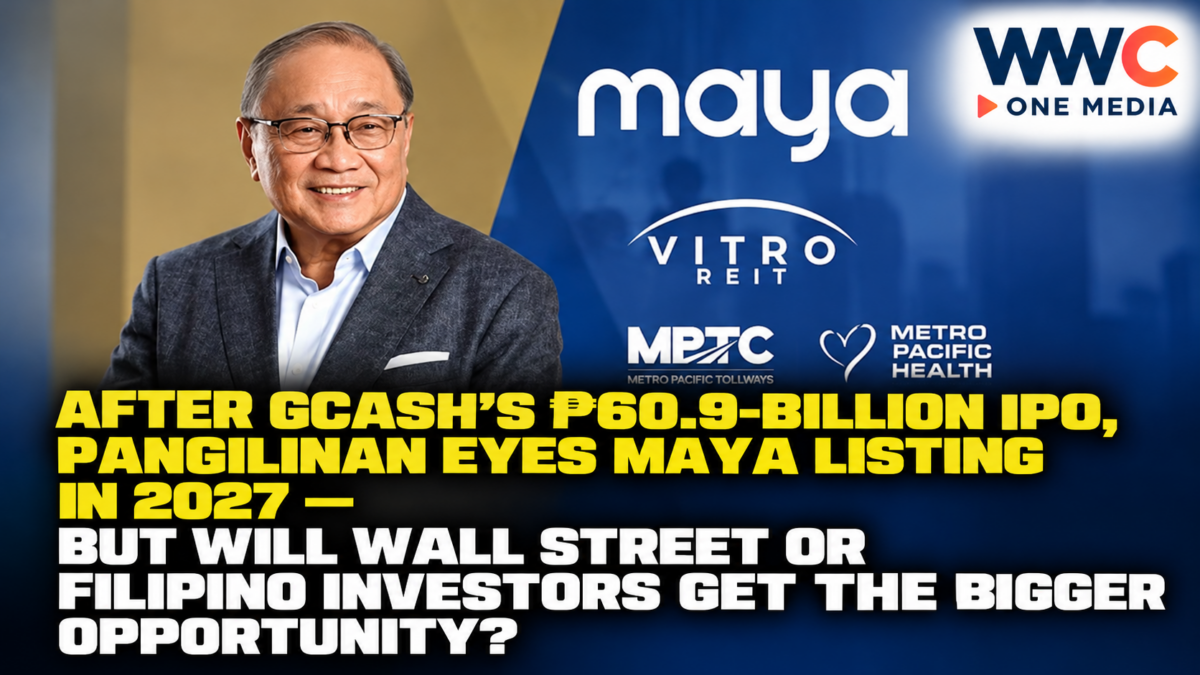
MANILA, PHILIPPINES — The Philippine financial technology industry could be heading toward another major stock market milestone as businessman Manuel V. Pangilinan targets a possible 2027 initial public offering (IPO) for Maya, following the historic ₱60.9-billion market debut of rival GCash’s parent company, Mynt.
Pangilinan, who chairs Maya, confirmed on October 28 that the company’s planned listing is unlikely to happen in 2026.
The businessman is keeping the door open to an overseas offering on the Nasdaq stock exchange but wants Philippine investors to have an opportunity to own shares in the homegrown digital financial services company.
His renewed interest follows the October 20 listing of Mynt on the Philippine Stock Exchange (PSE).
The GCash operator raised ₱60.9 billion in the largest IPO in the history of the local equities market, demonstrating the ability of a Philippine fintech business to attract substantial investor demand.
But Maya’s route to the stock market may be more complicated.
The company has several major shareholders, including interests associated with PLDT and First Pacific, as well as international investors Tencent, KKR and the International Finance Corporation.
Their agreement will be important in determining whether Maya ultimately lists in Manila, the United States or both.
Will GCash’s record-breaking debut open the door for another Philippine fintech giant—or will disagreements over where to list and uncertainty in global markets push Maya’s IPO further into the future?
MAYA IPO NOW TARGETED FOR 2027
Speaking on the sidelines of Manila Electric Company’s financial results briefing on October 28, Pangilinan said Maya’s proposed stock market debut would likely take place next year.
The comments confirm a shift away from an earlier objective of pursuing an offering during the second half of 2026.
The revised timing gives Maya and its shareholders more room to evaluate market conditions and listing arrangements.
However, a targeted year is not a confirmed transaction date.
The company has not announced an approved IPO timetable, final share price, public offer size or detailed allocation for investors.
Neither has it confirmed a final stock exchange venue.
For now, Maya’s 2027 IPO remains a proposal rather than an approved share offering.
PANGILINAN WANTS FILIPINO INVESTORS INCLUDED
One of Pangilinan’s clearest priorities is ensuring that Filipino investors have a chance to participate if Maya becomes publicly traded.
Some of the company’s foreign shareholders have shown interest in a US listing.
Pangilinan has indicated that he would not oppose a Nasdaq offering, provided there is also a Philippine listing.
His preference reflects a broader question about ownership of successful Philippine technology businesses.
Companies with international investors may have reasons to seek access to larger overseas capital markets.
But a domestic listing can allow qualified Filipino investors to purchase shares through the local exchange.
The final decision will depend on the shareholders and the practical requirements of the proposed transaction.
NASDAQ REMAINS A POSSIBLE LISTING VENUE
Nasdaq is one of the major stock exchanges in the United States.
It is widely associated with technology and growth-oriented companies.
A potential Nasdaq listing could provide Maya with access to a different pool of institutional and retail investors.
However, listing abroad also involves regulatory obligations, disclosure requirements and costs.
A dual listing or another structure involving both US and Philippine investors would need careful planning.
Pangilinan has not confirmed that Maya will pursue a simultaneous dual listing.
His remarks establish a preference for a Philippine component if shareholders proceed with a US offering.
GCASH’S ₱60.9-BILLION IPO CHANGES THE CONVERSATION
Maya’s renewed IPO discussions follow a major development in the Philippine stock market.
Mynt Inc., the parent company behind GCash, listed on the PSE on October 20, 2026.
The offering raised ₱60.9 billion, including the sale of primary and secondary shares.
The Philippine Stock Exchange described the transaction as the country’s largest maiden public offering.
Mynt’s shares were priced at ₱6.60 apiece.
The record transaction drew participation from domestic and international investors.
For other Philippine fintech companies, the successful completion of such a large offering provides an important market reference.
But it does not mean that Maya will automatically receive an equivalent valuation or investor demand.
MORE THAN 140,000 GCASH USERS BECAME IPO INVESTORS
One of the most notable aspects of Mynt’s listing was the participation of ordinary GCash users.
According to the Philippine Stock Exchange, 140,725 GCash subscribers invested approximately ₱1.1 billion through the GCash application.
Many were participating in stock ownership for the first time.
The achievement demonstrated how a digital financial platform can connect users with investment opportunities.
For Pangilinan, this experience reinforces the argument that Filipino investors should be given access to Maya’s potential public offering.
However, Maya has not announced whether it would distribute IPO shares directly through its application.
GCash’s IPO subscription mechanism should not be assumed to apply automatically to Maya.
RECORD FUNDRAISING DOES NOT GUARANTEE STRONG STOCK RETURNS
The successful completion of GCash’s IPO also requires careful interpretation.
Mynt raised a record amount of capital, but its shares closed at the ₱6.60 offer price on their first trading day.
That means the record fundraising did not translate into an immediate closing-day gain for investors.
Share prices can rise or fall after a listing depending on valuation, earnings expectations and market conditions.
The distinction matters for Maya.
An IPO can be successful as a capital-raising transaction without producing guaranteed short-term profits for shareholders.
Investors should evaluate the company’s financial position and offering price rather than assuming that a major fintech brand will necessarily deliver rising stock prices.
MAYA IS SMALLER THAN GCASH, PANGILINAN ACKNOWLEDGES
Pangilinan openly recognized that Maya operates on a different scale from Mynt.
The acknowledgment suggests that any Maya offering would need to be sized according to the company’s own business, valuation and financing requirements.
GCash has a substantial consumer payments ecosystem and a large established user base.
Maya operates an integrated digital payments, banking and merchant financial services platform.
Both compete in Philippine digital finance, but their business structures and financial profiles differ.
A comparison of their IPO valuations would require consistent data and a clear understanding of what assets and operations are included.
Maya has not announced a final valuation for its proposed 2027 offering.
WHO OWNS MAYA?
Maya’s ownership structure helps explain why the listing venue remains under discussion.
The business operates through Voyager Innovations and related financial services entities.
According to InsiderPH, the PLDT Group and Hong Kong-based First Pacific hold a combined interest of approximately 39%.
Other investors include Chinese technology company Tencent, global investment firm KKR and the International Finance Corporation.
These shareholders may have different preferences concerning capital markets, valuation and the structure of a public offering.
A decision to list must therefore reflect more than the preference of one investor or chairman.
However, the announced ownership percentage should not be treated as a complete current capitalization table.
The company has not publicly provided a final IPO ownership structure.
MAYA’S DIGITAL BANKING BUSINESS HAS BEEN PROFITABLE
While Maya’s listing plans remain uncertain, its banking business has shown encouraging operating trends.
In its August 13 financial announcement, PLDT reported that Maya remained profitable during the second quarter of 2026.
First Pacific’s interim reporting also indicated that Maya contributed approximately ₱559 million to PLDT’s core income during the first half.
These figures suggest that Maya has moved beyond a phase focused entirely on rapid expansion without profitability.
However, the ₱559-million contribution is a figure reported within PLDT’s investment-related financial results.
It should not automatically be presented as Maya’s total consolidated net income.
The company will need to provide appropriate financial statements and disclosures if it proceeds with a public offering.
MAYA DEPOSITS CLIMB 71% TO ₱86 BILLION
Maya’s banking operations have recorded strong deposit growth.
According to PLDT’s first-half 2026 disclosure, Maya’s deposit balances reached approximately ₱86 billion as of June.
That represented a 71% year-on-year increase.
Deposits are a key funding source for banking operations.
A larger deposit base can support lending and other financial activities.
However, growing deposits also create obligations to customers.
The bank must maintain adequate liquidity, capital and risk controls.
Deposit growth is therefore an important business indicator but not a stand-alone measure of profitability.
OUTSTANDING LOANS REACH ₱39 BILLION
Maya also reported approximately ₱39 billion in loans outstanding as of June 2026.
The amount was 56% higher than a year earlier.
Its reported loan-to-deposit ratio stood at approximately 45%.
The growth indicates expanding credit activity through its digital banking platform.
Lending can support revenue generation, particularly when the bank manages credit pricing and funding costs effectively.
But greater lending exposure also creates potential losses if borrowers fail to repay.
For prospective IPO investors, loan quality will be an important financial consideration.
BAD-LOAN RATIO STANDS AT 4.8%
PLDT reported that Maya’s gross nonperforming loan ratio stood at 4.8% in June 2026.
The figure is relevant because a rapidly expanding digital lender must balance growth with credit quality.
Nonperforming loans represent credit exposures that have encountered serious repayment problems under the applicable reporting definition.
A lower ratio may indicate improving loan performance, depending on the comparison period and portfolio composition.
However, the 4.8% figure is not evidence that every borrower is current on payments.
It also cannot be directly compared with another company’s credit ratio without considering different loan products, definitions and reporting structures.
MAYA COMBINES PAYMENTS, SAVINGS AND CREDIT
Maya’s business model extends beyond a standalone mobile wallet.
The platform offers payments, digital banking, savings, lending and financial services for merchants.
This creates opportunities to serve consumers and businesses through a connected ecosystem.
A merchant may use Maya for payment acceptance, while individual customers may access savings or credit products.
The approach can potentially create different sources of revenue.
However, an integrated platform also creates operational complexity.
The company must manage banking regulation, cybersecurity, customer protection and credit risk across its services.
These factors would be relevant in any future IPO prospectus.
PRODUCT INNOVATION CONTINUES BEFORE THE POSSIBLE IPO
PLDT’s August financial report highlighted several Maya product developments.
These included Maya Mini Payments, which allows eligible Maya Credit Card transactions to be converted into installment arrangements.
Maya also introduced an updated business application offering payment, banking, lending and financial management functions for merchants.
The group reported expanded merchant payment acceptance capabilities, including support for Apple Pay through its business acquiring solutions.
These initiatives indicate ongoing efforts to deepen the company’s financial services ecosystem.
However, Maya has not disclosed the incremental revenue attributable to each specific product in the source reviewed.
Their commercial importance will need to be assessed through future financial results.
MAYA’S DIGITAL BANKING PERFORMANCE MATTERS TO IPO VALUATION
If Maya proceeds with a listing, investors will likely examine several financial indicators.
These include revenue growth, profitability, customer activity, deposit trends and lending performance.
They may also consider the company’s competitive position in payments and merchant services.
A profitable digital bank may support investor interest.
But the valuation of the wider Maya business will depend on more than its banking subsidiary alone.
The company may have different business units, minority interests and capital requirements.
Until an official offering document is published, any precise IPO valuation would remain speculative.
A PHILIPPINE LISTING COULD HELP DEVELOP THE LOCAL STOCK MARKET
Pangilinan’s preference for a local listing reflects a wider capital market issue.
The Philippines has relatively few large publicly traded technology companies compared with some other markets.
A listing by Maya could broaden the range of businesses represented on the PSE.
It might also attract investors interested in digital finance.
However, additional listings do not automatically improve market performance.
The benefits depend on pricing, public share ownership, trading liquidity and the company’s financial outlook.
The successful completion of GCash’s IPO provides evidence of demand for a major fintech offering.
But Maya must still establish its own investment case.
FOREIGN INVESTORS MAY PREFER THE US MARKET
International shareholders may view a US listing as attractive because of access to global institutional investors.
They may also consider liquidity, valuation comparisons and the visibility of technology companies on Nasdaq.
However, overseas listings can involve greater costs and complex disclosure obligations.
A Philippine listing may offer advantages in reaching domestic investors who already use the company’s products.
The choice is therefore a strategic question involving investor access, regulation and economics.
Pangilinan’s remarks suggest that discussions with foreign shareholders remain important.
No final agreement has been publicly confirmed.
MAYA’S IPO WILL REQUIRE MORE THAN A PUBLIC ANNOUNCEMENT
A company planning an IPO must complete several steps before investors can purchase shares.
These typically include preparing the necessary financial disclosures, determining the transaction structure and securing regulatory approvals.
For a Philippine offering, relevant requirements involve the Securities and Exchange Commission and Philippine Stock Exchange.
A US listing would involve the applicable American securities requirements.
Advisers and underwriters may also be appointed as the transaction advances.
The company must decide how many shares to sell and at what price.
As of October 29, the reports reviewed do not establish that Maya has finalized these arrangements.
The 2027 timeline should therefore be treated as a target.
VITRO DATA CENTER IPO ALSO MOVES TOWARD 2027
Maya is not Pangilinan’s only potential listing candidate.
The businessman said that the proposed public offering of PLDT’s VITRO data center real estate investment trust could also proceed in 2027.
The transaction had previously been associated with a 2026 timetable.
However, market conditions and pricing considerations contributed to delays.
Bilyonaryo reported that Pangilinan sees the first quarter of 2027 as a possible window for VITRO REIT.
The company previously outlined a proposed offering of approximately ₱24.2 billion.
But that figure should not be described as proceeds already raised.
The VITRO transaction remains separate from Maya’s possible IPO.
DATA CENTER INVESTMENT ADDS ANOTHER TECHNOLOGY OPPORTUNITY
VITRO’s proposed offering reflects growing interest in Philippine data center infrastructure.
Data centers support cloud computing, telecommunications, enterprise technology and other digital services.
They require significant investment in buildings, cooling, electricity and network connections.
A REIT structure could provide investors with exposure to income-generating property assets associated with these facilities.
However, its investment characteristics differ from those of a digital payments and banking company.
Maya and VITRO should not be treated as interchangeable investments simply because both operate in technology-related sectors.
PANGILINAN ALSO DISCUSSES A POSSIBLE TOLLWAYS IPO
Another possible future listing involves tollway assets associated with Metro Pacific and San Miguel.
The two groups have been discussing a merger of their expressway businesses.
Pangilinan said negotiations concerning valuation were continuing, with hopes of reaching an agreement before the end of 2026.
A later IPO could become possible if the companies successfully complete the relevant corporate arrangements.
However, a tollways listing has not been finalized.
The merger negotiations remain an earlier prerequisite.
It would be misleading to describe the combined tollway company as already listed or fully merged.
METRO PACIFIC HEALTH IS ANOTHER POTENTIAL CANDIDATE
Pangilinan also raised the possibility of listing Metro Pacific’s hospital network.
However, he acknowledged that the group holds only a minority interest and that any IPO decision rests with the controlling shareholders.
This makes the potential healthcare listing different from the Maya and VITRO proposals.
A company can be an attractive listing candidate without having committed to a public offering.
The hospital network has not announced a finalized IPO timetable based on the October 28 remarks.
The possibility should therefore be treated as preliminary.
CAN THE PHILIPPINE STOCK EXCHANGE SUPPORT MORE MAJOR IPOS?
GCash’s record offering has renewed discussion about the ability of the Philippine market to attract large corporate listings.
The transaction raised ₱60.9 billion and drew considerable institutional participation.
But future offerings will depend on market conditions.
Interest rates, stock market valuations and investor sentiment can influence decisions about when companies go public.
Some companies may delay listings if market prices do not meet shareholder expectations.
The fact that Maya and VITRO have moved toward 2027 demonstrates that timing remains important.
A strong IPO market requires investor demand as well as companies willing to sell shares at acceptable valuations.
WHAT OTHER NEWS OUTLETS CONFIRM
InsiderPH reported Pangilinan’s October 28 comments, including his preference for a domestic Maya listing and his discussion of other possible IPOs.
GMA News separately confirmed that Maya’s offering is now expected in 2027 rather than 2026.
ABS-CBN News also reported his remarks following GCash’s stock market debut.
Daily Tribune documented his support for a Philippine listing despite foreign shareholder interest in Nasdaq.
Bilyonaryo provided additional details concerning VITRO REIT and other potential offerings.
The Philippine Stock Exchange’s official October 20 announcement independently verifies the completed ₱60.9-billion Mynt IPO.
Reuters confirmed Mynt’s first trading session and the company’s approximate ₱442-billion market valuation at the offer price.
For Maya’s operating performance, PLDT’s August 13 financial report verifies deposit growth, loan expansion and continued profitability during the second quarter.
The Bangko Sentral ng Pilipinas also publishes Maya Bank financial statements.
Together, these sources support the central developments.
However, none of them establishes a finalized Maya IPO price, transaction size or approved listing date.
WHAT SHOULD MAYA CUSTOMERS KNOW?
Maya’s possible IPO does not require users to close their accounts or change how they access the platform.
An IPO is a corporate transaction involving the sale of company shares.
It is not the same as a bank deposit or a customer savings product.
Maya users should not assume they automatically own shares because they hold a wallet or savings account.
If a public offering eventually takes place, investors would need to follow the official subscription arrangements and applicable requirements.
No verified public subscription process for Maya shares has been announced as of October 29.
Consumers should be cautious about unofficial advertisements promising early access to Maya IPO shares.
WHAT INVESTORS SHOULD WATCH IN 2027
The next important developments include the selection of a listing venue and any formal regulatory filings.
Investors will also want to know the proposed valuation, share price and number of shares available.
The company’s financial statements, credit quality and business growth will be relevant.
The structure of shareholder participation may also affect how much of the company becomes publicly traded.
Any final offering would need to be evaluated on its own terms.
The success of GCash’s IPO provides useful context but does not guarantee similar results for Maya.
THE BIGGER QUESTION: CAN MAYA FOLLOW GCASH’S HISTORIC DEBUT?
The possibility of a Maya IPO in 2027 represents an important moment for Philippine fintech.
GCash has already demonstrated that a large digital financial services company can attract substantial capital through the Philippine Stock Exchange.
Maya now has an opportunity to pursue its own public listing.
Its growing deposit and loan balances, continued profitability and integrated payments ecosystem provide potential talking points for prospective investors.
But major uncertainties remain.
The shareholders must agree on the transaction structure.
A decision must be made on whether to list in Manila, the United States or both.
The company must also determine a valuation acceptable to investors and complete the necessary regulatory processes.
The ultimate measure of success will not simply be whether Maya lists in 2027, but whether its offering creates sustainable value for shareholders while supporting the company’s long-term development.
And as Pangilinan prepares for what could be another major Philippine market debut, one question remains:
Will Maya follow GCash into the record books and give Filipino investors a chance to own a homegrown fintech giant—or will foreign shareholder preferences and volatile markets keep its biggest stock market ambition out of reach?










