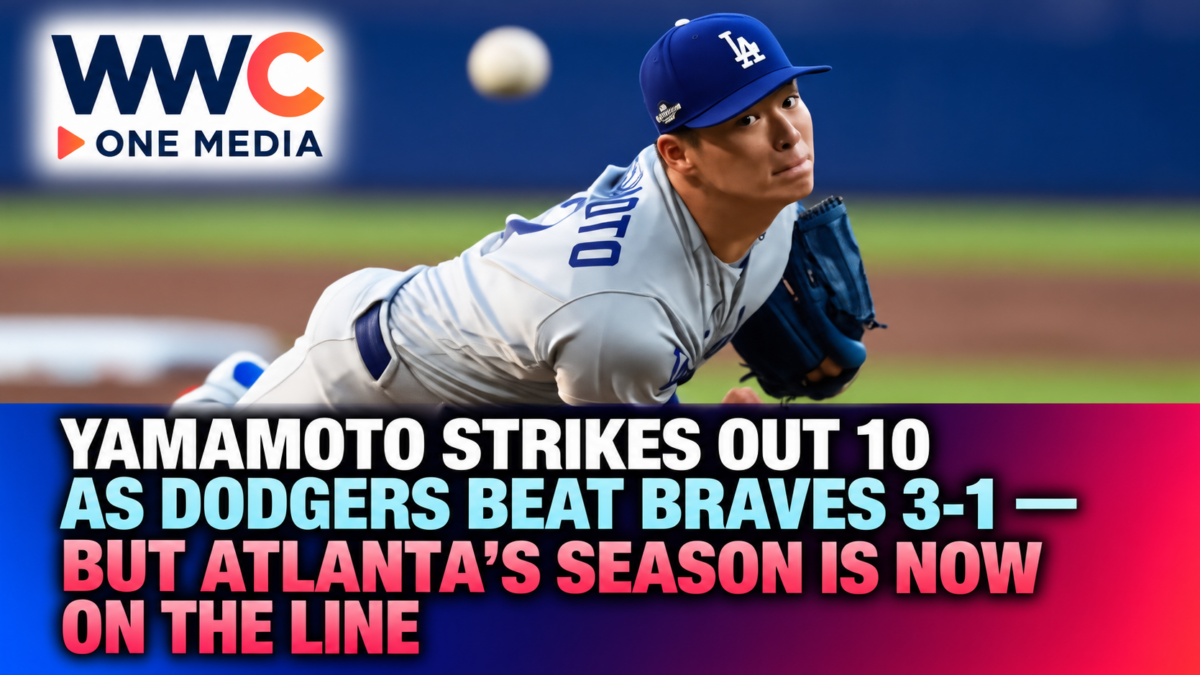
ATLANTA — Yoshinobu Yamamoto delivered another commanding October performance as the Los Angeles Dodgers defeated the Atlanta Braves 3-1 on Tuesday night, October 6, moving within one victory of the National League Championship Series.
The Japanese right-hander overwhelmed Atlanta’s lineup with 10 strikeouts over seven innings, allowing just one run on four hits and one walk.
Kiké Hernández and Freddie Freeman provided the offensive firepower, launching fourth-inning home runs against Braves ace Chris Sale to give Los Angeles a lead it never surrendered.
The victory at Truist Park put the Dodgers ahead 2-1 in their best-of-five National League Division Series (NLDS).
But the series is not over.
Atlanta still has an opportunity to force a decisive Game 5 if it can win Wednesday’s elimination game.
For the Dodgers, one more victory means a return to the National League Championship Series. For the Braves, another defeat means their World Series hopes are finished.
Yamamoto Delivers a 10-Strikeout Masterclass
Yamamoto entered Game 3 carrying enormous expectations.
The 28-year-old pitcher had already established himself as one of baseball’s most dependable postseason performers after helping Los Angeles capture the 2025 World Series championship.
He returned to the playoff stage facing one of Major League Baseball’s most accomplished pitchers, Chris Sale.
The matchup promised an intense battle between two elite starters.
Yamamoto delivered.
He dominated Atlanta through the early innings, retiring 10 of the first 11 batters he faced.
His command kept the Braves from generating consistent scoring opportunities.
By the time he completed the seventh inning, he had recorded 10 strikeouts, a personal postseason high.
It was another demonstration of why Los Angeles invested heavily in the Japanese star.
His performance also continued a remarkable trend of Japanese pitchers making a decisive impact in Major League Baseball’s postseason.
Kiké Hernández Delivers the First Blow
For three innings, the game remained scoreless.
The Dodgers created opportunities against Sale but struggled to turn baserunners into runs.
That changed in the fourth inning.
With Andy Pages aboard, Kiké Hernández connected on a pitch from Sale and launched a 406-foot, two-run home run into the left-field stands.
The blast broke the deadlock and gave Los Angeles a 2-0 advantage.
It was Hernández’s 17th career postseason home run.
The veteran utility player has built a reputation for producing important hits during October baseball.
Against Atlanta, he delivered another.
His home run changed the momentum of the game and forced the Braves to chase a Dodgers team backed by an exceptional starting pitcher.
Freddie Freeman Haunts His Former Team
The Dodgers were not finished.
Two batters after Hernández’s home run, Freddie Freeman added a solo shot to right-center field, extending the lead to 3-0.
The moment carried added significance.
Freeman spent the first 12 seasons of his Major League career with Atlanta, helping the Braves win the 2021 World Series.
Now wearing a Dodgers uniform, he returned to Atlanta and delivered another crucial postseason hit—this time against his former team.
Earlier in the game, Freeman had nearly homered, only to watch Braves left fielder Mauricio Dubón make a spectacular catch at the wall.
His fourth-inning drive left no such opportunity.
The home run was Freeman’s 18th in postseason competition, moving him into a tie for 10th place on Major League Baseball’s all-time playoff home run list.
For Atlanta fans, it was a painful reminder of the impact their former franchise cornerstone can still make.
Chris Sale Struggles Against Dodgers’ Power
Sale entered Game 3 as Atlanta’s best opportunity to regain control of the series.
The veteran left-hander had enjoyed an outstanding regular season and previously shut down the Dodgers in a late-August matchup.
But Los Angeles found a way to break through.
Sale worked five innings, allowing three runs on seven hits while striking out seven batters.
His performance was not without strong moments.
He escaped several early scoring threats and benefited from Dubón’s outstanding defensive play.
But the two fourth-inning home runs proved decisive.
The Dodgers punished a pair of pitches, and Yamamoto ensured those runs would be enough.
For Atlanta, the defeat means its most anticipated pitching matchup of the series ended in disappointment.
Braves Waste Their Biggest Opportunity
Atlanta had a chance to change the game’s direction in the fifth inning.
Trailing 3-0, the Braves loaded the bases with one out.
The situation brought the top of their batting order into position to deliver a potentially game-changing hit.
But Yamamoto refused to surrender control.
Drake Baldwin drove in Atlanta’s only run with a groundout to first base.
Yamamoto then induced Ronald Acuña Jr. to ground out to second, ending the inning and limiting the damage.
The Braves never mounted another sustained offensive threat.
Atlanta finished the game with five hits and two walks.
More importantly, the team went 0-for-6 with runners in scoring position.
The inability to convert scoring opportunities became one of the decisive factors in the loss.
In playoff baseball, those missed chances can determine an entire season.
Dodgers Bullpen Finishes the Job
After seven outstanding innings from Yamamoto, Los Angeles manager Dave Roberts turned to his bullpen.
Tanner Scott pitched a scoreless eighth inning.
Edwin Díaz then entered for the ninth, attempting to protect the two-run advantage.
The Braves immediately created some tension.
Ozzie Albies opened the inning with a double, giving Atlanta a potential rallying opportunity.
But Díaz recovered.
He retired the next three batters to secure the save and preserve the 3-1 victory.
The combination of Yamamoto, Scott and Díaz held Atlanta to one run across nine innings.
For a team seeking another championship, that level of pitching performance is exactly what October baseball demands.
Dodgers’ Home Run Dependence Creates a Bigger Concern
Although Los Angeles won, its offensive performance revealed an important weakness.
According to MLB.com, all 10 Dodgers runs through their first three postseason games had come via home runs.
That marked the longest such streak to begin a postseason in Major League Baseball history.
The statistic demonstrates the strength of the Dodgers’ lineup.
With players such as Freeman, Hernández, Shohei Ohtani and Mookie Betts, Los Angeles possesses substantial home-run potential.
But relying almost entirely on long balls can become dangerous.
Postseason pitchers are capable of limiting home runs, particularly when facing the same hitters repeatedly.
Teams that manufacture runs through timely singles, doubles, walks and aggressive baserunning may have more ways to score when the home runs stop coming.
Against Sale, the Dodgers again struggled to capitalize on several opportunities before their fourth-inning power surge.
The victory was convincing because of Yamamoto’s pitching.
But the offensive question remains.
Can Los Angeles continue winning if its opponents prevent the home-run barrage?
Shohei Ohtani Still Searching for His Offensive Rhythm
Another storyline involves Japanese superstar Shohei Ohtani.
Although Yamamoto dominated on the mound, Ohtani continued searching for consistency at the plate.
Roberts moved Ohtani into the fifth position in the batting order for Game 3 against Sale.
It was an unusual assignment for one of baseball’s most dangerous hitters.
The decision reflected the manager’s attempt to adjust the lineup against Atlanta’s left-handed ace.
Ohtani did not provide the decisive offensive contribution.
Instead, the Dodgers relied on Hernández and Freeman.
That could become an important development as the postseason continues.
Los Angeles has enough offensive talent to win without a dominant performance from Ohtani every night.
But a productive Ohtani would make the lineup significantly more dangerous.
For opposing teams, the possibility of his offensive breakthrough remains a major concern.
Yamamoto Continues His World Series MVP Form
Tuesday’s performance reinforced Yamamoto’s growing reputation as a big-game pitcher.
He entered the 2026 postseason after an excellent regular season in which he recorded a 2.53 earned run average and 182 strikeouts across 185 innings.
Those numbers placed him among the Dodgers’ most dependable starting pitchers.
His postseason reputation is even more impressive.
During Los Angeles’ 2025 World Series championship run, Yamamoto played a central role and earned World Series Most Valuable Player honors.
His ability to perform under pressure has become one of the Dodgers’ biggest advantages.
Against Atlanta, he demonstrated that his effectiveness was not limited to one championship run.
He remains capable of dominating some of Major League Baseball’s strongest lineups when the stakes are highest.
A Historic Three-Peat Is Within Reach
The Dodgers are pursuing a rare achievement.
After winning the World Series in 2024 and 2025, Los Angeles is attempting to become the first National League franchise to win three consecutive World Series championships.
Only a small number of Major League Baseball teams have achieved three straight titles.
The New York Yankees famously completed multiple championship streaks, including their three consecutive World Series victories from 1998 through 2000.
For Los Angeles, another championship would place the current team among baseball’s most successful modern dynasties.
But the Dodgers still have considerable work ahead.
They must first eliminate Atlanta.
Then they would need to win the National League Championship Series before reaching another World Series.
Tuesday’s victory was an important step.
It was not the completion of that journey.
Atlanta Still Has a Chance to Fight Back
Despite falling behind 2-1, the Braves remain alive.
They have already demonstrated their ability to challenge the Dodgers.
Atlanta won Game 2 in Los Angeles to even the series and take home-field advantage into the remaining games.
But Tuesday’s defeat has eliminated their margin for error.
The Braves must win Game 4 to force a fifth and deciding game.
Their hitters will need to perform better with runners in scoring position.
They will also need to find a way to contain the Dodgers’ power hitters.
Atlanta’s pitching has kept the series competitive.
Its offense now faces the greatest pressure.
Game 4 Could Decide the Series
Game 4 is scheduled for Wednesday, October 7, at Truist Park in Atlanta.
First pitch is set for 6 p.m. Eastern Time, equivalent to 6 a.m. Thursday, October 8, in the Philippines.
The Dodgers are expected to start Tyler Glasnow, while the Braves are preparing to counter with Tyler Mahle.
For Los Angeles, victory would secure a place in the National League Championship Series.
For Atlanta, only a win will keep its championship hopes alive.
The matchup will test whether the Braves can respond after being overpowered by Yamamoto.
It will also reveal whether the Dodgers can generate offense more consistently.
If Atlanta forces Game 5, the pressure would shift back to Los Angeles.
But with a 2-1 series advantage, the defending champions control their immediate postseason destiny.
Yamamoto Has Put the Dodgers One Win From Glory
The Dodgers entered Game 3 needing a response after losing their previous playoff matchup.
They received exactly what they needed.
Yamamoto delivered seven exceptional innings.
Hernández provided the breakthrough home run.
Freeman punished his former team.
And the bullpen finished the job.
The result was a 3-1 victory that gave Los Angeles control of the NLDS.
But the series remains unfinished.
Atlanta has one more opportunity to prevent the Dodgers from advancing.
And Los Angeles still faces questions about an offense increasingly dependent on home runs.
Yoshinobu Yamamoto has put the Dodgers one victory away from the National League Championship Series with a brilliant 10-strikeout performance.
But the bigger question is whether the defending champions can finish off a desperate Atlanta Braves team—or whether one final postseason fight will force this heavyweight matchup into a decisive Game 5.