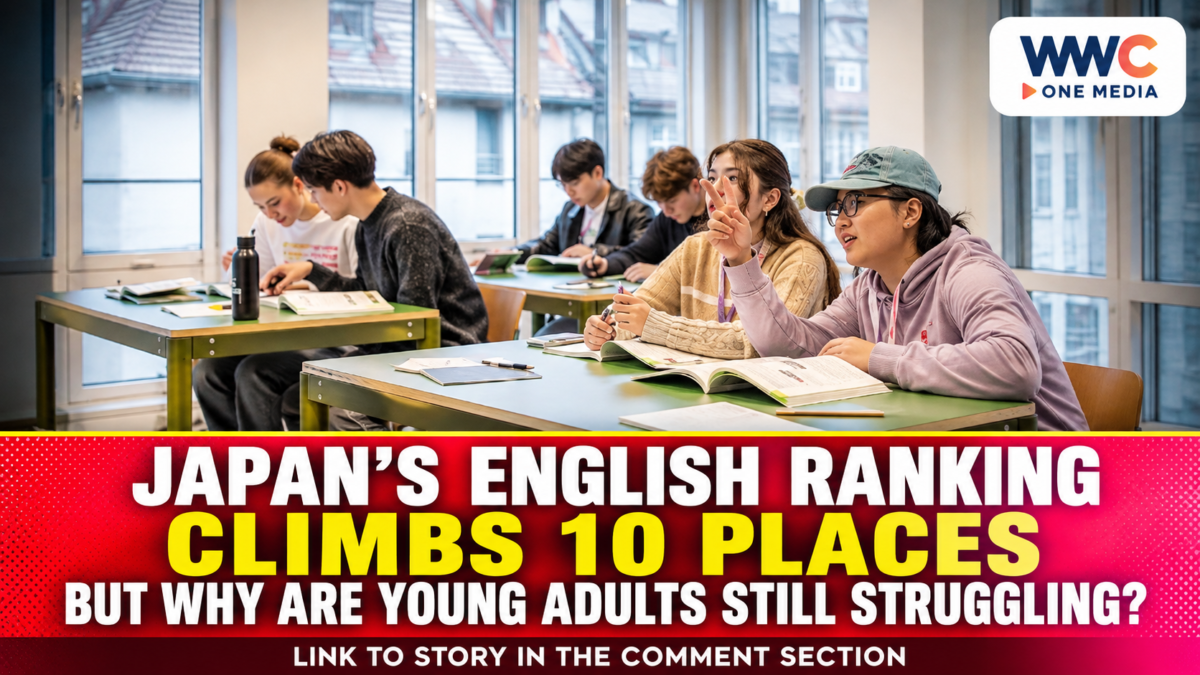
Japan has improved its position in the 2026 EF English Proficiency Index, rising 10 places to 86th among 117 countries and regions. But the country’s overall score of 450 remains 35 points below the global average of 485, and the results reveal a persistent gap between understanding written English and using the language to communicate. EF+3
The findings present a mixed picture for Japan. Its score increased by four points from the previous edition, while speaking and writing also improved. Yet reading remains the country’s strongest measured skill, and writing is its weakest.
The results matter because English is increasingly relevant to international business, education, research and cross-border communication. Japan’s improvement suggests some progress, but the figures raise a more difficult question: can better test performance translate into stronger practical communication?
Japan’s English ranking improves, but the global gap remains
Japan received an EF English Proficiency Index score of 450 in the 2026 edition, compared with 446 in 2025. Its position improved from 96th to 86th, moving it out of the index’s lowest proficiency category and into the low-proficiency band. イー・エフ・エデュケーション・ファースト・ジャパン株式会社のプレスリリース+2
However, the country’s position remains well below several Asian economies.
The Philippines ranked 25th with a score of 565, while Malaysia placed 23rd with 574. South Korea ranked 50th at 515, and China stood at 75th with 466. Japan’s score was therefore 115 points below the Philippines and 65 points below South Korea in this particular index. EF Education First
These comparisons provide regional context, but they should not be treated as a direct measurement of every citizen’s ability. The index measures results from people who took EF’s online English test, not a compulsory national examination administered to representative samples of entire populations.
Reading leads, while writing remains Japan’s weakest skill
The most revealing part of Japan’s results is the difference between its four English skills.
The country’s scores were:
- Reading: 475
- Listening: 434
- Speaking: 425
- Writing: 416
Reading led writing by 59 points and speaking by 50 points. The results indicate that participants performed better on tasks involving written comprehension than on the productive skills required to express ideas. EF Global Site (English)+1
This distinction matters in everyday situations.
A person may understand an English email, follow written instructions or read a business document but still find it difficult to explain an opinion during a meeting, negotiate an agreement or prepare a detailed written response.
The index does not prove that every Japanese worker or student experiences these difficulties. It does, however, identify a clear difference in the measured performance of the four skills.
For employers, the distinction is relevant when assessing the communication demands of international roles. Reading ability is useful, but jobs involving presentations, customer relations, negotiations and overseas partnerships also require people to speak and write effectively.
Younger Japanese adults record the weakest age-group result
The age breakdown also raises questions about the development of English skills among younger people.
EF Japan’s announcement identified respondents aged 18 to 20 as the lowest-scoring age group in the country’s results. The 31-to-40 age group recorded the highest score, at 488. イー・エフ・エデュケーション・ファースト・ジャパン株式会社のプレスリリース
That finding deserves attention because younger adults are entering universities, training programmes and workplaces where international communication may be increasingly important.
However, the index cannot establish that Japan’s entire younger generation has weaker English skills than older generations. The results reflect the people who participated in the online assessment, and the test-taking population is not a random sample of all Japanese residents.
EF’s methodology specifically acknowledges that participants tend to be younger adults and people already interested in learning English. The organisation also states that people without internet access are excluded from the testing population. EF Global Site (English)
The age result should therefore be treated as a warning signal worth investigating, rather than a definitive national diagnosis of the education system.
The global decline makes Japan’s improvement more complicated
Japan’s four-point increase came against a wider international trend.
EF’s 2026 report found that global average English proficiency declined for the fifth consecutive year. More than two-thirds of countries with comparable year-on-year results recorded lower scores. EF+1
The report also identified a worldwide imbalance between reading and speaking. Across the 115 countries and regions with available skill-level data, reading was the strongest skill in about four out of five. The global average speaking score was 464, trailing reading by 57 points. EF+1
Japan’s results fit that broader pattern, although its weakest skill is writing rather than speaking.
The distinction suggests that improving English proficiency requires more than teaching learners to recognise vocabulary and understand written passages. Communication also involves listening carefully, organising ideas, responding to other people and expressing information clearly.
For a country seeking to strengthen its international business and research connections, these abilities can be as important as reading comprehension.
What the results mean for Japan’s education and workforce
The findings put renewed attention on how English is taught and assessed.
Japan has been considering wider changes to its education system, including proposed routes for recruiting and training teachers. WWC previously examined Japan’s proposed changes to teacher licensing and training, which could broaden the pool of people entering the profession.
The EF results do not establish that teacher shortages caused the country’s English proficiency gap. Nor do they prove that any particular teaching method is responsible. They do, however, provide a reason to examine whether students receive enough opportunities to practise speaking and writing in realistic situations.
Japan’s wider education performance also needs to be considered carefully. Its strong results in international assessments of mathematics, science and reading do not automatically translate into high English proficiency, because these assessments measure different subjects and capabilities. WWC’s report on Japan’s performance in the OECD’s PISA assessment examined that distinction.
There is also a broader regional lesson. Language proficiency is not simply a matter of grammar or examination scores; it involves adapting communication to different audiences and settings. The debate over Singapore’s use of Singlish alongside standard English illustrates how language skills and cultural identity can coexist in a multilingual society.
For Japan, the practical challenge is to help learners use English confidently without treating the ability to communicate as a substitute for their own language and culture.
What happens next?
EF’s 2026 index provides a benchmark, not a government policy announcement or a formal evaluation of Japan’s national curriculum.
The next question is whether Japan’s improvement can continue and whether future results will show progress across all four skills rather than mainly in its overall score.
Schools, universities and employers may find the skill breakdown more useful than the ranking alone. A stronger reading score can support learning and professional work, but speaking, listening and writing are essential when communication requires active participation.
The methodology also matters when interpreting future changes. EF says its national scores use a three-year rolling average, combining the latest test results with the two previous published index scores. This means the national score is designed to smooth annual fluctuations rather than represent only one year’s test performance. EF Global Site (English)
Japan has moved up the ranking, but the larger test is whether learners can turn that improvement into practical communication.
The ranking has improved. The gap between understanding English and using it effectively remains Japan’s central challenge.