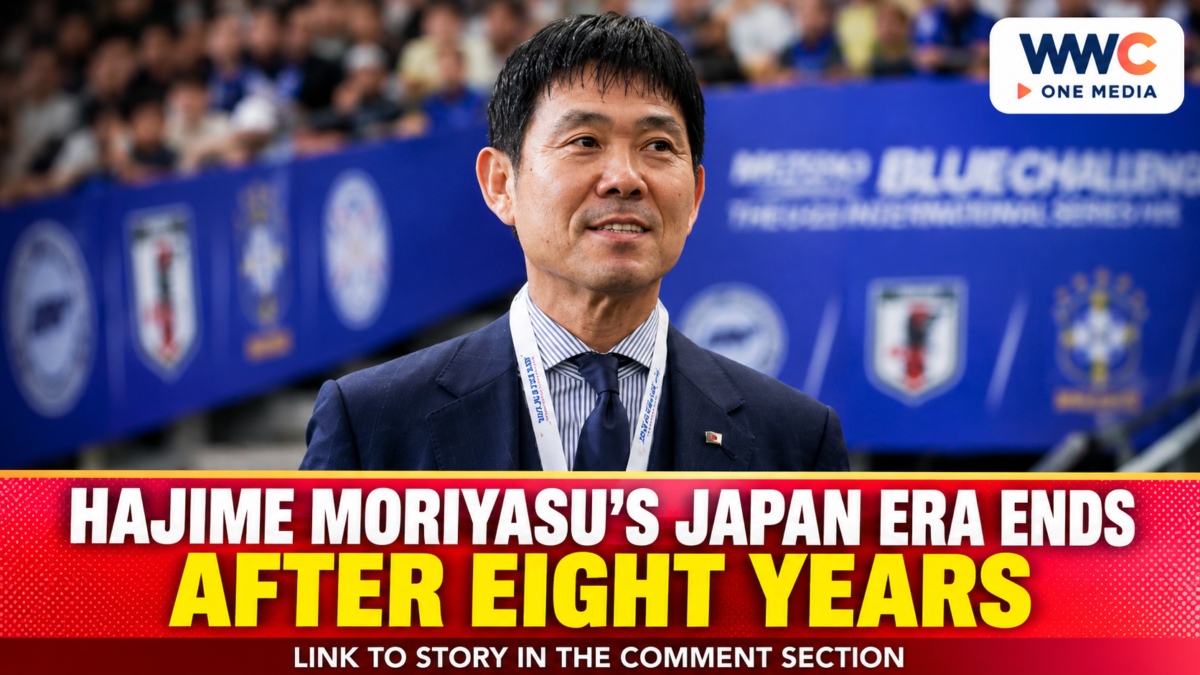
Hajime Moriyasu’s tenure as head coach of Japan’s men’s national football team ended on Nov. 17, 2026, after a 2-1 defeat to Paraguay in Singapore. The Japan Football Association (JFA) confirmed that the match was his final game in charge, closing an eight-year period that included major victories against established football powers but also tournament exits that left Japan short of its biggest ambitions. JFA|公益財団法人日本サッカー協会+1
Moriyasu’s departure closes a coaching chapter that produced some of Japan’s most memorable international results, but it also leaves a clear question for the next manager: how can the national team turn its ability to challenge elite opponents into deeper progress at the World Cup?
Eight years at the helm
Moriyasu took charge of Japan in September 2018. His tenure covered two World Cups, multiple continental competitions and a period in which Japan increasingly tested itself against leading national teams.
The JFA’s own retrospective described his eight years in charge as a period focused on the growth and success of the national team. It also highlighted his emphasis on respect within football and the importance of recognising the work of those who came before him. JFA|公益財団法人日本サッカー協会+1
His record cannot be reduced to one tournament result. Japan achieved significant victories under his leadership, but the team also experienced defeats that exposed the distance between competing with the world’s best and consistently progressing against them.
The victories that changed expectations
Japan’s 2022 World Cup campaign demonstrated the team’s ability to compete against highly regarded opposition.
The JFA’s official match records show Japan defeated Germany 2-1 on Nov. 23, 2022, and Spain by the same score on Dec. 1. Japan also defeated Germany 4-1 in a September 2023 friendly and Turkey 4-2 three days later. JFA|公益財団法人日本サッカー協会+1
These results helped establish Japan as a team capable of producing major performances against opponents with considerable international pedigree.
But individual victories do not automatically translate into tournament success. The challenge is maintaining that level across several matches, particularly when opponents adapt and the margin for error becomes smaller.
The World Cup hurdle remained
Japan’s 2026 World Cup campaign offered another example of both its potential and its unfinished business.
The team finished second in Group F after drawing 2-2 with the Netherlands, defeating Tunisia 4-0 and drawing 1-1 with Sweden. Those results secured a place in the Round of 32. JFA|公益財団法人日本サッカー協会+1
Japan then faced Brazil in Houston on June 29. Kaishu Sano gave Japan the lead in the 29th minute, but goals from Casemiro and Gabriel Martinelli turned the match around. Brazil won 2-1, ending Japan’s campaign in the first knockout round. JFA+1
That result placed another limitation on the team’s World Cup progress. Japan had advanced beyond the group stage, but it again failed to reach the last 16.
The difference between a promising group campaign and a deeper knockout run remains one of the major challenges facing the national programme.
His final matches brought contrasting results
Moriyasu’s final international assignment included two matches in Singapore against South American opposition.
On Nov. 14, Japan defeated Brazil 3-2, recording a comeback victory after previously losing to the same opponent at the World Cup. The JFA match report highlighted the team’s aggressive pressing and contributions from players introduced during the game. JFA|公益財団法人日本サッカー協会
Three days later, Japan lost 2-1 to Paraguay. The JFA reported that both Paraguayan goals came from set pieces, an outcome that Moriyasu said the team needed to learn from.
The contrast was striking: Japan had just beaten Brazil, but could not finish its final match under Moriyasu with a victory.
The coach acknowledged that the team had failed to achieve its objective of improving its overall level and squad depth while winning the match. He urged players to take lessons from the defeat and continue developing at their clubs. JFA|公益財団法人日本サッカー協会+1
The standards he leaves behind
Moriyasu’s departure does not erase the progress made during his tenure. Japan demonstrated that it could defeat major football nations, develop a competitive squad and enter international tournaments with ambitions beyond simply qualifying.
At the same time, the World Cup record shows why those achievements are not the end of the country’s ambitions.
Japan’s 2022 campaign ended in a penalty shootout defeat to Croatia in the Round of 16. Four years later, the team again reached the first knockout stage but lost to Brazil. JFA|公益財団法人日本サッカー協会+1
The next coaching era will inherit players who have experienced major international competitions and victories against top-ranked opposition. It will also inherit the need to improve defensive organisation, set-piece execution and consistency in decisive matches.
These are performance questions that cannot be answered by a change of coach alone. The JFA, coaching staff and players will all have roles in determining whether Japan can move beyond its previous World Cup limits.
What happens next
The JFA has identified Go Oiwa as the successor in its July 2026 announcement, stating that he would take charge of the senior national team after the AFC Asian Cup Saudi Arabia 2027. That announcement also said Moriyasu would remain in charge until the tournament’s conclusion, making his departure after the Paraguay match an earlier end to the originally announced arrangement. JFA|公益財団法人日本サッカー協会+1
The next stage will be about continuity as much as change. Japan must preserve the strengths developed under Moriyasu while addressing the shortcomings exposed by its recent tournament campaigns.
For Moriyasu, the final message was not a claim that Japan had reached its ultimate goal. He expressed hope that the players and staff who follow him would aim higher and eventually take Japan to a World Cup final.
That ambition remains the measure against which his successor will be judged.
The legacy: Moriyasu leaves Japan with landmark victories and a stronger belief that it can compete with the world’s leading teams. But the country’s pursuit of a first World Cup semi-final — and ultimately a place in the final — remains unfinished. JFA|公益財団法人日本サッカー協会+1