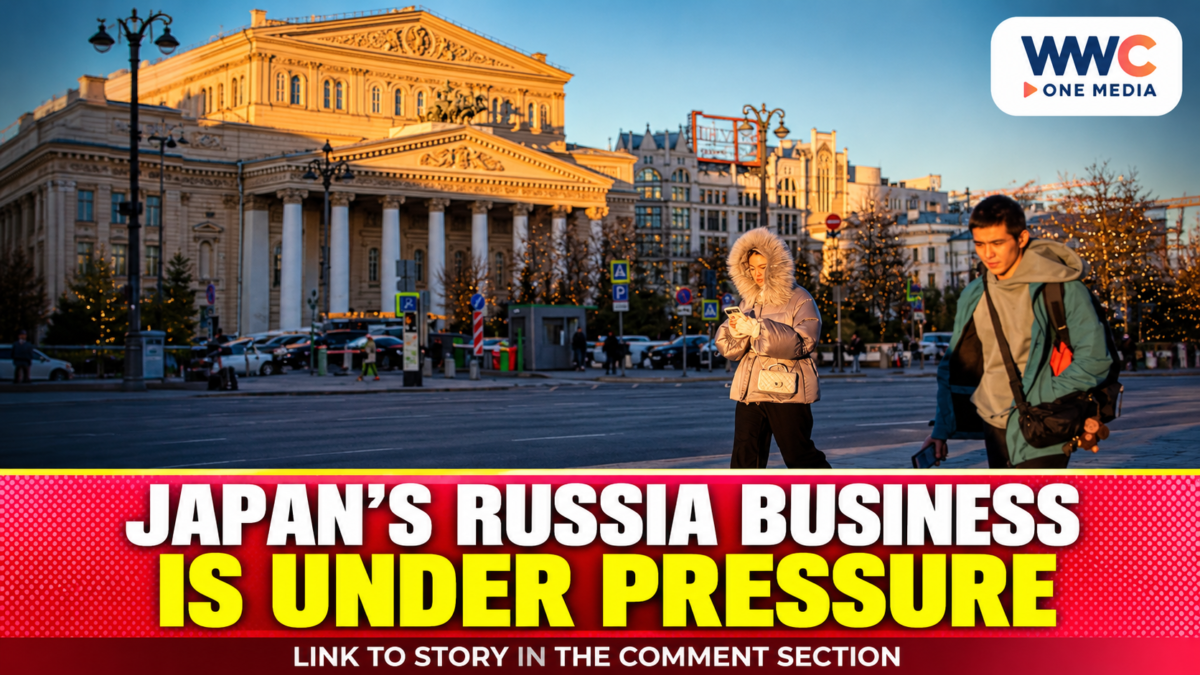
Japanese companies with operations in Russia face a difficult business calculation as government restrictions, sanctions and uncertainty over corporate control complicate decisions about whether to remain or leave. The challenge became especially clear on Nov. 9, 2026, when Japan Tobacco Inc. disclosed that all seven of its Russian subsidiaries had been placed under temporary administration while their operations continued.
The disclosure highlights a problem extending beyond one company: leaving a market can carry substantial financial consequences, but staying does not necessarily guarantee that a business can retain control over its assets and operations.
For Japanese companies, the question is no longer simply whether Russia remains commercially attractive. It is whether they can continue operating, protect their investments and comply with international sanctions in an increasingly complicated environment.
Japan Tobacco’s Russian operations face a major change
Japan Tobacco’s Nov. 9 disclosure said four Russian manufacturing companies had already been placed under temporary administration under a Russian presidential decree dated Nov. 5. Three additional subsidiaries became subject to the measure under another decree dated Nov. 6.
The company identified the affected entities as Petro LLC, JTI Donskoy Tabak LLC, JTI Yelets LLC and Cres Neva LLC under the Nov. 5 decree. The Nov. 6 decree covered JTI Russia LLC, JTI Innovative Products LLC and one dormant company.
The company said all its Russian local subsidiaries were consequently under temporary administration, although business operations were continuing at the time of the disclosure. JTウェブサイト
The financial exposure helps explain why the development matters.
In its revised full-year outlook disclosed with its third-quarter 2026 results, Japan Tobacco estimated that Russia would account for approximately 10% of consolidated revenue and approximately 25% of adjusted operating profit.
As of the end of September 2026, the company’s estimated Russian-related assets on its consolidated balance sheet, including goodwill, stood at approximately ¥1.5 trillion. Cash and deposits accounted for approximately ¥360 billion, while liabilities were approximately ¥200 billion.
These were estimates, not final valuations of what the company might lose. Japan Tobacco said it was still examining how temporary administration could affect its business performance. JTウェブサイト
The possibility of leaving was already being considered
Japan Tobacco’s earlier disclosures show that the company had been examining different ways to manage its Russian business before the latest development.
Its semi-annual securities report for the six months ended June 30, 2026, said the group continued operating in Russia while complying with applicable sanctions and regulations.
It also disclosed that the company was considering different options, including the potential transfer of ownership of its Russian tobacco business. At that time, Japan Tobacco said it could not reasonably estimate the future outlook or the effect on its financial results. JTウェブサイト
The November developments add another complication to that decision.
A company considering a transfer or sale must assess not only the value of its operations but also the conditions under which a transaction could take place. Temporary administration introduces uncertainty over how the Russian subsidiaries will be managed and how the situation could affect future corporate decisions.
Japan Tobacco has not announced a completed sale or a final decision to abandon the Russian market. Its latest disclosure says it is continuing to gather information and examine possible responses.
Other Japanese companies have taken different routes
Japan Tobacco’s position should not be treated as representative of every Japanese business in Russia. Corporate disclosures show that companies have made different decisions depending on their industries, operations and circumstances.
Toyota Motor Corporation announced in September 2022 that it would end vehicle production at its Saint Petersburg plant. Manufacturing had been suspended on March 4 that year because of interruptions in the supply of essential materials and parts.
Toyota said it had been unable to resume normal operations after six months and saw no indication that production could restart. It also said its Moscow operations would be restructured to continue supporting the retail network and existing Toyota and Lexus customers in Russia. Toyota Motor Corporation Official Global Website
Fast Retailing, the parent company of UNIQLO, took another approach. In a May 2023 statement, it said its Russian operations had remained temporarily suspended since March 2022. The company added that some stores had been closed because there was no foreseeable prospect of resuming operations. FAST RETAILING CO., LTD.
These examples illustrate an important distinction: suspending business, ending production and transferring ownership are not identical decisions.
Some companies may retain limited activities or customer support while stopping major operations. Others may continue running local subsidiaries while reviewing whether their ownership structure can be changed.
The wider issue of Japanese companies reassessing overseas exposure is also relevant to the discussion of Japanese businesses reducing their presence in China. The markets and political circumstances are different, but both cases demonstrate why international expansion can create difficult choices when business conditions change.
Tokyo faces a balancing act between sanctions and business protection
Japan’s government has two responsibilities that can be difficult to reconcile: maintaining its policy response to Russia’s invasion of Ukraine while seeking to protect Japanese companies that still have assets and operations in Russia.
The Ministry of Foreign Affairs announced additional measures on Oct. 2, 2026, under Japan’s Foreign Exchange and Foreign Trade Act. These included asset-freeze measures covering 33 Russian entities and nine individuals, restrictions on certain payments and capital transactions, and additional export prohibitions. Ministry of Foreign Affairs of Japan
Japan’s position has also been expressed through its diplomatic support for Ukraine. Prime Minister Sanae Takaichi reaffirmed in a Sept. 22 meeting with Ukrainian President Volodymyr Zelenskyy that Japan would continue supporting Ukraine and imposing sanctions against Russia in coordination with the international community.
For Japanese businesses, this creates a complicated operating environment. Companies must consider the rules imposed by Japan and its partners while also dealing with the legal and commercial conditions governing their activities inside Russia.
Tokyo’s efforts to protect existing corporate assets do not necessarily mean that Japan is preparing to restore broad economic cooperation with Moscow.
The distinction matters. Protecting investments already in place is different from encouraging new projects or relaxing sanctions.
Japan’s energy-security priorities provide another example of how international business interests can intersect with foreign policy. Its cooperation with the Philippines on petroleum reserves, discussed in WWC’s coverage of the Japan-Philippines oil stockpiling initiative, shows the importance Tokyo places on supply resilience and regional partnerships. That cooperation, however, is separate from the issue of Japanese corporate assets in Russia.
Why the situation matters beyond Japan Tobacco
Japan Tobacco’s figures show that the Russian market remains financially significant to the company despite the difficulties surrounding its operations.
When a foreign subsidiary continues operating under temporary administration, the parent company may face uncertainty over management decisions, future investment and the practical control of its business. The full financial consequences cannot be determined simply by looking at the value of assets recorded on a balance sheet.
For other Japanese companies, the case is a reminder that an overseas investment can become difficult to manage when political decisions affect the conditions under which a business operates.
The consequences may extend beyond shareholders. Employees, suppliers, distributors and customers can also be affected when a company changes production, suspends operations or loses flexibility over its local business structure.
Japan’s approach to Ukraine and Russia remains an important part of that commercial calculation. WWC has previously examined Tokyo’s commitment to continued support for Ukraine and sanctions against Russia, a policy that continues to shape the environment in which Japanese companies make decisions.
What happens next
Japan Tobacco said it would continue monitoring conditions in Russia, gathering information and examining the options available to the group. It also said it would disclose developments when matters requiring public disclosure arise.
The immediate question is whether temporary administration will materially affect the company’s ability to operate its Russian subsidiaries and what consequences may emerge for its financial results.
For the Japanese government, protecting the legitimate interests of companies already operating in Russia remains a diplomatic and economic concern. But that objective must be pursued alongside Japan’s sanctions policy and its coordination with international partners.
For now, the situation does not establish that all Japanese businesses will leave Russia or that every company remaining there faces the same restrictions.
Japan Tobacco’s experience nevertheless demonstrates the difficult choices facing companies with significant investments in a market where political decisions can change the conditions of business.
The next disclosures from the company may reveal whether it can maintain its Russian operations under the new arrangement, pursue a change in ownership or consider another course. Until then, the value of its Russian business and the longer-term impact on its earnings remain uncertain.