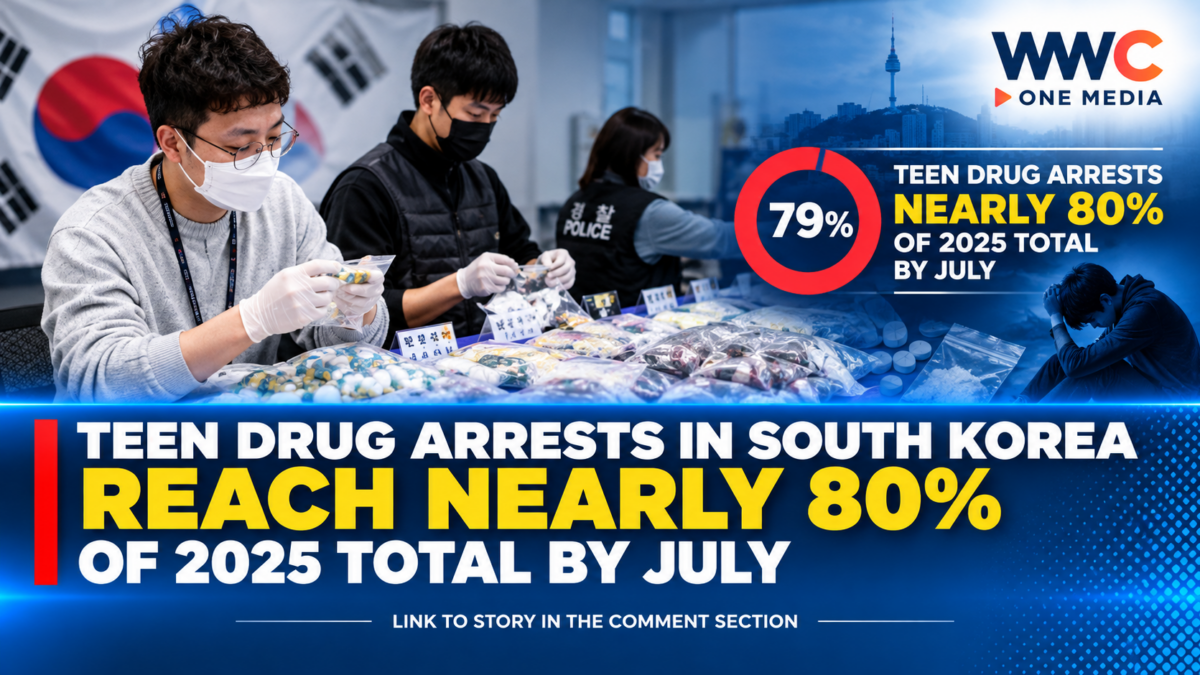
South Korea is reporting a sharp rise in teenage drug-related arrests, with police recording 370 arrests among people in their teens during the first seven months of 2026.
The figure already represents 78.7% of the 470 teenagers arrested during the entire year of 2025, according to data submitted by the National Police Agency to lawmaker Kim Jun-hyuk of the National Assembly Education Committee.
The numbers have renewed attention on prevention and early intervention as authorities confront drug-related offenses involving younger age groups.
Teen Arrests Have Fluctuated Dramatically
The latest figures show that teenage drug arrests have changed significantly over the past several years.
Police recorded 309 teenage arrests in 2021 and 294 in 2022. That number jumped to 1,066 in 2023, before falling to 442 in 2024 and rising again to 470 in 2025.
The 2026 figure is therefore not simply a continuation of the 2023 peak, but the pace recorded during the first seven months has raised concern because it has already approached last year’s full-year total.
Students Account for Hundreds of Cases
The data also show that students make up a significant portion of those arrested.
Police recorded 295 student drug-related arrests through July 2026, equivalent to 63% of the 468 students arrested during all of 2025.
Student arrests increased from 346 in 2021 to 380 in 2022 and then surged to 988 in 2023. The number subsequently declined to 368 in 2024 before increasing to 468 in 2025.
Authorities caution that age-based and occupation-based statistics use different classification standards, meaning the teenage and student figures should not simply be added together.
Broader Drug Enforcement Remains a Major Focus
The teenage figures come as South Korean authorities continue expanding efforts against drug-related crime.
Government data show that police arrested 6,648 people during a six-month intensive crackdown from August 2025 through January 2026, including cases involving online distribution, medical drugs and entertainment venues. Young people in their teens through 30s accounted for 67.4% of arrests in online drug-related cases during that operation.
South Korea’s National Forensic Service has also reported growing concern about new types of drug misuse among teenagers. Its 2025 drug analysis report identified an increase in synthetic-cannabis misuse among adolescents and highlighted the need for stronger prevention measures.
Calls Grow for Prevention and Treatment
Kim Jun-hyuk said government agencies, education authorities and police should work together to strengthen enforcement while expanding targeted prevention education and treatment and rehabilitation support for young people involved in drug-related offenses.
The latest numbers do not establish how many teenage arrests will be recorded for the whole of 2026. However, with seven months already accounting for nearly four-fifths of last year’s total, the figures are likely to keep attention focused on how schools, families and government agencies respond to the issue.
For South Korea, the warning in the latest data is not simply the number of arrests—it is how quickly the teenage figure has approached an entire year’s total before 2026 has even ended.
WWC ONE MEDIA G,A