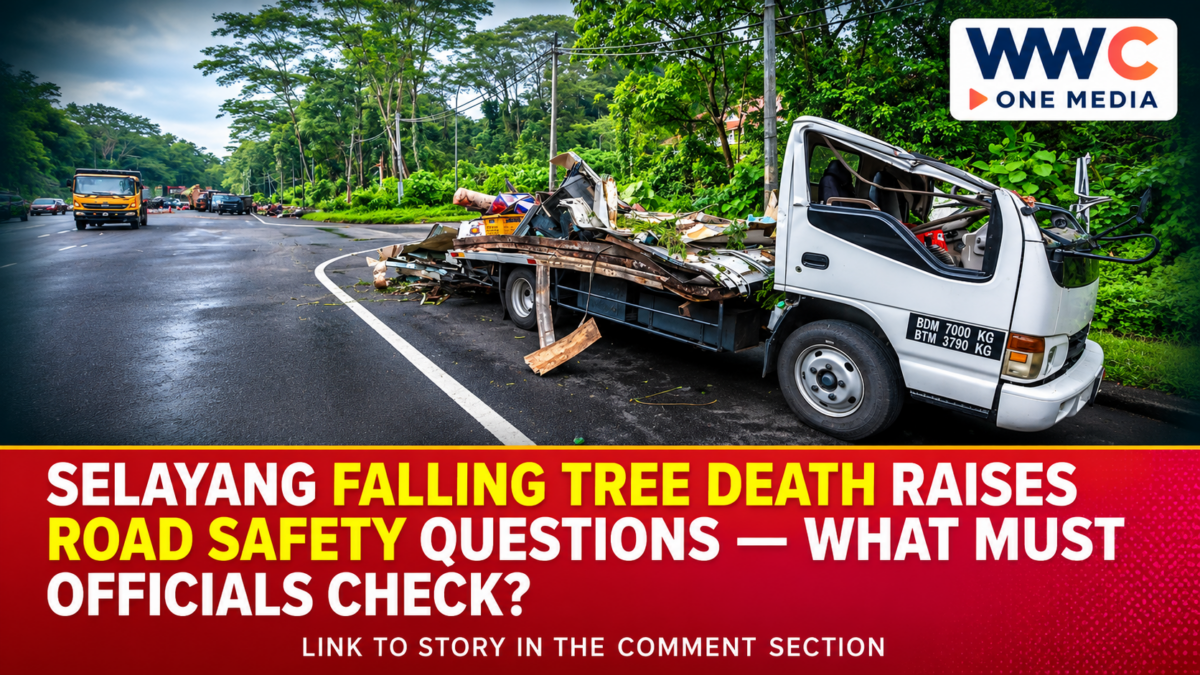
SELAYANG, Malaysia — A motorcyclist died after a roadside tree collapsed onto a motorcycle and a lorry in Selayang, Selangor, on Nov. 18, 2026. The Selangor Fire and Rescue Department’s operational account, published by Malaysia’s government broadcaster, confirms that emergency personnel freed the trapped rider before medical workers pronounced him dead at the scene.
The incident raises a wider public-safety question: how can authorities identify dangerous roadside trees before they become hazards to motorists?
Malaysia already has official procedures covering emergency road maintenance and weather warnings. What remains unclear is whether the tree involved in the Selayang incident had previously been inspected, whether any warning signs were documented and which authority was responsible for its maintenance.
Selayang Falling Tree: What Emergency Records Establish
The incident occurred along Jalan Setia Eco Templer in Selayang on the afternoon of Nov. 18.
The Selangor Fire and Rescue Department’s operations centre received an emergency call at approximately 2:19 p.m. Six firefighters from the Selayang Fire and Rescue Station were deployed.
Emergency responders reached the location about nine minutes later. They found a fallen tree affecting a motorcycle and a lorry, with the motorcyclist trapped and unconscious.
Firefighters freed the rider at approximately 2:35 p.m. Medical personnel from Malaysia’s Ministry of Health confirmed his death at the location.
The body was subsequently handed over to police for further action, while emergency crews completed the removal of the fallen tree.
These details establish the broad emergency-response sequence. They do not establish why the tree collapsed, how long it had been structurally compromised or whether its condition had previously been reported.
That distinction matters because an emergency-response record explains what rescuers encountered, not necessarily what caused the hazard.
Roadside Tree Safety: The Questions That Remain
A tree collapsing onto a public road can involve several different issues, including its physical condition, surrounding ground conditions, exposure to severe weather and the effectiveness of maintenance procedures.
Determining which factors contributed to the Selayang incident would require examining the tree and its surroundings rather than relying on assumptions about the weather.
A useful technical assessment could examine whether the trunk, branches or root system showed signs of deterioration before the collapse.
Investigators could also review the surrounding soil, drainage conditions and any records of previous tree maintenance.
An important administrative question concerns responsibility.
Before any conclusion about maintenance failures can be reached, officials would need to establish which agency, road operator or property manager had responsibility for the tree and the land where it stood.
There is no verified finding in the official material reviewed for this article that identifies a responsible party as negligent.
The distinction between an unexpected tree failure and an avoidable maintenance problem cannot be resolved simply because an incident resulted in a death.
WWC ONE MEDIA has previously examined a separate roadside tree collapse involving vehicles in Singapore. The incidents should not be treated as having the same cause, but both illustrate why follow-up inspections can be an important public-safety consideration.
What Malaysia’s Road Maintenance Rules Already Cover
Malaysia’s Ministry of Works describes three broad categories of road maintenance on federal roads: routine, periodic and emergency work.
Routine maintenance includes scheduled inspections and work on road shoulders, drainage and other roadside facilities.
The ministry’s published maintenance guidance also identifies the removal of fallen trees as part of emergency maintenance operations.
This framework demonstrates that roadside hazards are recognised within Malaysia’s road-management system.
However, the existence of a federal maintenance framework does not establish that the Selayang road falls under federal jurisdiction or that the same maintenance arrangements applied to the tree involved in this incident.
That would need separate confirmation.
The larger policy issue is the relationship between preventive work and emergency intervention.
Clearing a collapsed tree can restore access after an incident. Preventive inspection, where required and properly carried out, has a different purpose: identifying potential problems before road users are exposed to them.
For road administrators, useful measures may include keeping inspection records, documenting public complaints, prioritising trees showing visible deterioration and tracking whether recommended maintenance work has been completed.
These are potential review measures, not findings that the Selayang authorities failed to perform them.
The broader principle of acting before hazards escalate has also featured in WWC’s reporting on local government disaster preparedness in the Philippines.
Severe Weather Adds Another Layer of Risk
Malaysia’s Meteorological Department explains that thunderstorms can develop rapidly and are commonly associated with heavy rain and strong winds.
Its published guidance also warns that thunderstorms can produce flash flooding and other dangerous conditions.
That makes severe-weather monitoring relevant to road safety, particularly where trees stand close to moving vehicles.
However, the general relationship between thunderstorms and falling trees does not establish what caused the particular tree in Selayang to collapse.
A weather-related explanation would require incident-specific evidence, including observations from the relevant location and an assessment of the tree itself.
The Meteorological Department advises people to seek proper protection during thunderstorms and avoid sheltering beneath isolated trees.
For motorcyclists, who lack the enclosed protection of a car, this reinforces the importance of monitoring weather conditions and choosing safe shelter when storms develop.
WWC previously explored related public-safety guidance in its Malaysia thunderstorm and lightning safety coverage.
Lightning risks and falling-tree risks are different hazards. Both, however, demonstrate why shelter decisions during dangerous weather deserve careful attention.
Why the Incident Matters Beyond Selayang
The Selayang death brings two public responsibilities into focus: responding effectively when an emergency occurs and managing identifiable hazards before an emergency develops.
The available operational account provides a documented rescue timeline, including the emergency call, arrival of firefighters and extraction of the victim.
It does not provide a complete technical investigation into the tree’s condition.
This gap is important for evaluating what preventive measures might be appropriate.
A review that identifies the tree’s condition, ownership, maintenance history and surrounding environmental circumstances could help officials distinguish an unforeseeable event from a potentially manageable hazard.
Such a review could also help determine whether nearby roadside trees require further assessment.
Any wider inspection programme would need to be proportionate to the actual risks identified rather than presume that every mature roadside tree is dangerous.
Trees provide environmental and public benefits. Road safety therefore requires informed assessment and appropriate maintenance, not indiscriminate removal.
What this could mean: The most useful public-safety outcome would be a transparent explanation of the tree failure, followed by targeted action if investigators identify risks that could affect other road users.
What Happens Next?
The central unresolved issue is the cause of the tree collapse.
The official operational account reviewed for this report confirms the fatality and emergency response but does not establish the tree’s previous condition or maintenance history.
Further clarity would require an authoritative technical assessment, confirmation of the responsible maintenance authority and any applicable inspection records.
It would also be useful for authorities to clarify whether additional checks of nearby roadside trees are necessary.
No completion date for such a review has been verified.
Until further findings are made public, it would be premature to attribute the death to poor maintenance, particular weather conditions or wrongdoing by any individual or agency.
For the public, the lesson is practical: heed severe-weather warnings, report visible roadside hazards through appropriate official channels and avoid making assumptions about whether an apparently healthy tree is structurally safe.
The Selayang incident is a tragedy with a confirmed loss of life. Understanding whether anything could have reduced the danger requires evidence, not speculation.