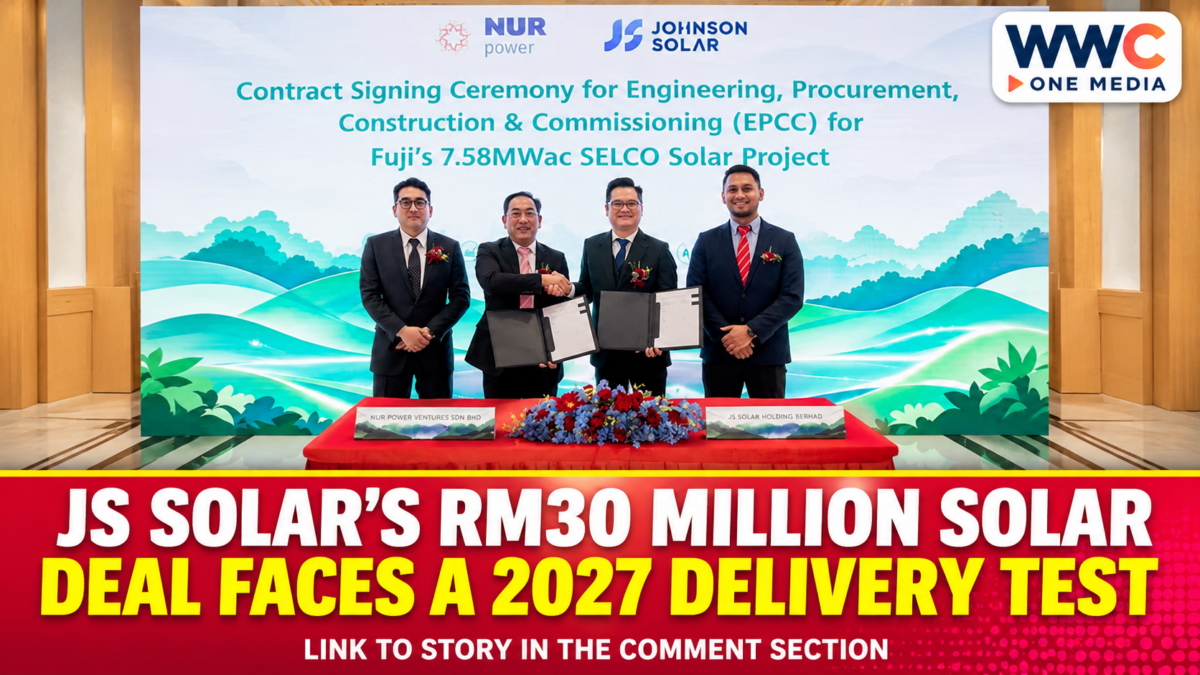
KUALA LUMPUR, Nov. 21, 2026 — JS Solar Holding Berhad has announced an RM30 million contract for a rooftop solar photovoltaic installation and battery storage system in Kulim, Kedah. Its subsidiary, JS Solar Sdn. Bhd., will handle engineering, procurement, construction and commissioning, with commercial operations targeted for July 1, 2027.
The contract is significant because it moves a previously announced business collaboration towards a specific industrial energy installation. Yet the bigger commercial question is not simply the value of the award: it is whether JS Solar can deliver the equipment, integrate the battery system and complete commissioning on the planned timetable.
What the JS Solar contract actually covers
The company-issued announcement identifies NUR Power Ventures Sdn. Bhd. as the contracting party. A stock exchange announcement dated Nov. 18 describes the location as Industrial Zone Phase 1 of Kulim Hi-Tech Industrial Park and gives the rooftop solar system a direct-current capacity of 9,879 kilowatts, equivalent to 9.879 megawatts.
The agreement combines photovoltaic panels with a battery energy storage system, commonly abbreviated BESS. Solar panels generate electricity when sunlight is available; a battery can store some electricity and release it at another time, subject to the installation’s technical design and operational limits.
JS Solar’s role is as an engineering and construction contractor. That distinction matters: the RM30 million figure is the reported contract value, not a figure for annual sales, profit, free cash flow or guaranteed earnings. Nor does a signed contract establish that electricity is already being delivered to industrial customers.
The released announcement identifies July 1, 2027, as the target commercial operation date. A target date is a project milestone, not a confirmation that commissioning has occurred.
From a February agreement to an actual project
The development follows a memorandum of understanding entered into in February 2026 between JS Solar Sdn. Bhd. and N.U.R Power Sdn. Bhd., the parent of NUR Power Ventures. The earlier arrangement explored cooperation on rooftop renewable-energy projects.
A memorandum of understanding can open negotiations and technical discussions without itself being evidence of completed construction. The November contract is more concrete: it assigns delivery responsibilities for a particular rooftop system and associated storage equipment at an identified industrial location.
That movement from cooperation to execution is the central development. It also offers a useful test of whether the partners can turn a strategic relationship into an operating asset, rather than relying on announcements of possible future opportunities.
WWC ONE MEDIA has separately examined regional solar-and-storage cooperation for island communities, where the distinction between a partnership announcement and a financed, commissioned project is equally important.
Why batteries change the engineering challenge
A conventional solar installation mainly requires photovoltaic equipment, inverters, electrical protection and grid integration. Adding storage introduces battery equipment, control systems and additional safety and operating requirements.
The engineering challenge involves more than placing two technologies at the same site. The solar installation, battery and the customer’s electricity demand must work together under defined operating conditions. Usable storage capacity, discharge duration and the control strategy can determine how valuable the installation becomes for its intended user.
JS Solar’s own corporate profile describes battery-storage work in Kulim Hi-Tech Park and a 2023 collaboration involving Huawei and N.U.R. Distribution Sdn. Bhd. The profile presents storage as an extension of the company’s existing photovoltaic contracting and maintenance activities. That history provides context, but it does not prove the financial outcome of the newly announced contract.
For Philippine readers, the technology has parallels with battery storage plans to support grid reliability. The applications are not identical: an industrial rooftop installation and a large grid-support programme have different operating objectives.
What the RM30 million award does—and does not—mean
A contract award can increase a contractor’s potential work pipeline. It does not necessarily translate immediately into recognised revenue, and the announcement by itself does not establish the eventual profit margin. Those outcomes depend on project execution, accounting treatment, costs, variations and the timing of milestones.
Investors should therefore avoid treating the contract value as an earnings forecast. Materials procurement, installation complexity, testing and handover could affect the eventual financial contribution. The public information reviewed for this report does not provide a verified project-specific profit estimate.
Equally, there is no basis to assert that an industrial electricity customer will receive a specified reduction in its power bill. The saving, if any, would depend on tariff arrangements, energy production, battery dispatch and the economics of the final system.
The broader relevance is clear without inventing a return figure. The arrangement illustrates how industrial solar projects can increasingly combine generation with storage. WWC’s examination of Malaysia’s large industrial electricity demand shows why energy infrastructure and dependable supply have become important business questions in the country.
What happens next
The immediate test is project delivery ahead of the July 1, 2027, target. Meaningful future updates would include the start of construction, equipment installation, testing, commissioning and confirmation that commercial operations have begun.
Further disclosures may also help investors understand how the contract contributes to JS Solar’s financial results. A completed and commissioned system would provide stronger evidence of operating execution than the contract announcement alone.
The assessment is straightforward: the RM30 million agreement represents a specific commercial opportunity, while the benefits remain contingent on delivery. For both businesses and investors, the next important headline should be about progress on the ground, not merely another agreement on paper.
Frequently asked questions
How much is JS Solar’s new contract worth?
The company-issued announcement states a contract value of RM30 million. That amount is not the same as net profit or cash received.
Where is the solar-and-battery project located?
The Nov. 18 exchange announcement identifies a site in Industrial Zone Phase 1, Kulim Hi-Tech Industrial Park, Kedah, Malaysia.
How large is the planned solar installation?
The exchange announcement specifies 9,879 kWdc, or 9.879 MWdc, for the rooftop solar component. That figure should not be confused with the battery’s storage capacity.
When is the project expected to operate?
The announced target for commercial operation is July 1, 2027. It remains a target until completion is confirmed.