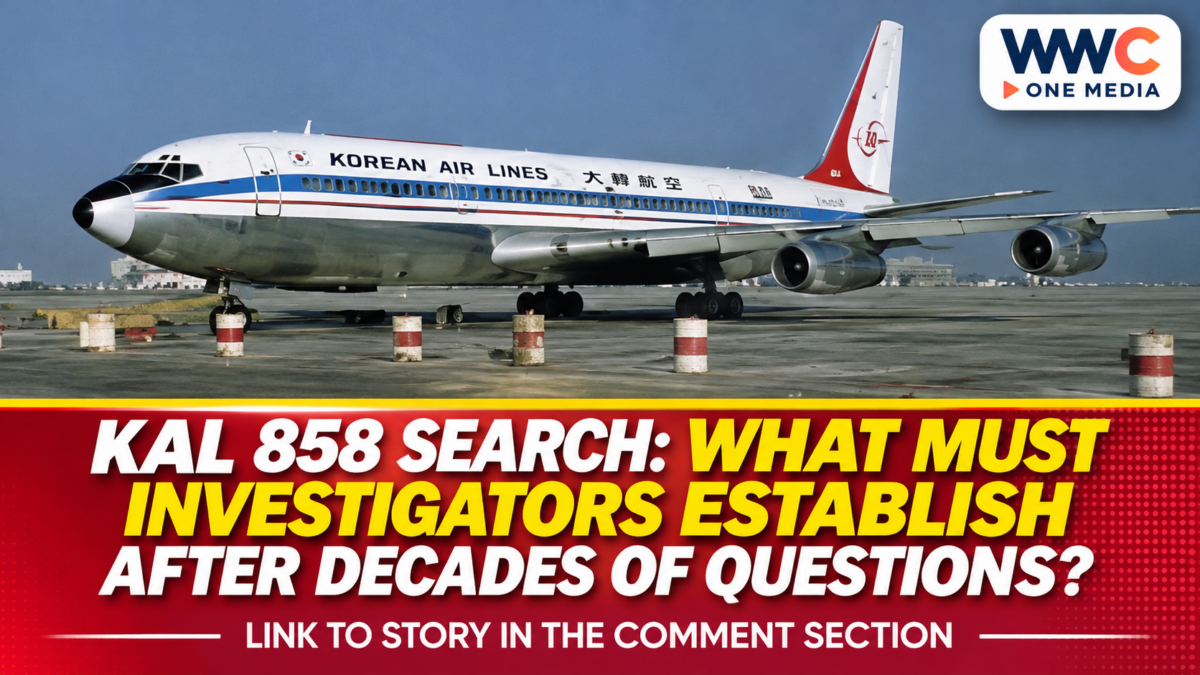
SEOUL, South Korea — Nov. 21, 2026. South Korea’s Foreign Ministry previously documented a plan to investigate an object suspected of being the wreckage of Korean Air Flight 858 in waters near Myanmar, where the aircraft was lost on Nov. 29, 1987. In a March 16, 2022, statement, the ministry said it had prepared for a search but could not dispatch an inspection team because Myanmar’s political situation had deteriorated.
The official historical records establish a deadly aviation incident, a lengthy effort to investigate a possible wreckage site and the families’ continuing interest in answers. They do not, by themselves, confirm a separately reported November 2026 government deployment, its results or the recovery of any new physical evidence.
KAL 858 Search: What the Government Documented
The Foreign Ministry’s March 2022 announcement described a meeting chaired by First Vice Foreign Minister Choi Jong-kun with relatives of those aboard Flight 858. The ministry explained its efforts to verify reports of an object suspected to be part of the aircraft in waters near Myanmar and discussed earlier contacts with Myanmar authorities.
The announcement said the Korean government had sought to organise a joint inspection following reports in early 2020. After obtaining a budget from the National Assembly, it had completed preparations in early 2021, but Myanmar’s Feb. 1, 2021, military takeover and subsequent deterioration of conditions delayed the deployment.
That chronology shows a government intention and advance planning. It does not establish that a team actually searched the water in 2021 or 2022. Nor can the earlier statement serve as confirmation of the newly reported 2026 mission without a separate official document.
What Happened to Korean Air Flight 858?
South Korea’s Foreign Ministry identifies Nov. 29, 1987, as the date the aircraft exploded above the Andaman Sea near Myanmar while travelling from Baghdad towards Seoul. Its official account records the deaths of all 115 passengers and crew members.
The National Archives of Korea likewise describes the incident as an aircraft bombing and attributes responsibility to North Korean operatives in its historical account. That represents the South Korean government’s established position. It is important to distinguish this historical finding from any new evidence that a modern seabed search might or might not uncover.
The archives also catalogue investigation and diplomatic-response files related to Flight 858. An archived file’s existence, however, is not proof that its entire contents have been released or that the records resolve every question raised by victims’ families.
Why a Possible Wreckage Location Matters
The ministry’s 2022 statement referred to media reports that an object resembling part of the aircraft had been found in waters near Myanmar in early 2020. It described efforts to verify that claim, rather than declaring that the object was conclusively identified as Flight 858.
A credible identification would require the investigators to explain what was observed and how it was linked to the missing aircraft. An underwater image, a reported outline or an initial assessment may justify further inspection, but none necessarily establishes the identity of a submerged object.
Analysis: The public-interest value of an investigation depends not only on whether an item is located, but also on documentation of the method, authenticity and limitations of any findings. Families and the wider public need to know what officials have actually verified, rather than which possibilities remain under consideration.
WWC’s reporting on questions about evidence in a Los Angeles helicopter crash concerns a wholly separate incident. It illustrates the broader editorial importance of distinguishing preliminary observations from an established investigative conclusion.
Families Were Part of the Official Process
The Foreign Ministry said its March 2022 meeting was the ninth discussion with relatives since an initial meeting in September 2020. It explained the difficulties delaying a search and stated that it remained committed to seeking cooperation from Myanmar.
The ministry also recorded the relatives’ request for continued attention and regular information on developments. That is a documented institutional interaction, not a claim that every family member held an identical position or that the requested search had already taken place.
For people affected by disasters many years ago, uncertainty about remains and belongings may persist alongside the historical conclusion about the incident. A practical investigative update would therefore need to distinguish searches for physical evidence, potential recovery work and any broader reassessment of earlier findings.
WWC’s coverage of the Philippine military’s aircraft safety review discusses a different event, but underscores why families and the public benefit when official processes identify what is known and what remains under examination.
What a New Search Could Establish
Analysis: If a government search has now taken place, a formal announcement should identify the responsible agencies, the search area, the time frame and whether any suspected aircraft material was documented or recovered. A further technical report could then explain how investigators assessed the material and whether it was possible to identify it securely.
Those are criteria for evaluating future records, not assertions that work has been completed. The earlier Foreign Ministry statement shows why logistical and diplomatic conditions can affect an underwater investigation, particularly one involving waters outside South Korea.
In another unrelated aviation case, WWC examined unanswered questions following a Greek military-aircraft crash. Neither that investigation nor another country’s technical practice should be presented as evidence about Flight 858 itself.
What Happens Next
The immediate verification priority is an official November 2026 statement from the South Korean Foreign Ministry, Korea Coast Guard or another participating authority. Such a record would be needed to confirm the reported team’s deployment, its scope and whether it found anything associated with Flight 858.
Until that record is opened, the historical facts and the earlier investigation efforts can be reported, but the new search must remain unconfirmed under a primary-record-only editorial standard. A full update should be based on published findings, not on an assumption that a survey necessarily led to identification or recovery.
Frequently Asked Questions
When did Korean Air Flight 858 disappear?
South Korea’s Foreign Ministry records that the aircraft exploded on Nov. 29, 1987, above the Andaman Sea near Myanmar. The official account identifies 115 passengers and crew members who died.
Did South Korea previously prepare a search near Myanmar?
Yes. The ministry said preparations were completed in early 2021 after budget approval, but Myanmar’s political upheaval delayed a planned joint inspection.
Was the suspected wreckage identified in the 2022 announcement?
No. The ministry referred to efforts to verify a reported object, not a conclusive identification of Flight 858 wreckage.
Has the November 2026 government search been independently confirmed?
Not through an incident-specific primary record opened for this editorial review. A new official release or investigation report is needed before presenting the deployment or results as verified facts.