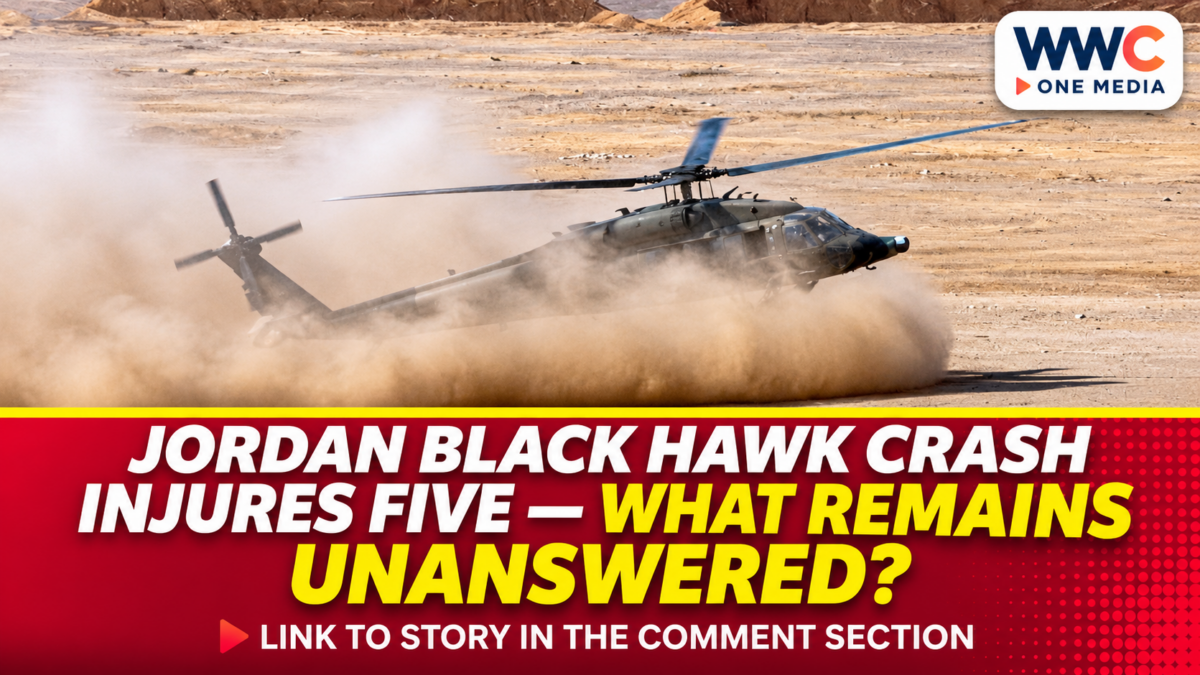
AMMAN, Jordan — Nov. 21, 2026. A Jordanian Armed Forces Black Hawk helicopter crashed during a military training exercise on Nov. 18, injuring five service members, the military’s official announcements confirmed. One person sustained a serious injury and four had minor injuries; a later military hospital briefing said all five were in stable condition.
The incident raises a straightforward operational question that the available public statements do not yet answer: what caused the aircraft to go down? For now, the records establish the training setting, emergency response and medical follow-up, but do not provide a technical finding or evidence of a specific mechanical or human failure.
Jordan Black Hawk Crash: What the Military Confirmed
The General Command’s first announcement on Nov. 18 identified the aircraft as a Black Hawk belonging to the Jordanian Armed Forces and said it crashed during a military training exercise. Specialised teams began emergency-response procedures, while the military indicated that further information would be issued through official channels.
A follow-up statement later the same day gave the casualty breakdown: five injured personnel, including one seriously hurt and four with minor injuries. All were transferred to Queen Alia Military Hospital for medical care.
These details are important because the initial acknowledgment of an accident and the later medical accounting address different questions. Neither statement identifies a cause, and neither provides a detailed minute-by-minute reconstruction of the flight.
The announcements also do not identify the exact crash site, the aircraft’s registration or a specific training manoeuvre. Reporting any of those details as confirmed would go beyond the published record.
Hospital Update Offers a Clearer Picture
On the evening of Nov. 18, Chairman of the Joint Chiefs of Staff Maj. Gen. Majdi Harasis visited the five injured personnel at Queen Alia Military Hospital. A briefing from Jordan’s Royal Medical Services said all five were in stable condition and outlined the care being provided.
That later medical update should be read alongside, not as a contradiction of, the original injury classification. A serious injury can require significant care even when a patient’s condition is described as stable. The official announcements do not establish recovery times or discharge dates.
Royal Hashemite Court Chief Yousef Issawi also visited the injured on Nov. 18, conveying messages from King Abdullah II and Crown Prince Hussein bin Abdullah II. The visit documents official attention to the personnel, not a conclusion about how the accident happened.
Why a Training Accident Needs Its Own Investigation
A training flight can involve hazards even when it is not a combat mission. But the fact that an aircraft was training cannot tell investigators whether weather, maintenance, a manoeuvre, equipment or another factor contributed to a particular accident.
The military’s public announcements reviewed for this report do not assign responsibility or present investigation findings. They also do not announce a grounding of Jordan’s Black Hawk fleet. Those possibilities should remain questions unless an official subsequent release establishes them.
WWC has previously examined military training-aircraft safety questions following a Batangas accident. That Philippine incident involved different aircraft and circumstances; its unresolved questions cannot be transferred to the Jordanian crash.
Analysis: A useful future report would distinguish what investigators have established about the aircraft, flight plan and conditions from any procedural changes actually ordered by the military. A recommendation, a precautionary inspection and a finding of cause are not interchangeable.
The Black Hawk’s Role Goes Beyond Training
Jordan’s official public record illustrates that its Black Hawk helicopters also undertake operational support missions. In July 2026, a Royal Jordanian Air Force Black Hawk assigned to the country’s Congo/2 unit within the United Nations mission in the Democratic Republic of the Congo carried out a search-and-rescue and medical-evacuation mission after a small passenger aircraft crashed.
That operation demonstrates the variety of tasks described in official statements, from transporting people to reaching remote locations. It does not identify the Black Hawk model involved in the November crash or establish whether the two aircraft had the same configuration.
The distinction also matters when comparing this incident with WWC’s coverage of military aviation risks during an Indonesian firefighting operation. The missions and aircraft environments are not the same, even though aviation safety and emergency response are relevant to both.
The November crash should therefore be evaluated through evidence specific to the Jordanian helicopter, not through assumptions drawn from another operator’s accidents.
What the Public Still Needs to Know
The most consequential missing information concerns the sequence of events before the crash, the condition of the aircraft and the eventual technical findings. It is not yet possible to say whether the helicopter was airborne at a particular height, whether any warning was issued or whether the training programme was altered afterward.
Nor does the record establish any injuries outside the five armed forces personnel reported by the military. Absence of an additional official casualty figure should not be turned into an unsupported claim about everyone who may have been near the scene.
WWC’s earlier examination of questions surrounding a Greek military-aircraft crash concerns a separate event, but illustrates why the existence of a crash alone cannot prove its cause.
Analysis: The priority for public understanding is a careful progression from immediate rescue and medical information towards a documented technical account. Any later conclusions should be measured against what the investigating authority actually publishes.
What Happens Next
Jordan’s military initially committed to providing further updates through official procedures. The next meaningful disclosures would be a confirmed status of the injured personnel and, if released, a technical account of the crash and any safety measures resulting from it.
As of the official statements reviewed for this report, the known outcome is five injured service members, with all five later described as stable. The cause of the Black Hawk crash remains publicly unestablished.
Frequently Asked Questions
When did the Jordan Black Hawk crash happen?
The Jordanian Armed Forces reported the helicopter crash on Nov. 18, 2026, during a military training exercise.
How many people were injured?
The military confirmed five injured personnel: one with a serious injury and four with minor injuries. A subsequent hospital briefing described all five as stable.
Where were the injured taken?
The five personnel were transported to Queen Alia Military Hospital, where senior military and Royal Court officials visited them.
Has the cause of the crash been confirmed?
No cause was established in the official statements reviewed for this article. Details such as a mechanical failure, weather contribution or crew error must not be presented as findings without an official investigative record.