
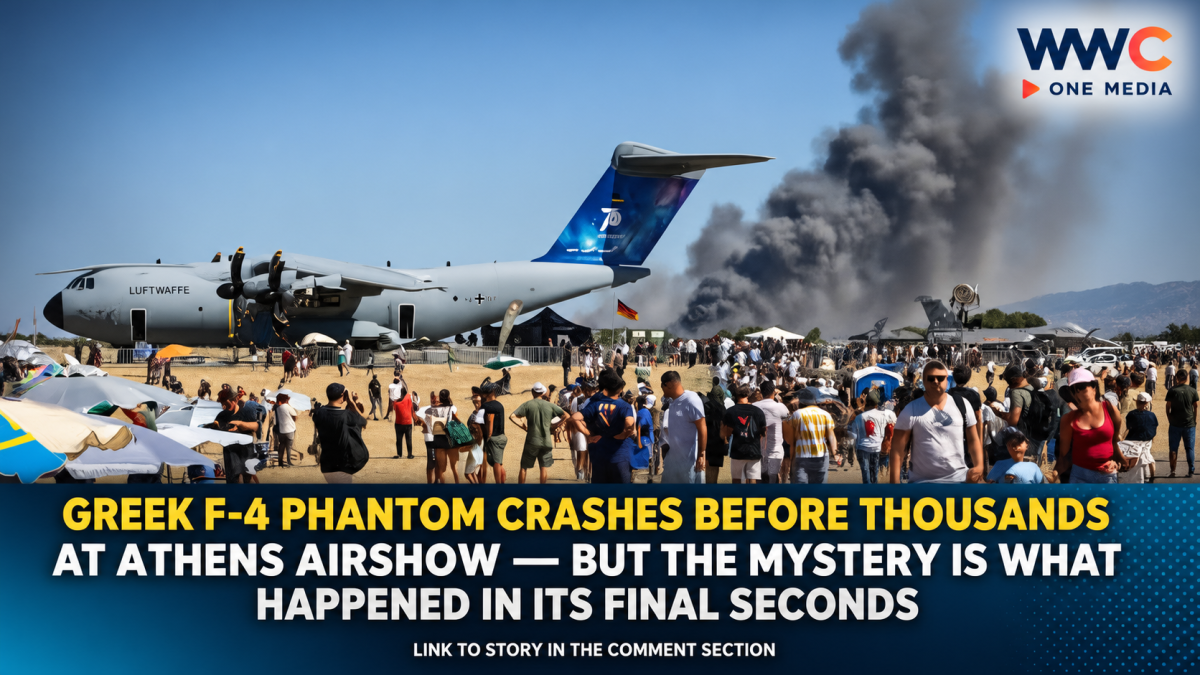
ATHENS — Thousands of aviation fans had gathered at Tanagra expecting to watch one of Greece’s most recognizable combat aircraft roar through the sky.
Minutes later, they were looking at a column of black smoke.
A twin-seat Hellenic Air Force F-4E Phantom II crashed during a flying display at Athens Flying Week on Saturday, Sept. 5, killing both members of its crew and bringing one of Greece’s largest aviation events to an abrupt and devastating halt.
The fighter went down during a low-altitude maneuver shortly after beginning its demonstration.
Video and eyewitness accounts show the aircraft entering a low turn before losing altitude and striking the ground, erupting into a fireball.
But what those images do not explain is why.
And that distinction is crucial.
The Greek Air Force has not announced an official cause.
Mechanical failure has not been established.
Pilot error has not been established.
And despite widespread discussion online about the aircraft’s age, investigators have not linked its decades of service to the crash.
The central fact remains brutally simple: two pilots are dead, and investigators are now trying to understand why their Phantom never recovered from its final maneuver.
The crash happened at 2:55 p.m.
Greek Air Force information cited by domestic media places the accident at approximately 2:55 p.m. local time.
The aircraft belonged to 338 Squadron of the 117th Combat Wing, whose F-4s are normally based at Andravida in western Greece.
It crashed roughly three nautical miles southeast of the 114th Combat Wing at Tanagra, according to the Air Force statement reported by Greek media.
Tanagra lies about 60 kilometers north of Athens and was hosting thousands of spectators for the annual two-day Athens Flying Week event.
The aircraft had been airborne only a short time before the accident.
Reuters reported eyewitness descriptions of the jet making a low right turn before descending rapidly and exploding on impact.
ERT similarly reported that the Phantom suddenly lost altitude during the maneuver.
Neither crew member survived
Both airmen aboard the two-seat fighter were killed.
Greek authorities initially launched rescue efforts while firefighters struggled with the blaze created by the impact.
The two crew members were subsequently confirmed dead.
Greece’s Defence Ministry declared three days of mourning across the armed forces, from Sept. 5 through Sept. 7.
Defence Minister Nikos Dendias abandoned his program at the Thessaloniki International Fair and returned following the accident.
Prime Minister Kyriakos Mitsotakis also expressed condolences, saying the accident underscored the dangers faced by Greek military aviators who remain on operational readiness.
Did the pilots eject?
This is one of the most repeated questions surrounding the crash.
CNA cited local media saying the pilots did not eject, and publicly available video does not show visible parachutes or ejection-seat activation before impact.
But that should not be converted into a definitive explanation of what happened inside the cockpit.
Kathimerini reported that preliminary accounts indicated the ejection system may not have been activated, while also stressing that those reports had not been independently confirmed.
Other Greek outlets similarly reported no evidence of an ejection.
The safest wording is therefore:
No ejection is visible in the footage, and Greek media report that the crew did not eject, but investigators have not yet publicly established why.
That unanswered “why” matters.
Were the pilots attempting to recover the aircraft?
Was there insufficient altitude?
Did a technical problem affect their options?
Those questions remain under investigation.
The aircraft appears to have been flying extremely low
Video of the display has become a major piece of publicly available evidence.
The aircraft can be seen banking at low altitude before descending toward the ground.
Aviation reporting describes the sequence as a low-altitude maneuver, consistent with accounts from AP and Reuters.
But video analysis alone cannot establish cause.
A low aircraft might be suffering from a technical malfunction.
It could encounter an aerodynamic problem.
A control or engine issue could develop.
Or the flight path itself could become unrecoverable.
Investigators will need aircraft wreckage, maintenance records, cockpit communications, flight parameters and other technical evidence before reaching conclusions.
Greek reporting says the appointed accident committee is examining material including organizers’ camera footage and communications between the aircraft and control tower.
The crash triggered a major fire
The impact did not end with the explosion.
Burning wreckage ignited vegetation around the crash area, forcing authorities to launch a substantial firefighting operation.
Reuters reported that 11 firefighting aircraft and helicopters participated in the response.
Kathimerini put the broader deployment at 115 firefighters, 36 vehicles, nine fixed-wing aircraft and four helicopters as crews fought fires spreading through rural and wooded terrain.
Emergency alerts were issued to nearby communities, and road restrictions were imposed in parts of the area.
The fire also complicated early access to the wreckage.
Early reports said spectators escaped unharmed — later reports changed that picture
International wire reports initially said there were no injuries among spectators.
AP, for example, reported that the crash occurred some distance from the principal viewing area and that the crowd escaped injury.
Later Greek reporting added an important update.
ERT reported that two people were injured by fragments from the aircraft.
CNN Greece said the two were transported to Chalkida hospital with abrasions reportedly caused by flying debris, including injuries around their shoulders, and that their conditions were not considered serious.
So an updated article should not simply repeat the initial “no spectator injuries” line without qualification.
The most defensible current wording is:
No mass casualties occurred among the thousands attending, although later Greek reports said two people suffered minor injuries from debris.
Athens Flying Week was immediately shut down
Organizers canceled the remainder of the flying program following the crash.
Athens Flying Week posted an official notice saying its remaining displays were canceled because of the Hellenic Air Force Phantom accident.
The event had been scheduled for Sept. 5 and 6 at Tanagra Air Base and traditionally features Greek and international military aircraft, aerobatic teams and other aviation demonstrations.
Instead, what was intended as a celebration of aviation became a national military tragedy.
This was not just any aircraft
The F-4 Phantom occupies a special place in Greek military history.
Greece received its first F-4s in 1974, meaning the aircraft type has now served the Hellenic Air Force for more than half a century.
The American-designed Phantom originated during the Cold War and became one of the most recognizable Western fighters of the jet age.
It served extensively with the United States and numerous allied air forces.
Most countries retired it years ago.
Greece did not.
The Hellenic Air Force modernized part of its fleet through the Avionics Upgrade Programme, commonly known as the F-4E AUP or Peace Icarus 2000 configuration. The upgrade introduced newer avionics and weapons capabilities that allowed the old airframe to remain operational decades beyond its original era.
Today, Greece maintains one of the world’s dwindling operational Phantom fleets.
338 Squadron has become the Phantom’s Greek home
The aircraft involved belonged to 338 Squadron, part of the 117 Combat Wing at Andravida.
The unit has become closely associated with Greece’s surviving operational F-4E AUP fleet.
Only months before Saturday’s tragedy, Andravida hosted the 2026 European Phantom Conference, where aviation enthusiasts were given a rare look at Greece’s remaining operational F-4s and the personnel maintaining them.
That illustrates how unusual Greece’s position has become.
For aviation enthusiasts, these aircraft are living pieces of military history.
For the Hellenic Air Force, however, they remain operational combat aircraft — and therefore must continue meeting military flight-safety standards regardless of their historical significance.
Retirement was already approaching
Greek media and aviation reporting indicate that the remaining Phantom fleet is expected to leave service before or around the end of the decade.
That impending retirement makes Saturday’s accident particularly poignant.
Athens Flying Week was displaying an aircraft that represents more than 50 years of Greek military-aviation history.
But it is essential not to turn that history into premature blame.
An old aircraft is not automatically an unsafe aircraft.
Military jets undergo continuing inspections, maintenance and airworthiness controls.
Older fleets can require increasingly intensive maintenance and spare-parts management, but age alone does not establish why a specific aircraft crashed.
The official investigation — not the Phantom’s birth date — has to answer that.
Greece suffered another fatal Phantom crash only three years ago
Saturday’s tragedy also revives memories of a previous Greek F-4 accident.
On Jan. 30, 2023, another F-4E Phantom II from the same 338 Squadron and 117 Combat Wing crashed into the Ionian Sea during a low-altitude training exercise from Andravida.
Both crew members were eventually confirmed dead.
That earlier accident does not establish any connection with the 2026 crash.
The circumstances were different, and separate investigations are required.
But the fact that 338 Squadron has now lost another aircraft and crew will inevitably place renewed attention on operations involving Greece’s shrinking Phantom fleet.
Airshows operate in a uniquely unforgiving environment
Military flying displays are designed to showcase aircraft performance.
That often means aircraft operate:
at relatively low altitude,
inside tightly defined display areas,
through rapid turns,
and within viewing distance of large crowds.
The safety margin available to recover from some types of problem can therefore be far smaller than during ordinary high-altitude flight.
This is why airshow planning involves specially approved routines, display lines, crowd separation and emergency arrangements.
It is also why investigators will focus closely on the exact sequence of the Phantom’s final maneuver.
The fact that the aircraft was low does not itself tell investigators why it crashed.
But at low altitude, time becomes the most unforgiving variable of all.
One dramatic claim should be treated especially carefully
Some Greek reports have suggested that the crew may have deliberately tried to steer the aircraft away from spectators or populated areas.
Kathimerini reported that possibility but explicitly noted it had not been independently confirmed.
That is exactly how it should remain.
It would be emotionally compelling to write:
“The pilots sacrificed themselves to save the crowd.”
But unless investigators establish that from cockpit communications or other evidence, such language goes beyond the verified facts.
The crash location being away from the main viewing area does not by itself prove intent.
Respect for the pilots means avoiding fictional certainty, even when the speculation is heroic.
Investigators now have several critical questions
The investigation will need to determine:
- whether both engines were functioning normally;
- whether flight controls responded correctly;
- whether any mechanical or hydraulic failure occurred;
- what the pilots communicated before impact;
- whether the aircraft’s speed and altitude allowed recovery;
- whether the ejection system was activated or usable;
- whether maintenance or airworthiness issues played any role;
- and whether the planned maneuver was executed within its approved parameters.
Until those questions are answered, assigning blame would be irresponsible.
The Greek Air Force says the causes are being investigated by a designated committee.
That is the most important sentence in the story right now.
Greece is mourning two aviators — while waiting for evidence
Saturday’s images are dramatic enough on their own.
A veteran F-4 flying before thousands.
A low turn.
A sudden descent.
An explosion.
Then smoke dominating the horizon where an airshow had been underway only seconds earlier.
But video captures only the end of the accident.
It does not explain the beginning.
Greece has now canceled the celebration, declared military mourning and begun examining the wreckage and available recordings.
For the families and colleagues of the two pilots, no technical finding can undo what happened.
For the Hellenic Air Force, however, understanding those final seconds is essential — particularly while other F-4s remain operational.
The Phantom has flown over Greece for more than half a century.
Now investigators have to determine why one of its final-era public appearances ended in tragedy.
WWC ONE MEDIA M.J.E




Leave a Reply