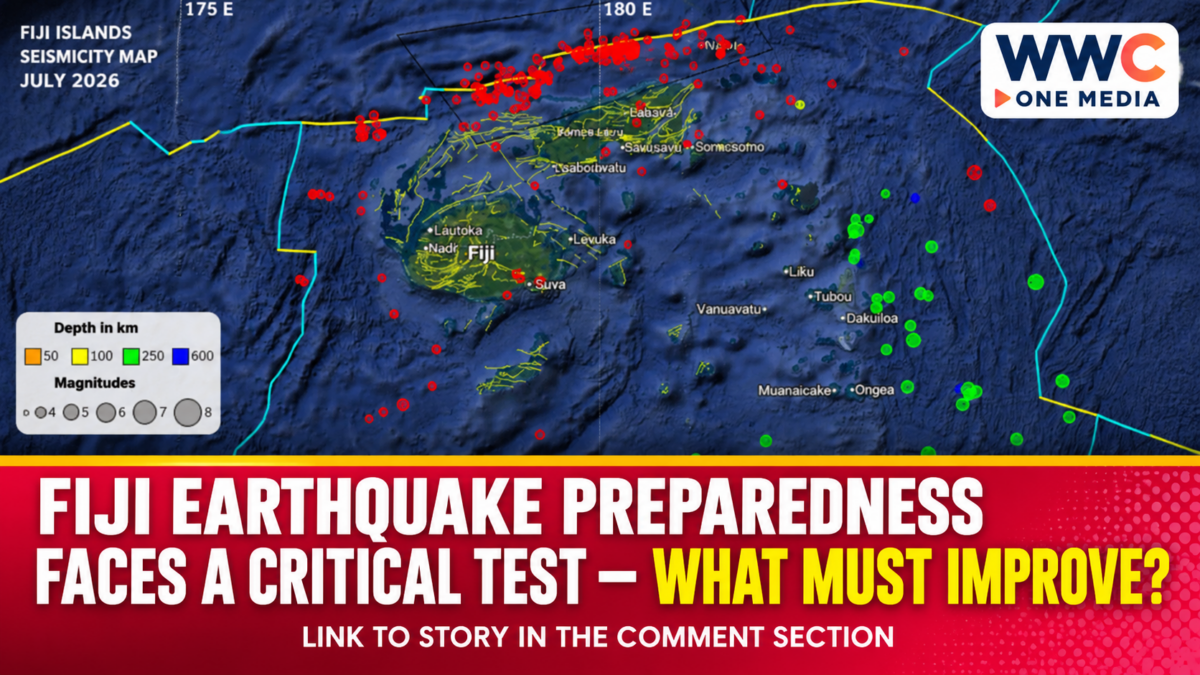
SUVA, Fiji — Fiji’s earthquake preparedness came under renewed scrutiny after national agencies reviewed draft geohazard procedures in October 2026. A regional tsunami exercise held on Nov. 5 subsequently tested how Pacific authorities share warnings and coordinate decisions during simulated emergencies.
The two initiatives address a challenge that goes beyond detecting an earthquake: converting technical information into instructions that communities can receive, understand and act upon. Official assessments published in October and November identify clearer agency roles, reliable communication channels and practical public training as priorities.
Fiji earthquake preparedness moves beyond detection
On Oct. 13–14, Fiji’s Mineral Resources Department and National Tsunami Warning Centre joined national disaster-management and meteorological agencies and UNESCO’s Intergovernmental Oceanographic Commission in a technical workshop in Suva.
Participants reviewed a draft integrated Geohazard Standard Operating Procedure, a training and public-awareness toolkit, and plans for drills. The review covered not only earthquake and tsunami procedures but also other geological hazards, reflecting the need to coordinate different kinds of emergencies.
The workshop did not establish that the draft procedures were already fully approved or operational. Participants instead identified matters that required refinement before final approval. This distinction matters: proposing a response process is different from demonstrating that the process works under pressure.
What the official review found still needs work
The October review identified several operational priorities. These included checking the legal mandates of participating institutions, clarifying which agencies can issue warnings and direct protective action, and improving escalation arrangements when a situation changes.
Participants also called for more consistent operational logs, clearer shift handovers and stronger procedures for analysing events and communicating warnings. These are practical concerns rather than abstract paperwork. An alert may become less useful if a decision is delayed, responsibility is uncertain or a message does not reach its intended audience.
Fiji’s geography adds another challenge. The workshop specifically highlighted the difficulties of reaching outer islands and communities whose normal communications may be interrupted. That makes backup channels and locally understood guidance important parts of the preparedness system.
The experience has parallels with WWC ONE MEDIA’s examination of Philippine earthquake lifeline resilience, where access to essential services after a major shock is a central planning concern. The countries face different hazards and infrastructure conditions; the comparison concerns the importance of continuity planning, not a shared prediction.
Why a recorded earthquake is not automatically a tsunami warning
Earthquake monitoring and coastal warning decisions serve related but different purposes. Detecting a seismic event provides information for assessment, but an earthquake listing alone does not establish that damaging tsunami waves will follow.
That distinction is explored in WWC’s report on an earthquake near Papua New Guinea, which separates seismic measurements from tsunami assessments. The same caution applies when reading earthquake totals for Fiji: a monthly count cannot by itself show the level of tsunami danger or predict the next damaging event.
The October Fiji workshop emphasized natural warning signs that should prompt immediate protective action. Strong or prolonged shaking, an unusual rise or fall in sea level, and abnormal sounds from the ocean were identified as reasons to move inland or to higher ground without waiting for an official alert.
This does not mean every tremor produces a tsunami. It means people near exposed coastlines should understand the difference between ordinary earthquake information and urgent local warning signs. WWC has also examined this distinction in its coverage of a deep earthquake near Japan’s Ogasawara Islands.
Pacific Wave 2026 tested regional communications
On Nov. 5, the Pacific Wave 2026 exercise brought tsunami warning centres and disaster-management agencies together for simulated volcanic tsunami emergencies. The scenarios involved overlapping events at Home Reef near Tonga and Kuwae near Vanuatu, testing how participants exchanged information and made decisions.
A follow-up assessment published on Nov. 18 reported that WhatsApp, high-frequency radio and other communications were used to exchange observations and warning-related information. It also identified opportunities to improve dedicated communication accounts, user verification, message formats and the distinction between preliminary observations and official alerts.
The exercise highlighted why relying on a single channel is risky. Internet services may fail during disasters, and a message that travels quickly between institutions still has to reach local responders and the public. Regional participants, including Fiji, discussed different national challenges at the Nov. 18 debrief.
The exercise was a test, not evidence that every national warning problem had been solved. Its value lies in revealing weaknesses while authorities still have the opportunity to change procedures.
What this could mean for communities and businesses
Analysis: Fiji’s preparedness challenge is not simply a question of how many earthquakes instruments record. The more consequential questions are whether an assessment reaches the right decision-maker, whether an authorized alert is delivered clearly, and whether people know which action to take.
Schools, tourism businesses, community groups and emergency managers will not all need identical plans. The October workshop recognized differences in exposure and operational needs, supporting training that can be adapted for specific audiences and locations.
For businesses, that suggests checking staff communication plans, evacuation routes and arrangements for guests or customers who may not know the local warning system. For communities, it points to familiar evacuation routes, clear responsibilities and inclusion of residents who need additional assistance.
These are preparedness implications of the official reviews, not claims that particular hotels, schools or neighbourhoods failed an inspection. Nor do the records establish that Fiji faces an imminent major earthquake.
What happens next
The October review called for revisions to the draft procedures and public-awareness materials, followed by further testing and exercises. The November regional debrief identified improvements to information-sharing, warning procedures and backup communications, with lessons intended to inform work during 2027 and preparations for Pacific Wave 2028.
The immediate editorial question is therefore measurable: which recommended changes become approved procedures, trained practice and dependable public communication? Until implementation is documented, a workshop recommendation should not be presented as a completed safety upgrade.