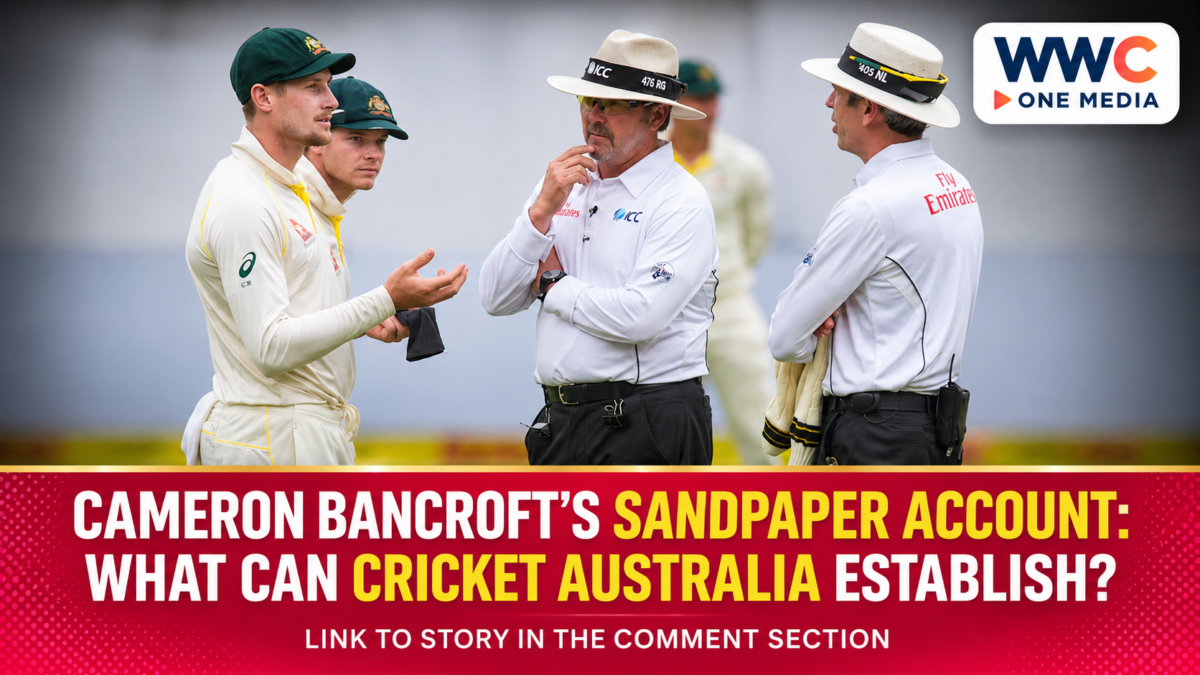
Cameron Bancroft has challenged the official account of Australian cricket’s 2018 ball-tampering scandal, saying in a statement published on Nov. 18, 2026, that knowledge of the sandpaper scheme extended beyond the three players originally sanctioned. Cricket Australia has announced an independent forum for members of the 2018 South Africa touring party, but says the process is not a new disciplinary investigation.
The distinction matters. Bancroft’s account raises specific questions about what happened before the incident at Cape Town, while other players have publicly denied knowing sandpaper was being used. A forum may collect accounts without resolving every contradiction in public.
Cameron Bancroft’s sandpaper account challenges the timeline
In his signed, first-person statement, Bancroft said his evidence to the original investigation was incomplete. He claimed he withheld details about when sandpaper was first used and what other people knew. Those are his assertions, not findings independently confirmed by Cricket Australia.
Bancroft placed the alleged escalation in the second Test at Port Elizabeth, now Gqeberha, rather than solely in the third Test at Newlands. He described conversations about reverse swing and claimed the proposed use of sandpaper emerged amid pressure to improve the movement of the ball.
His account also described earlier manipulation of the ball’s quarter seam, which he said had become a normalised team practice. This is a separate allegation from the use of sandpaper. It should not be treated as proof that every player knew what happened on the field at Cape Town.
For readers revisiting the team’s earlier tour, WWC has examined the rivalry and controversies surrounding Australia’s return to Cape Town.
What the 2018 official findings actually established
The original Cricket Australia investigation identified Bancroft, then captain Steve Smith and then vice-captain David Warner as the three players with prior knowledge of the scheme to alter the condition of the ball. Its published findings did not identify other players or support staff as having known about that plan in advance.
Bancroft was seen with a foreign object during the third Test against South Africa in Cape Town in March 2018. The International Cricket Council charged him with changing the condition of the ball. It initially fined him 75 per cent of his match fee and gave him three demerit points.
The ICC also imposed a one-Test suspension and a match-fee fine on Smith for his part in the decision to seek an unfair advantage. Cricket Australia’s separate sanctions subsequently barred Smith and Warner for 12 months each, and Bancroft for nine months.
These penalties concern conduct established through the disciplinary process at that time. They do not by themselves determine whether Bancroft’s newly published account is accurate.
WWC has separately covered how the scandal affected Smith’s return to South African cricket.
Why the bowlers’ denial remains important
Pat Cummins, Mitchell Starc, Josh Hazlewood and Nathan Lyon issued a joint statement in May 2021 denying prior knowledge that a foreign substance would be taken onto the field to change the ball’s condition. That denial remains a direct statement from the players and must be considered alongside Bancroft’s later account.
Cummins also rejected claims that the entire side knew sandpaper was being used during the Cape Town Test when discussing the renewed allegations in November 2026. He distinguished knowledge of dubious ball-management practices in general from advance knowledge of a specific sandpaper operation.
That distinction is central. Discussions about reverse swing, evidence of irregular treatment of a cricket ball and prior knowledge of sandpaper use are not interchangeable. Establishing one does not automatically establish the others.
Equally, a player’s denial should not be presented as an independent investigation’s final determination. The accounts remain in conflict, and there has been no announced revised finding against additional players.
Why Cricket Australia’s forum is different from an inquiry
On Nov. 18, Cricket Australia announced a confidential forum for players and staff who were part of the 2018 South Africa tour. Its chief executive, Todd Greenberg, and interim chair, David Boon, outlined a process intended to hear participants’ perspectives outside another disciplinary hearing.
The governing body said the forum would be led by an independent senior lawyer or former judge. Greenberg indicated that it would not reopen disciplinary proceedings or produce new sanctions, and that the board would decide what information could be released while respecting confidentiality.
This makes the forum potentially useful but limited. It can offer people an opportunity to put their recollections on record without automatically producing the transparency of a published investigation, sworn evidence or an adjudicated conclusion.
WWC has already analysed what participants and the public can expect from Cricket Australia’s independent forum.
What this could mean for trust in the sport
The immediate governance issue is not whether the loudest account prevails. It is whether Cricket Australia can explain which matters were decided in 2018, which questions have emerged since then, and which questions a confidential discussion is capable of answering.
That is an editorial assessment, not an allegation of further misconduct. Fairness requires maintaining the distinction between a signed recollection, a player’s public denial and an official disciplinary finding.
Australian cricket’s response will also be judged by how clearly it communicates the limits of the forum. Confidentiality may encourage participation, but supporters may still want an account of the process and its broad conclusions that does not unfairly expose participants.
For background on the renewed debate, WWC previously explored the questions raised by Usman Khawaja’s account of the 2018 scandal.
What happens next
Bancroft has publicly said he intends to participate in the forum. Cricket Australia has indicated that the process is expected to run for roughly a month, with an emphasis on allowing those involved to speak privately. No new disciplinary findings have been announced as of Nov. 21, 2026.
The next meaningful development will be Cricket Australia’s explanation of what, if anything, it can disclose from that process. Until then, claims about wider advance knowledge should remain clearly attributed and disputed rather than presented as settled history.
Frequently asked questions
What did Cameron Bancroft say about the sandpaper scandal?
In his Nov. 18, 2026 statement, Bancroft alleged that his 2018 account was incomplete and that knowledge of sandpaper use went beyond the three players originally sanctioned. His allegations have not been adopted as new official findings.
Who was punished in 2018?
Cricket Australia suspended Steve Smith and David Warner for 12 months each, and Cameron Bancroft for nine months. The ICC imposed additional match-related penalties during the incident.
Did Australia’s bowlers admit knowing about sandpaper?
No. Cummins, Starc, Hazlewood and Lyon publicly denied advance knowledge of a foreign substance being taken onto the field in a joint 2021 statement.
Is Cricket Australia reopening the investigation?
Not as a new disciplinary inquiry. It has announced an independent, confidential forum to receive accounts from members of the 2018 touring party, without announcing new sanctions.