Cape Town, South Africa | October 24, 2026
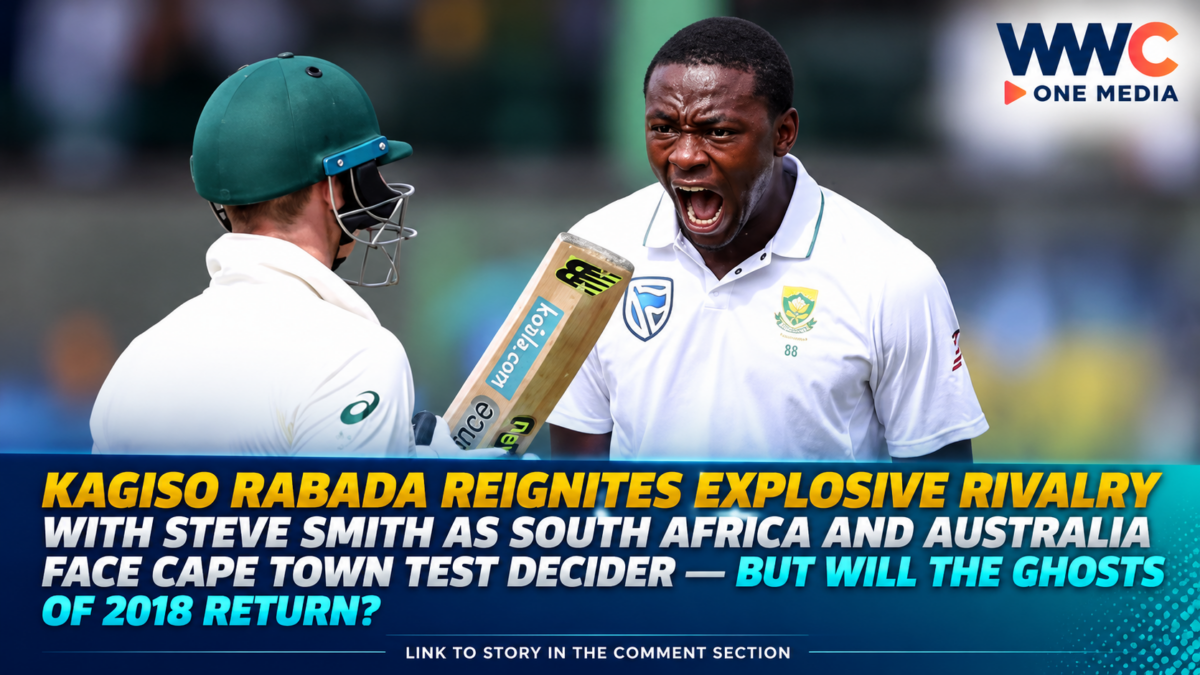
One of international cricket’s most intense rivalries has come roaring back, with South African fast-bowling star Kagiso Rabada and Australian batting legend Steve Smith preparing for another high-stakes showdown that could determine the winner of a fiercely contested Test series.
Eight years after their explosive encounters became part of one of cricket’s most controversial tours, the two stars are once again at the center of attention as South Africa and Australia prepare for the third and final Test at Newlands in Cape Town on October 27.
With the three-match series tied at 1-1, the stakes could hardly be higher. South Africa are riding a wave of momentum following a crushing victory, while Australia must recover from a humiliating defeat and growing concerns about Smith’s physical condition.
The question now is whether Australia’s experienced batting lineup can withstand Rabada’s renewed aggression—or whether South Africa’s pace spearhead will deliver another match-defining performance.
South Africa’s stunning comeback changes everything
South Africa dramatically revived their chances of winning the series after defeating Australia by an innings and 31 runs in the second Test at St George’s Park in Gqeberha on October 22.
The emphatic victory leveled the contest and transformed the final Test into a winner-takes-all battle.
Rabada played a major role in the comeback after returning from an extended absence caused by a hamstring injury.
Despite the lengthy layoff, the South African paceman immediately demonstrated why he remains one of the most feared fast bowlers in world cricket.
He captured four wickets in Australia’s second innings, including the prized dismissal of Smith, whose wicket became a defining moment of the contest.
The result gave South Africa renewed confidence heading into the series finale and placed the Australians under significant pressure to respond.
Steve Smith’s costly mistake raises concerns
For Australia, Smith’s dismissal was particularly damaging.
The 37-year-old former captain had reached a remarkable personal milestone during the second Test, surpassing 11,000 career runs in Test cricket.
However, his achievements were overshadowed by an unusually poor decision against Rabada’s short-pitched bowling.
With Australia already in serious trouble, Smith attempted to hook a bouncer early in his innings, only to miscue the shot and send a catch toward midwicket.
He departed for just three runs.
The dismissal was especially surprising given Smith’s reputation for extraordinary concentration, technical skill and his ability to withstand demanding bowling spells.
Adding to Australia’s concerns, Smith was reportedly struggling with a neck complaint during the match.
Although Rabada acknowledged that the Australian star was not fully fit, he emphasized that Smith remained one of the most important wickets in international cricket.
Removing Australia’s most accomplished batter early, he explained, increases the pressure on the rest of the team.
Smith’s physical condition and ability to recover before the Cape Town Test could become crucial factors in Australia’s hopes of securing the series.
The infamous 2018 rivalry returns to the spotlight
The renewed confrontation carries an extraordinary historical backdrop.
When Australia toured South Africa in 2018, Rabada and Smith became central figures in a series remembered as much for its controversies as for its extraordinary cricket.
During the second Test in Port Elizabeth, now known as Gqeberha, Rabada dismissed Smith and made shoulder contact with the Australian batter while celebrating.
The incident triggered disciplinary action against the South African fast bowler.
Rabada was initially handed a two-match suspension, but the penalty was subsequently reduced to a fine following an appeal.
The confrontation became one of several flashpoints during an increasingly hostile series.
Yet the controversy surrounding that tour would eventually become much bigger than the dispute between the two players.
Sandpapergate: The scandal that changed Australian cricket
The 2018 South Africa-Australia series is inseparable from the infamous Sandpapergate ball-tampering scandal at Newlands.
Australian player Cameron Bancroft was caught using sandpaper to alter the condition of the cricket ball during the third Test in Cape Town.
The revelations triggered a crisis for Australian cricket.
Smith, who was Australia’s captain at the time, was stripped of the captaincy and received a 12-month ban from Cricket Australia.
David Warner also received a 12-month ban, while Bancroft was suspended for nine months.
The scandal damaged Australia’s international reputation and reshaped the careers of several players.
For Smith, returning to Newlands for a Test match carries particular historical significance.
Although he returned to the venue for a Twenty20 international in 2020, this will be his first Test appearance at the ground since the 2018 controversy.
Smith has previously acknowledged the emotional difficulty of that period and explained that he has tried to move forward from the experience.
His return to Cape Town now presents an opportunity to create a very different memory at one of cricket’s most recognizable venues.
Rabada insists there is no personal hatred
Despite their confrontational history, Rabada has dismissed suggestions that his rivalry with Smith is driven by personal animosity.
The South African bowler emphasized that heated exchanges are part of competing at the highest level, particularly when elite athletes are battling under enormous pressure.
His comments suggest that both players view the rivalry primarily as a professional contest rather than a personal feud.
That distinction is important as anticipation builds for another encounter between a world-class pace bowler and one of Australia’s most successful Test batters.
Their battle could nevertheless become the defining individual contest of the series.
Why the Cape Town Test matters
Beyond the personal history between Rabada and Smith, the final Test represents an important opportunity for both national teams.
South Africa enter the contest with renewed belief after proving that their bowling attack can dismantle Australia’s batting order.
Australia, meanwhile, must demonstrate that their experienced players can respond under pressure following one of the most decisive defeats of the series.
For Rabada, another exceptional performance would strengthen his reputation as a bowler capable of delivering when the stakes are highest.
For Smith, the challenge is equally significant.
He must overcome questions surrounding his fitness, rediscover his batting rhythm and help Australia avoid another collapse.
The psychological battle could be just as important as the technical contest.
Australia will be determined to prevent Rabada from dominating the early exchanges, while South Africa will seek to exploit the confidence gained from their Gqeberha victory.
Can Smith silence Rabada, or will South Africa complete the comeback?
The deciding Test begins Tuesday, October 27, at Newlands, where memories of cricket’s most infamous modern scandal remain closely associated with Australia’s previous visit.
This time, however, both teams have an opportunity to ensure that their performances—not controversy—define the occasion.
South Africa have the momentum. Australia have experience and plenty to prove.
And at the heart of the battle stands a familiar confrontation: Rabada charging toward the crease, Smith waiting with bat in hand and a series on the line.
Will Steve Smith deliver redemption at the scene of his greatest cricketing controversy, or will Kagiso Rabada lead South Africa to another devastating victory?
The answer will emerge when the teams meet for the Cape Town decider.