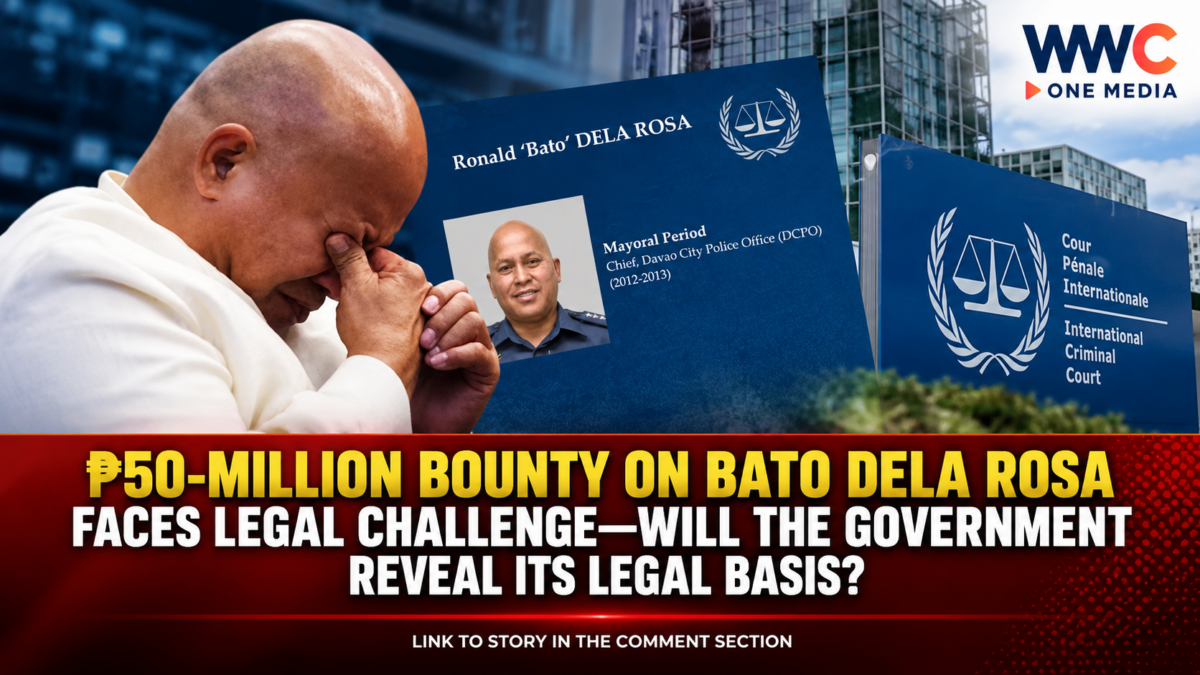
The Philippine government’s ₱50-million reward for the arrest of Senator Ronald “Bato” Dela Rosa is facing a legal challenge, with his lawyers demanding that authorities explain the legal basis for the bounty and identify the documents authorizing the operation.
The Law Firm of Torreon & Partners, which represents Dela Rosa, questioned the Department of the Interior and Local Government’s (DILG) decision to offer the reward, arguing that the government must establish the legal foundation for using public funds to facilitate the senator’s arrest.
The dispute adds another layer to the controversy surrounding Dela Rosa, who is wanted by the International Criminal Court (ICC) over alleged crimes against humanity linked to former president Rodrigo Duterte’s anti-drug campaign.
Lawyers Question the Legal Basis of the Reward
In a statement reported by GMA News and TV5 News on October 23, Dela Rosa’s lawyers argued that the government had not identified a Philippine court-issued arrest warrant that could serve as the basis for the reward.
The law firm maintained that the document cited by authorities was an arrest warrant issued by the ICC, an international tribunal operating under the Rome Statute.
The Philippines’ withdrawal from the Rome Statute took effect on March 17, 2019. Dela Rosa’s lawyers contend that the withdrawal raises questions about the domestic legal authority for implementing the ICC warrant and using government funds to support the operation.
The lawyers also called on the DILG to disclose the applicable memorandum circular, the criminal case number, the issuing court, and the specific legal provisions authorizing the reward.
They further questioned the government’s description of Dela Rosa as “armed and dangerous,” arguing that the public designation should have a clearly established basis.
These statements reflect the legal position of Dela Rosa’s camp. They do not, by themselves, establish that the bounty is illegal or that the ICC warrant cannot be implemented.
Where Will the ₱50 Million Come From?
Interior Secretary Juanito Victor “Jonvic” Remulla announced the ₱50-million reward on October 23, describing the move as part of the government’s intensified efforts to locate and arrest the senator.
According to reports by GMA News and The Philippine Star, the reward would be sourced from intelligence funds of the DILG and the Philippine National Police (PNP).
Dela Rosa’s lawyers argued that the use of intelligence funds must comply with applicable government accounting, auditing, and documentation requirements. They called for authorities to explain how the proposed expenditure meets those requirements and how any reward payment would be authorized and documented.
The issue places the government’s use of confidential funds under scrutiny, particularly because the operation involves an ICC arrest warrant and a senator whose whereabouts remain uncertain.
The lawyers are seeking a clear explanation of the legal and administrative basis for the expenditure.
Why Is Dela Rosa Wanted by the ICC?
The controversy stems from the ICC’s investigation into alleged crimes against humanity associated with the Duterte administration’s war on drugs.
Dela Rosa served as Philippine National Police chief from 2016 to 2018, during the early years of the anti-drug campaign. The ICC accuses him of alleged responsibility for crimes against humanity connected to killings during that period.
The allegations are not a final determination of guilt. Dela Rosa and Duterte have denied authorizing extrajudicial killings.
Duterte was arrested in March 2025 and transferred to the Netherlands to face proceedings before the ICC. Dela Rosa, meanwhile, has remained out of public view since leaving the Senate premises in May 2026.
Authorities have said they are pursuing efforts to locate the senator and have urged him to surrender.
Is a Philippine Arrest Warrant Necessary?
The question of whether authorities need a separate Philippine court warrant to implement an ICC warrant has already divided legal commentators.
In a report published in May 2026, GMA News quoted National Union of Peoples’ Lawyers president Ephraim Cortez and other legal figures who argued that a separate local warrant may not be necessary to implement the ICC’s process.
They cited constitutional principles recognizing generally accepted principles of international law and provisions of Republic Act No. 9851, the Philippine Act on Crimes Against International Humanitarian Law, Genocide, and Other Crimes Against Humanity.
Other political and legal figures have argued that constitutional protections and domestic judicial procedures must be considered before an arrest or transfer can take place.
The competing arguments illustrate why the latest challenge should not be treated as a settled legal ruling. The legality of the reward, the rules governing the use of intelligence funds, and the implementation of the ICC warrant are related but distinct questions.
What Happens Next?
The immediate issue is whether the DILG will provide the documents and legal justification requested by Dela Rosa’s lawyers and whether the challenge will lead to further administrative or judicial proceedings.
The government has maintained that it is pursuing the senator’s arrest. Authorities have also warned of potential security risks associated with an operation in areas where armed groups may be present, while emphasizing the preference for a peaceful surrender.
The dispute now raises a broader question about accountability, public spending, and the government’s obligations under domestic law and international legal processes.
Will authorities publicly establish the legal basis for the ₱50-million reward, or will Dela Rosa’s lawyers take their challenge further?
For now, the bounty remains at the center of a growing legal and political controversy, with its ultimate legal status dependent on the applicable rules, official documentation, and any authoritative determination by the proper institutions.