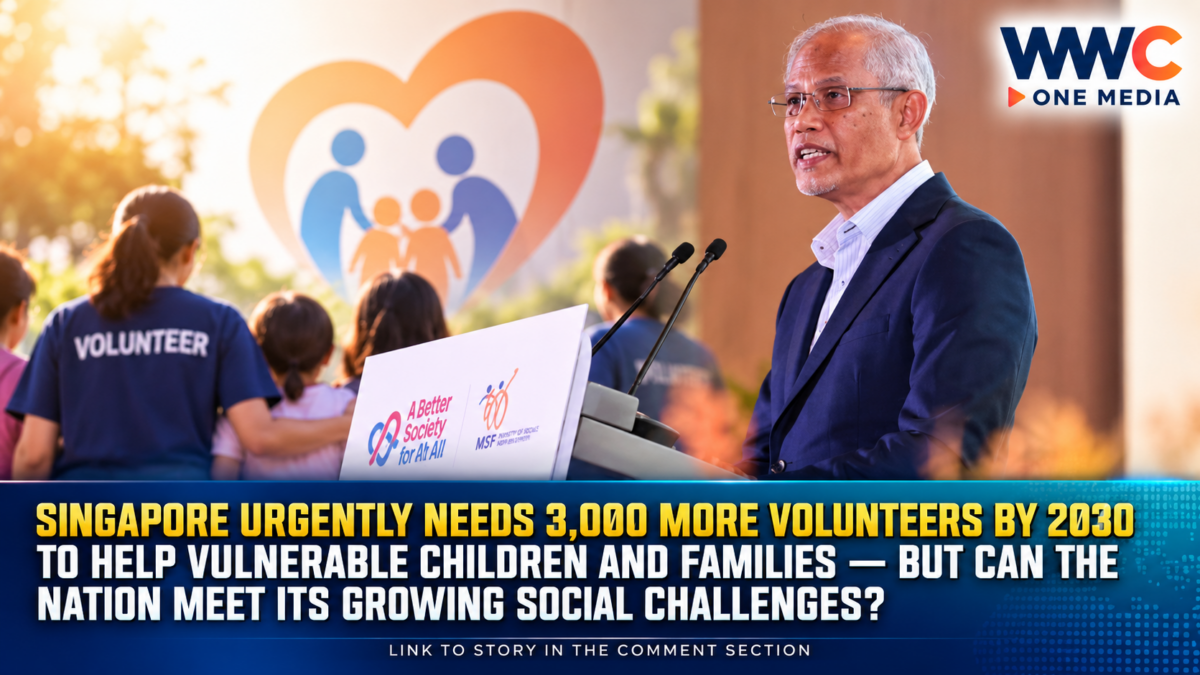
Singapore, October 24, 2026 — Singapore is preparing for a major expansion of its social support network, with the government seeking approximately 3,000 additional regular volunteers by 2030 to help vulnerable children, struggling families and young people navigating difficult circumstances.
The ambitious target would roughly double the Ministry of Social and Family Development’s (MSF) existing pool of more than 3,000 active volunteers, reflecting a broader effort to strengthen community support as social needs become increasingly complex.
Minister for Social and Family Development Masagos Zulkifli announced the direction at the MSF Volunteer and Partner Awards on October 23, emphasizing that Singapore needs more than occasional acts of kindness to address the long-term challenges confronting vulnerable individuals.
Instead, the government wants volunteers to develop lasting relationships, guide families toward stability and take on greater leadership responsibilities.
Singapore’s Volunteer Expansion: Why 3,000 More People Are Needed
The expansion comes as Singapore seeks to strengthen its community-based social support system, particularly in areas such as youth rehabilitation, child protection, family assistance, mentoring and fostering.
Under the plan, volunteers will increasingly work alongside trained professionals, community organizations and families to provide consistent assistance.
The ministry is moving away from a model focused primarily on isolated volunteering activities toward one that measures progress in people’s lives.
For families experiencing financial difficulties, this could mean sustained encouragement and practical guidance toward employment or greater financial stability.
For children in alternative care arrangements, it could mean having a dependable adult who remains involved through difficult transitions.
And for young people undergoing rehabilitation, it could mean receiving structured mentoring that continues as they prepare to return to their communities.
The shift signals a significant change in how Singapore intends to mobilize volunteers: not simply as additional helping hands, but as trusted members of a wider social support network.
Three Major Changes Could Transform Volunteerism in Singapore
Masagos outlined three priorities intended to redefine community volunteering.
First, focus on outcomes rather than activities.
Volunteers will be encouraged to help individuals achieve meaningful goals, including greater family stability, improved employment prospects and successful youth rehabilitation.
Second, build long-term relationships instead of offering only occasional assistance.
The ministry recognizes that individuals facing complicated social difficulties often require consistent emotional support and encouragement over extended periods.
Third, create stronger volunteer leadership opportunities.
Experienced volunteers will increasingly help train newcomers, guide programmes and propose improvements to community initiatives.
Together, these changes are designed to make volunteering more sustainable and potentially more effective in addressing persistent social challenges.
New Programmes Aim to Protect Vulnerable Children
One of the most significant developments involves new initiatives designed to support children and young people in Singapore’s care system.
Under the Transition Support Companions programme, volunteers will provide a stable adult presence for children and young people moving between different care settings.
Such transitions can be emotionally challenging, particularly for children who have already experienced family instability or other difficult circumstances.
The initiative aims to provide continuity, strengthen relationships and help young people adjust to unfamiliar environments.
Another initiative, Project Care, provides counselling-related support to families, helping parents and caregivers better understand children’s emotional needs and behaviour.
According to reporting by The Straits Times, the programme involves people pursuing or having completed master’s-level counselling studies.
Both initiatives are being piloted through the MSFCare Network, with plans to expand their combined volunteer involvement to 300 by 2027.
These programmes highlight an increasingly important principle in social care: protecting vulnerable children requires not only professional intervention but also reliable relationships and sustained family support.
Nearly 100 Mentors Supporting Youth Rehabilitation
Singapore is also expanding the responsibilities of volunteers working with young people in rehabilitation.
Under the Youth Home Mentors initiative at Singapore Boys’ Home and Singapore Girls’ Home, volunteers collaborate with staff to understand young people’s personal goals and provide structured guidance.
The programme currently involves nearly 100 mentors and more than 100 youths.
Mentors work to strengthen confidence, encourage positive relationships and support young people as they prepare to reintegrate into society.
The initiative also aims to reduce the risk of reoffending by helping young people develop stronger foundations for their future.
Rather than focusing exclusively on activities inside rehabilitation facilities, the mentoring approach emphasizes the longer-term outcomes that young people can achieve.
University Students Contribute More Than 20,000 Volunteer Hours
The National University of Singapore (NUS) has emerged as an important partner in the expansion of community volunteering.
Through a collaboration with MSF under the ComLink+ programme, more than 1,100 student befrienders have contributed over 20,000 volunteer hours since 2022.
The programme connects volunteers with lower-income families who may need assistance with employment, housing aspirations and financial stability.
More than 340 students joined as volunteer befrienders in 2025, and the university has broadened its involvement to include alumni and staff.
The initiative demonstrates how educational institutions can support Singapore’s social assistance programmes while providing students with practical experience serving communities.
Decades of Service Show Why Long-Term Commitment Matters
Beyond the government’s recruitment targets, individual volunteers continue to demonstrate how sustained involvement can make a difference.
The Straits Times reported that 68-year-old Mildred Tan, who received a Lifetime Achievement Award in 2026, has contributed more than 25 years of service in areas involving family support, women’s development and the protection of vulnerable individuals.
Her long-standing commitment reflects the direction Singapore is encouraging more volunteers to take.
Another volunteer recognized at the awards, Irene Soh, has helped families in Boon Lay through home visits, practical assistance and community initiatives.
An effort she began during the pandemic to distribute Mother’s Day cakes to single mothers has evolved into regular birthday cake distributions, reaching approximately 50 to 60 recipients monthly.
These activities have also created opportunities for volunteers to identify residents who may need additional support.
Such grassroots efforts illustrate how seemingly modest acts of kindness can develop into meaningful community relationships.
Can Singapore Reach Its 2030 Volunteer Target?
While the recruitment target represents an ambitious expansion, attracting 3,000 additional regular volunteers is only part of the challenge.
Long-term volunteering requires time, reliability, appropriate training and the willingness to establish relationships with individuals facing complicated circumstances.
Programmes involving vulnerable children, counselling-related assistance and youth rehabilitation also require careful supervision and coordination with qualified professionals.
The success of Singapore’s strategy will therefore depend not only on volunteer numbers, but also on retention, training and the measurable benefits delivered to families and individuals.
The ministry’s emphasis on sustained engagement reflects an understanding that complex social difficulties rarely disappear after a single intervention.
The bigger question is whether Singapore can turn its willingness to volunteer into a dependable, long-term support system for the people who need it most.
With the 2030 deadline approaching, the country’s next test will be whether thousands of additional residents are prepared to move beyond occasional community service and become consistent sources of support for vulnerable families and children.
For Singapore, the challenge is no longer simply finding people willing to help. It is building a volunteer network capable of making that help last.