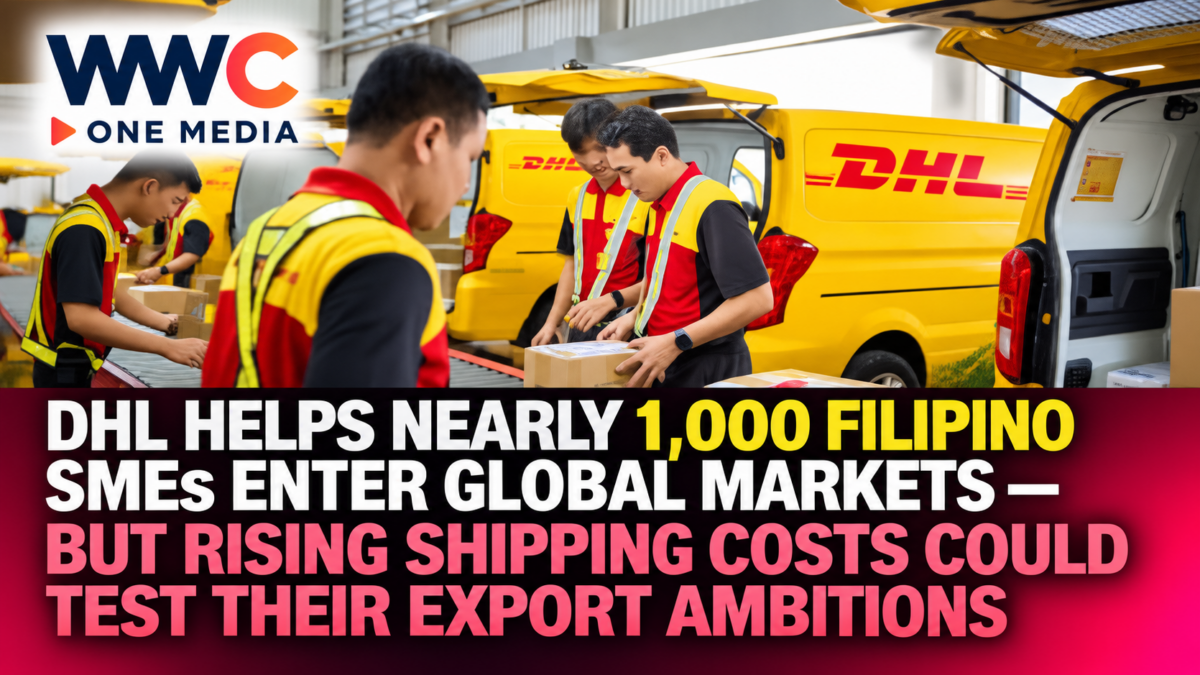
MANILA, PHILIPPINES — Nearly 1,000 Filipino small businesses have taken their first steps into international trade through DHL Express, highlighting a growing movement among local entrepreneurs seeking customers beyond the Philippine market.
The development comes as DHL Group expands its GoTrade initiative, a program designed to help micro, small and medium enterprises overcome the financial, technological and logistical challenges associated with selling products overseas.
During the DHL GoTrade Summit 2026 in Manila on October 6, company executives revealed that approximately 900 to 1,000 Philippine MSMEs had opened DHL accounts and started shipping internationally for the first time over the previous two to three years.
The figure signals growing interest among Filipino entrepreneurs in international markets, particularly across Asia, North America and selected Middle Eastern economies.
But while opportunities are expanding, smaller exporters face a significant challenge.
International shipping is becoming more expensive, customs requirements remain complicated, and many Filipino businesses still lack the financing and expertise needed to compete successfully abroad.
The question is whether programs such as DHL GoTrade can help turn export ambitions into sustainable international businesses.
Nearly 1,000 Filipino Businesses Take Their First Step Abroad
DHL Express Philippines Managing Director Nigel Lockett said the company has observed growing interest in international shipping among local entrepreneurs.
According to DHL’s internal figures, approximately 900 to 1,000 Philippine MSMEs have started shipping internationally through its network over the past two to three years.
The businesses are involved in industries such as fashion, retail and consumer products.
These sectors are particularly suited to cross-border e-commerce because entrepreneurs can potentially reach overseas customers without establishing physical stores in other countries.
The figures are encouraging, but they require an important distinction.
Opening a shipping account and sending an international shipment does not automatically mean a business has established a profitable export operation.
Long-term success depends on repeat orders, sustainable shipping expenses, regulatory compliance and customer demand.
Nevertheless, DHL’s data suggests that more Filipino entrepreneurs are willing to explore markets beyond their traditional domestic customer base.
Philippine MSMEs Represent 99.6% of Businesses
The opportunity is substantial because smaller enterprises dominate the Philippine economy.
According to figures presented at the GoTrade Summit, the country has approximately 1.24 million MSMEs, representing around 99.6% of registered business establishments.
These businesses support approximately 6.35 million jobs, making them essential to employment and local economic activity.
However, many MSMEs primarily serve customers within the Philippines.
Some sell through neighborhood stores.
Others operate through Facebook, Instagram, TikTok or online marketplaces.
For these businesses, reaching international customers can unlock opportunities for additional sales and business expansion.
But a significant gap remains between operating a successful local enterprise and becoming a competitive exporter.
International trade requires knowledge of customs documentation, shipping procedures, foreign regulations and customer expectations.
DHL’s GoTrade initiative aims to narrow that gap.
DHL GoTrade Targets Four Major Export Barriers
The GoTrade program focuses on helping smaller businesses address four major obstacles: access to financing, trade knowledge and skills, digital technology, and logistics.
These challenges frequently overlap.
A business may manufacture a high-quality product but lack the financing needed to produce larger orders.
Another may receive interest from overseas buyers but struggle to calculate shipping costs.
Some entrepreneurs are unfamiliar with international customs requirements.
Others have limited access to digital platforms that allow them to accept payments and reach foreign customers.
GoTrade combines training, industry partnerships and logistics expertise to help businesses address those problems.
The objective is to make international trade more accessible to smaller enterprises rather than leaving export opportunities primarily to large corporations.
Nearly 200 Philippine Businesses Have Received Training This Year
DHL Group GoTrade Head Sarah Meinert said almost 200 Philippine businesses had received training through the initiative in 2026.
Additional sessions are planned through partnerships with government agencies and private-sector organizations.
The training targets entrepreneurs with products that could potentially compete internationally.
These include locally produced handicrafts, coconut-based goods and other consumer products.
For many smaller businesses, the first challenge is determining whether their products are suitable for international markets.
Export readiness involves more than producing something customers want.
Businesses must understand foreign regulations, product packaging, labeling, documentation and delivery requirements.
Training can help reduce mistakes that might otherwise cause shipment delays, unexpected costs or rejected deliveries.
DHL’s figures demonstrate the program’s reach, although the company has not established that every training participant subsequently became an active exporter.
DHL and DTI Are Working Together
The GoTrade expansion builds on an earlier partnership between DHL Group Philippines and the Department of Trade and Industry.
In September 2025, the two organizations signed a memorandum of understanding to strengthen Philippine MSMEs’ export capabilities.
The agreement involves several DHL business units.
DHL Express provides international parcel delivery and customs-related services.
DHL Global Forwarding supports international air and ocean freight.
DHL Supply Chain provides warehousing and contract logistics solutions.
This arrangement allows participating businesses to learn about different shipping and distribution options as their operations expand.
The partnership also includes training workshops, consultations and market information.
It represents an effort to combine government export-development programs with private-sector logistics expertise.
The United States Remains an Important Export Market
According to DHL’s October 2026 briefing, Filipino MSMEs using its international shipping services are finding opportunities in several established markets.
These include the United States, Canada, Singapore, Japan, Australia and Hong Kong.
Each market offers potential advantages.
The United States has a large consumer economy and substantial Filipino communities.
Singapore serves as a major Southeast Asian business and logistics center.
Japan provides opportunities for specialized consumer products, subject to strict quality and compliance requirements.
Australia and Canada are also potential destinations for Philippine-made goods.
However, market potential does not guarantee commercial success.
Entrepreneurs must research customer demand, competing products, import rules and delivery costs before committing substantial resources.
ASEAN and the Middle East Offer New Opportunities
DHL is also identifying opportunities beyond traditional export destinations.
The company sees growth potential in neighboring ASEAN economies and selected Middle Eastern markets.
This reflects broader changes in international trade.
Businesses are increasingly exploring regional supply chains and diversifying their commercial relationships.
For Philippine exporters, nearby Asian countries may offer opportunities to reach new customers and develop more resilient sales networks.
However, geographic proximity does not always guarantee inexpensive shipping.
Delivery costs depend on the destination, shipment size, service selected and applicable surcharges.
Exporters also need to consider differences in product regulations, consumer preferences and import taxes.
A successful market-entry strategy therefore requires more than choosing a country with strong economic growth.
DHL Sees the Philippines as a High-Growth Market
DHL Express Asia-Pacific CEO Ken Lee said the Philippines is among the economies expected to benefit from changing global trade patterns.
During the summit, Lee identified the country as part of a group of 22 economies DHL expects to experience relatively strong growth.
The company believes increasing trade within Asia and supply-chain diversification could support greater international shipment volumes.
Technology, life sciences and new-energy industries were also identified as potential sources of logistics demand.
These developments could create opportunities for Philippine businesses supplying products and services to international customers.
However, DHL’s assessment is a business outlook, not a guarantee of higher Philippine exports.
Actual growth will depend on global demand, investment conditions and the country’s ability to remain internationally competitive.
A Bigger Manila Gateway Could Support Philippine Exporters
DHL has also invested in physical infrastructure to support international trade.
In May 2026, the company opened an expanded Manila Gateway in Parañaque City.
The facility represents an investment of approximately €9 million.
According to DHL, the upgraded gateway can process up to 2,400 import parcels and 2,000 export parcels per hour.
The expansion is intended to strengthen shipment processing and improve connectivity with DHL’s international network.
That could benefit businesses needing predictable delivery schedules.
Fast and reliable shipping can be particularly important for online sellers, time-sensitive products and customers who expect accurate delivery information.
But additional logistics capacity does not automatically make exporting affordable.
Businesses must still evaluate whether their products can absorb the cost of international transportation.
The Biggest Challenge: DHL Shipping Rates Are Rising
Despite the growth opportunities, Filipino exporters face a new financial obstacle.
DHL Express has announced an average 5.9% increase in Philippine shipping rates effective January 1, 2027.
The company attributed the adjustment to rising operating expenses, inflation, currency movements and continued investment in its logistics network.
The increase could affect small businesses that depend on international express shipping.
For exporters selling relatively inexpensive products, shipping can account for a significant portion of the final customer price.
Higher delivery charges may force entrepreneurs to adjust product prices or accept lower profit margins.
Businesses shipping lightweight, high-value products may find international express delivery easier to justify than companies exporting bulky, low-value goods.
The 5.9% figure is an average adjustment, not necessarily the exact increase for every shipment or service.
Nevertheless, the timing creates a challenge.
DHL is helping more businesses enter international markets while the cost of using its express delivery network is set to increase.
Exporters Must Understand the True Cost of Shipping
One common challenge for first-time exporters is determining the full cost of delivering products overseas.
The courier’s quoted shipping charge may not represent the final expense.
Businesses may also encounter customs duties, taxes, insurance costs, fuel surcharges and additional handling fees.
These expenses can affect profitability.
For example, an entrepreneur selling a product for ₱1,000 may discover that international transportation and related charges significantly increase the final price paid by the customer.
If a foreign buyer can purchase a similar product locally for less, the Philippine exporter may struggle to compete.
That makes accurate pricing essential.
DHL’s own export guidance advises businesses to understand their total landed costs—the combined expenses associated with getting a product into its destination market.
Exporters must also clarify whether the seller or buyer is responsible for applicable duties and taxes.
Customs Compliance Can Make or Break an Export Business
Another major obstacle involves documentation.
Products shipped internationally may require invoices, declarations, permits and compliance with destination-country regulations.
Food products can be especially complicated because importing countries may impose strict requirements involving safety, ingredients, labeling and product registration.
Other goods may require different documentation.
Entrepreneurs must also satisfy applicable Philippine export requirements.
DHL’s September 2026 guidance explains that businesses may need appropriate Bureau of Customs accreditation and product-specific permits.
These requirements vary depending on the type of product and transaction.
Failure to comply can lead to delays, added expenses or shipment rejection.
That is why export training remains important even when a business already has customers willing to buy its products.
E-Commerce Could Help Small Businesses Compete Globally
Digital platforms are creating new opportunities for entrepreneurs who previously depended on physical stores.
Social media allows businesses to display products to international audiences.
E-commerce platforms can help manage orders and customer interactions.
Digital payments may simplify transactions.
For Philippine manufacturers and sellers, these tools can reduce some of the barriers associated with entering foreign markets.
A business no longer necessarily needs an overseas retail store to make its first international sale.
However, selling online does not eliminate traditional trade requirements.
Products still need to be shipped.
Customs regulations still apply.
Customers still expect reliable delivery.
And businesses must manage returns, complaints and product quality.
Digital marketing may create demand, but logistics determines whether orders can be fulfilled successfully.
Global GoTrade Program Has Reached Thousands of Businesses
DHL’s Philippine initiative is part of a larger international program.
According to figures presented during the October summit, GoTrade has trained approximately 10,351 MSMEs through 96 projects in 45 countries.
The program works with government organizations, development institutions and other partners.
In September 2026, DHL and the International Trade Centre renewed their partnership supporting smaller businesses, particularly women-led enterprises seeking to participate in international trade.
The renewed agreement focuses on trade knowledge, logistics, supply chains and institutional support.
DHL said its longer-running collaboration with the International Trade Centre has supported businesses across Africa, ASEAN, Latin America and the Caribbean.
These partnerships reflect an important principle.
Expanding international trade requires cooperation between logistics providers, policymakers, financial institutions and businesses themselves.
The Opportunity Extends Beyond Metro Manila
DHL has identified several Philippine regions with potential for additional export growth.
These include CALABARZON, Central Luzon, Central Visayas and the Davao Region.
The regions support different manufacturing, agricultural and commercial activities.
For provincial businesses, international trade can create opportunities beyond local demand.
Producers of handicrafts, processed food and specialized consumer products may be able to reach overseas buyers through digital sales channels.
But regional exporters can face additional costs.
Goods may need to travel from provincial production facilities to international shipping gateways.
Domestic transportation, packaging and warehousing can increase expenses.
Improving regional logistics connections is therefore important if export growth is to extend beyond major cities.
The Real Challenge Is Turning First Shipments Into Repeat Customers
The figure of nearly 1,000 first-time exporters is an encouraging sign.
But the more meaningful measure of success will be how many continue exporting.
Sending one shipment abroad can demonstrate that a business is capable of reaching an international customer.
Building a sustainable export operation requires much more.
A company needs consistent demand, reliable products and a financially viable pricing strategy.
It must also respond to customer concerns and manage delivery problems.
Repeat customers are particularly important because they provide opportunities for more predictable revenue.
For DHL and its government partners, the next challenge is helping newly participating businesses move beyond experimentation.
That means supporting entrepreneurs as they build commercial relationships and improve their competitiveness.
A New Opportunity for Filipino-Made Products
The GoTrade initiative highlights the potential for Philippine businesses to participate more actively in global commerce.
Many Filipino entrepreneurs produce goods that could appeal to international consumers.
These include handmade products, coconut-based goods, fashion items and specialty consumer products.
But having an attractive product is only the beginning.
Businesses must understand foreign markets, price products competitively and comply with international requirements.
They also need affordable and reliable transportation.
Programs such as DHL GoTrade can provide training and access to expertise.
Yet business owners remain responsible for determining whether exporting makes financial sense.
The ultimate objective should not simply be increasing the number of businesses sending goods abroad.
It should be developing exporters capable of generating recurring sales and sustainable profits.
DHL Opens the Door to Global Markets—But Can Filipino SMEs Afford to Walk Through It?
The latest figures suggest that Philippine MSMEs are becoming more ambitious.
Nearly 1,000 businesses have started international shipping through DHL over the past two to three years.
Almost 200 have received GoTrade training in 2026.
The government and DHL are working together to expand export readiness.
And new investments in logistics infrastructure could support additional trade.
But the challenges remain substantial.
Shipping rates are increasing.
Customs requirements can be complicated.
International competition is intense.
And many small businesses still lack financing and specialized trade knowledge.
DHL is helping Filipino entrepreneurs discover customers beyond the Philippines.
But the bigger challenge is ensuring that overseas sales generate enough profit to justify the cost of reaching those customers.
The question is whether the next wave of Filipino MSMEs can transform their first international shipments into lasting export businesses—or whether rising costs and complex trade rules will keep global markets beyond their reach.