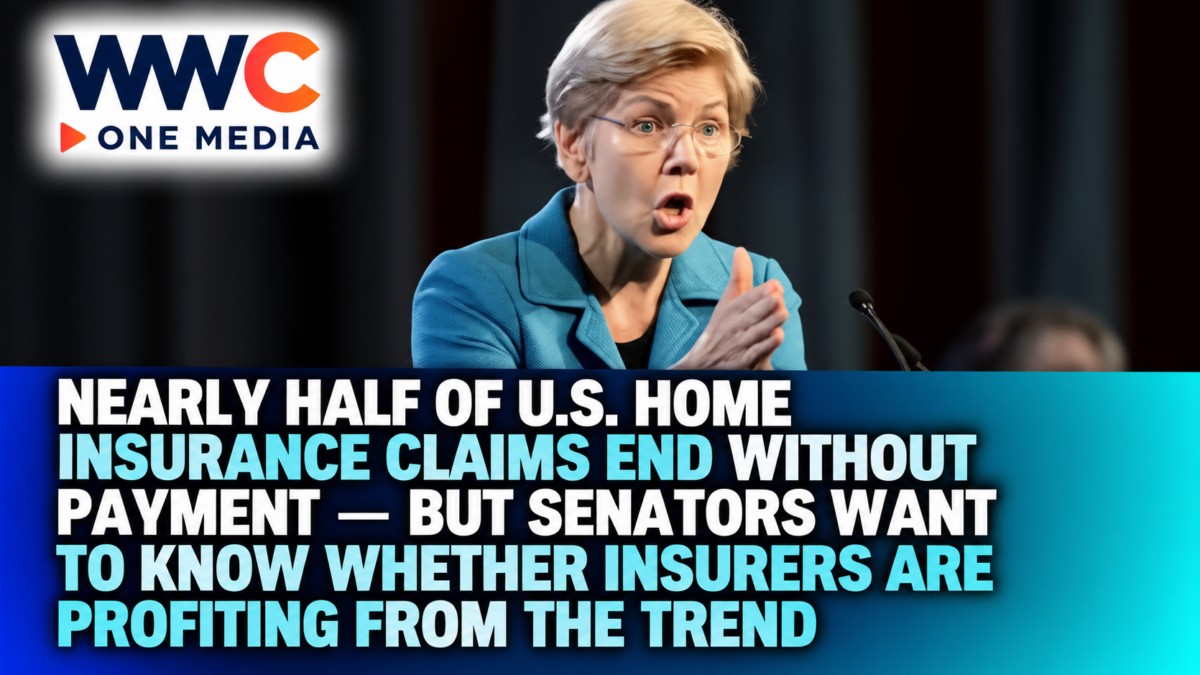
WASHINGTON — Two American senators from opposing political parties are joining forces to investigate why a growing share of home and auto insurance claims end without payment, raising questions about whether some of the nation’s largest insurers are providing the financial protection their customers expect.
Senator Elizabeth Warren, a Massachusetts Democrat, and Senator Josh Hawley, a Missouri Republican, sent letters dated October 2 to six major insurance companies, demanding detailed records covering the past decade.
The companies are State Farm, Allstate, USAA, Farmers Insurance Group, Liberty Mutual and American Family Insurance.
The senators want to know why the proportion of claims closed without payment has increased and whether changes in company policies or financial incentives have contributed to the trend.
Their inquiry follows reporting by The Wall Street Journal showing that more than four in ten resolved homeowners insurance claims at the five largest insurers resulted in no payment in 2025.
Similar patterns were identified in automobile liability and medical insurance.
The findings are particularly significant because insurance premiums have increased dramatically, leaving homeowners and drivers paying more for coverage while questioning what protection they will actually receive.
But the controversy is not simply about how many claims went unpaid.
It is about why those claims went unpaid—and whether consumers are receiving fair treatment when they need financial assistance most.
Nearly 44% of Home Insurance Claims Resulted in No Payment
The congressional investigation was prompted by an examination of insurance-company regulatory filings conducted by The Wall Street Journal.
According to the report, America’s five largest homeowners insurers closed more than 44% of their resolved claims without payment in 2025.
A decade earlier, the corresponding figure was approximately 36%.
That represents an increase of roughly eight percentage points.
The figures have drawn attention because homeowners purchase insurance to protect themselves against potentially devastating financial losses.
A major storm, house fire or other disaster can result in expensive repairs.
When a claim is closed without payment, the homeowner may be left responsible for some or all of those expenses.
However, the 44% figure requires careful interpretation.
It includes multiple reasons for nonpayment, not solely formal denials.
For example, a homeowner may file a claim for damage costing less than the deductible.
In that situation, the insurance company may owe nothing under the policy.
Other claims may be withdrawn, duplicated or excluded under the applicable contract.
The rising percentage is significant, but it does not establish that 44% of claims were improperly rejected.Auto Insurance Customers Are Facing a Similar Pattern
The issue extends beyond homeowners.
A separate Wall Street Journal investigation found that approximately 45% of resolved automobile liability and medical claims ended without payment in 2025.
That compares with roughly 35% in 2016.
The findings suggest that the increase in zero-payment claims is not confined to one insurance category.
Automobile insurance is particularly important because drivers in nearly every U.S. state must maintain some form of liability coverage.
Consumers generally expect these policies to provide financial protection when accidents occur.
But coverage depends on the specific contract, the circumstances of an accident and applicable legal requirements.
A claim may produce no payment from one insurer because another company is responsible for the loss.
That is different from a company improperly refusing to pay a valid claim.
Warren and Hawley want insurers to explain how much of the increase reflects these ordinary circumstances and how much may be related to changes in claims management.
Six Major Insurance Companies Face Questions
The inquiry covers some of the largest providers of personal insurance in the United States.
State Farm and Allstate are among the best-known brands in the industry.
USAA serves military members, veterans and eligible families.
Farmers, Liberty Mutual and American Family also provide significant homeowners and automobile coverage.
The senators are requesting information covering ten years of claims activity.
They want the companies to identify how many claims were paid, how many were closed without payment and why customers received nothing.
They are also asking about changes to claims-handling procedures and the use of automated technology.
The letters represent a congressional information request.
They are not criminal charges, regulatory findings or proof that any of the six companies has violated the law.
Why Warren and Hawley Are Investigating Together
The partnership between Warren and Hawley is notable because the senators frequently disagree on major political issues.
Warren has built much of her political career around consumer financial protection and corporate accountability.
Hawley has also questioned the power and practices of large corporations.
On insurance claims, they share a concern that consumers may be paying increasingly expensive premiums without receiving the protection they expect.
Warren is the ranking Democratic member of the Senate Banking, Housing and Urban Affairs Committee.
Their October 2 letters argue that the growing proportion of unpaid claims raises questions about whether insurers are fulfilling their responsibilities to policyholders.
The senators are seeking evidence rather than relying solely on the headline statistics.
That approach matters because understanding the reasons for nonpayment is essential to determining whether additional regulatory scrutiny is warranted.
Home Insurance Premiums Have Jumped 70%
The investigation comes as American homeowners face rapidly increasing insurance costs.
According to research published by the Federal Reserve Bank of Dallas in March 2026, average U.S. homeowners insurance premiums increased approximately 70% between 2019 and 2025.
The Dallas Fed attributed the rise partly to increasing climate-related disaster risks and higher construction costs.
For many households, insurance has become a more significant part of the monthly cost of owning a home.
In 2013, homeowners insurance premiums represented approximately 10% of the average mortgage principal-and-interest payment.
By 2025, that share had increased to 14%.
The research also found that rising premiums can contribute to financial distress.
Some households respond by relocating or searching for cheaper insurance.
Others struggle to afford higher costs.
The Dallas Fed estimated that insurance-premium increases contributed to approximately 31,000 additional mortgage delinquencies in 2022.
The concern is no longer limited to insurance affordability. Rising coverage costs can also threaten homeowners’ ability to keep up with their mortgages.
Higher Deductibles Could Explain Some Zero-Payment Claims
One important factor is the growing use of higher deductibles.
A deductible is the amount a policyholder must absorb before an insurance company begins paying an eligible claim.
For example, suppose a homeowner has a $3,000 deductible and experiences $2,500 in covered damage.
The insurer may legitimately close the claim without payment because the damage is below the deductible.
Higher deductibles can reduce insurance premiums.
But they also transfer more financial responsibility to policyholders.
The senators’ letter cites research showing that 26% of auto insurance customers had deductibles of at least $1,000 in 2025.
Some homeowners face special deductibles for hurricane or hail damage.
These may be calculated as a percentage of the insured property’s value rather than a fixed dollar amount.
As a result, customers may discover that they must pay thousands of dollars before their insurance coverage provides assistance.
This helps explain why Warren and Hawley are asking insurers to separate claims closed because of deductibles from those formally denied.
Storm Damage Claims Are Becoming More Complicated
Climate-related disasters have added another challenge.
Hurricanes, hailstorms and severe weather can cause extensive damage to homes and vehicles.
But insurance policies do not necessarily cover every type of damage.
For example, standard homeowners policies generally exclude flood damage.
A hurricane can cause both wind damage and flooding.
Determining which source caused particular losses can create disputes.
A homeowner may believe damage should be covered, while the insurer classifies it under an exclusion.
The senators cited reports of increasing disagreements over roof repairs and hurricane-related damage.
These disputes can delay the resolution of claims and leave households uncertain about how much financial assistance they will receive.
However, the existence of a coverage dispute does not automatically mean either party is acting dishonestly.
The relevant policy terms, evidence and applicable state regulations determine the outcome.
Insurance Companies Are Reporting Strong Profits
The investigation has also intensified scrutiny of insurance-industry profitability.
In their letters, Warren and Hawley cited estimates that U.S. property and casualty insurers earned approximately $136 billion in profits during 2025.
They also highlighted Allstate’s financial performance.
According to the senators, Allstate reported net income of approximately $10.2 billion in 2025, an increase of about $5.6 billion from 2024.
These results have prompted questions about whether insurers’ improved financial performance is partly connected to tighter claims-handling practices.
However, strong profitability does not establish that an insurer improperly withheld payments.
Insurance-company earnings depend on premium revenue, investment returns, underwriting expenses, catastrophe losses and other financial factors.
Industry representatives argue that recent profits must be considered alongside years of severe weather losses, rising repair expenses and inflation.
The senators want more detailed claims data to help determine whether there is any connection between company practices and the rise in zero-payment claims.
Are Insurers Rewarding Employees for Paying Less?
One of the most significant elements of the investigation concerns employee compensation.
Warren and Hawley want to know whether claims adjusters, managers or contractors receive financial incentives linked to claim outcomes.
Their letters ask companies to disclose whether bonuses or performance evaluations consider settlement amounts, claim severity, loss ratios or the percentage of claims closed without payment.
The concern is straightforward.
If employees are rewarded for reducing payouts, those incentives might influence how claims are evaluated.
But no conclusion can be drawn without examining the actual compensation structures.
The senators have not established that the six companies operate improper incentive programs.
They are requesting the information needed to assess that possibility.
Artificial Intelligence Is Also Under Scrutiny
The congressional letters raise another increasingly important question: how insurance companies use artificial intelligence.
Insurers employ technology to organize documents, analyze information and support claims processing.
Automated systems can help identify missing information, detect potential fraud and improve operational efficiency.
But they may also create risks if their recommendations are inaccurate or poorly supervised.
Warren and Hawley specifically asked the companies to explain their use of artificial intelligence, predictive analytics and other automated tools.
They also want to know what safeguards exist to ensure fair and accurate decisions.
The inquiry could provide greater transparency into how technology influences insurance claims.
However, the senators have not established that AI caused the increase in zero-payment claims.
The investigation is asking whether automation plays a role—not declaring that computers are improperly denying claims.
State Farm Says Zero Payment Does Not Mean Denial
State Farm has challenged the implication that every closed, unpaid claim represents a failure to honor an insurance policy.
The company said it evaluates claims according to the facts and coverage purchased.
It also explained that a claim may be closed without payment if the loss is smaller than the deductible or the policyholder decides not to continue.
USAA offered a similar explanation.
The insurer said zero-payment outcomes can arise for several reasons, including cases in which another insurance company ultimately pays.
These responses highlight a central weakness in interpreting aggregate claims statistics.
The term closed without payment covers multiple situations.
Some may involve legitimate contractual exclusions.
Others may involve customers withdrawing claims.
Still others could involve disputed decisions that deserve closer examination.
The insurers argue that these categories should not be treated as equivalent.
Insurance Industry Groups Dispute the Interpretation
The National Association of Mutual Insurance Companies has criticized the interpretation of the findings.
The organization argues that no-payment figures reported to regulators include claims that do not represent improper denials.
Examples include withdrawn claims, losses below deductibles and cases where another insurer provides compensation.
The association also raised concerns about how claims remaining open at year-end were treated in the statistical analysis.
That issue matters because an unresolved claim may eventually result in payment.
The Insurance Information Institute has similarly emphasized the financial pressures affecting insurers.
These include severe weather losses, expensive repairs, increasing construction costs and fraud.
Industry representatives say companies must maintain enough financial reserves to meet future claims, including those arising from major catastrophes.
Their argument is that insurance profitability and claims practices must be evaluated over time rather than through one year’s results.
These explanations do not eliminate the senators’ concerns, but they demonstrate why the investigation needs more detailed information before reaching conclusions.
A Zero-Payment Claim Is Different From a Wrongful Denial
The distinction between different claim outcomes is central to the story.
A customer may receive no payment because the loss is below the deductible.
A claim may be withdrawn because the customer decides to handle repairs independently.
Another insurer may pay the loss.
A policy may exclude a particular type of damage.
Alternatively, an insurance company may deny a claim that the customer believes should have been paid.
Those situations are not legally or financially identical.
The congressional inquiry is designed to separate them.
The senators want insurers to disclose how many claims fall into each category and how those figures have changed during the past decade.
Without that breakdown, it is impossible to determine precisely how much of the increase reflects legitimate insurance arrangements and how much may warrant stronger consumer protection.
Why Appeals and Reversed Denials Matter
Another major focus is what happens when customers challenge an insurer’s decision.
Warren and Hawley want to know how many unpaid claims were appealed or disputed.
They also want figures showing how frequently insurers subsequently reversed those decisions or made payments.
This information could be particularly revealing.
If a large percentage of disputed claims eventually results in payment, that might indicate weaknesses in the initial review process.
However, a reversal does not automatically prove misconduct.
Additional evidence, revised estimates or new documentation can legitimately change an insurer’s assessment.
The important question is whether companies consistently evaluate claims fairly and whether customers have effective opportunities to challenge decisions.
More Americans Are Considering Going Without Coverage
Rising premiums have created another troubling development.
Some households are deciding they can no longer afford homeowners insurance.
The senators cited research indicating that approximately 12% of Americans lacked homeowners coverage in 2024, compared with 5% in 2019.
Those figures come from research cited in their letters and should not be interpreted as an official count of every uninsured U.S. property.
Nevertheless, they illustrate the potential consequences of rising insurance costs.
A homeowner without insurance may face catastrophic financial losses after a fire, hurricane or other disaster.
People with outstanding mortgages may also be required by their lenders to maintain appropriate coverage.
For drivers, insurance is generally mandatory.
But higher premiums can still contribute to people operating vehicles without adequate coverage.
The Insurance Research Council estimated that 15.4% of U.S. drivers were uninsured in 2023.
The broader concern is that increasingly expensive insurance may weaken financial protection rather than strengthen it. Senate Banking Committee
The Insurance Crisis Could Affect the U.S. Housing Market
The Federal Reserve Bank of Dallas has warned that higher insurance costs can influence mortgage payments and household financial stability.
When premiums increase sharply, homeowners may respond by taking on additional debt, delaying mortgage payments or relocating.
Financially secure households may have greater freedom to switch insurers or move to lower-risk locations.
Lower-income households often have fewer options.
This can create unequal financial consequences.
The Dallas Fed estimated that continued increases in insurance premiums could contribute to additional mortgage delinquencies over the coming decades.
Its projections depend on assumptions about future premiums and should not be treated as guaranteed outcomes.
However, the research demonstrates why insurance affordability has become a broader economic issue.
An insurance system that becomes too expensive or unreliable can affect homeownership, consumer finances and even the stability of mortgage markets.
Could Congress Force Greater Transparency?
The senators are also asking whether insurers will publicly disclose annual claims data.
They want more information about how many claims are paid, how many are closed without payment and why.
Greater disclosure could help consumers compare insurance companies.
It could also allow researchers and regulators to identify unusual patterns.
However, the October letters are requests for information.
They do not themselves create new federal disclosure requirements.
Insurance regulation in the United States is primarily conducted at the state level.
Any significant changes to federal reporting obligations would require additional legislative or regulatory action.
For now, the immediate objective is to obtain detailed information from the six companies.
Insurers Face an October 16 Deadline
Warren and Hawley have asked the companies to respond by October 16, 2026.
The requested information covers ten years of homeowners and personal auto claims.
The senators want explanations of nonpayment, appeals, claims-handling changes, employee incentives and automated decision-making tools.
Their questions could help determine whether zero-payment claims are becoming more common because of higher deductibles and coverage limitations—or whether other business practices are contributing.
The responses may also influence future congressional scrutiny.
However, there is no basis to claim that the companies have already been found guilty of wrongdoing.
As of October 7, the deadline had not passed.
The Bigger Question: Are Americans Paying More for Less Protection?
The investigation exposes a growing tension in America’s insurance market.
Homeowners are paying substantially higher premiums.
Drivers are also facing expensive coverage.
Insurance companies must manage rising catastrophe risks and repair costs.
But consumers expect their policies to provide meaningful protection.
When nearly half of certain categories of resolved claims produce no payment, questions about transparency and fairness become unavoidable.
Insurers argue that many zero-payment outcomes are legitimate.
Warren and Hawley want the evidence needed to evaluate those explanations.
The answer could have consequences for insurance regulation, consumer confidence and how companies handle claims.
A Major Test of America’s Insurance Industry
The latest inquiry represents a rare bipartisan challenge to some of the country’s largest insurers.
It follows reporting showing that the share of claims closed without payment has increased over the past decade.
The companies maintain that many of those outcomes reflect deductibles, policy terms and other legitimate circumstances.
The senators are demanding detailed records to distinguish those explanations from potentially unfair practices.
Americans are paying more for home and auto insurance, yet a growing proportion of resolved claims ends without payment.
Insurance companies say those figures do not necessarily indicate wrongful denials.
But with Warren and Hawley demanding ten years of records, the bigger question is whether the industry can demonstrate that its customers are receiving the protection they were promised—or whether the investigation will reveal serious weaknesses in how claims are handled.
The October 16 deadline could provide the first important answers.