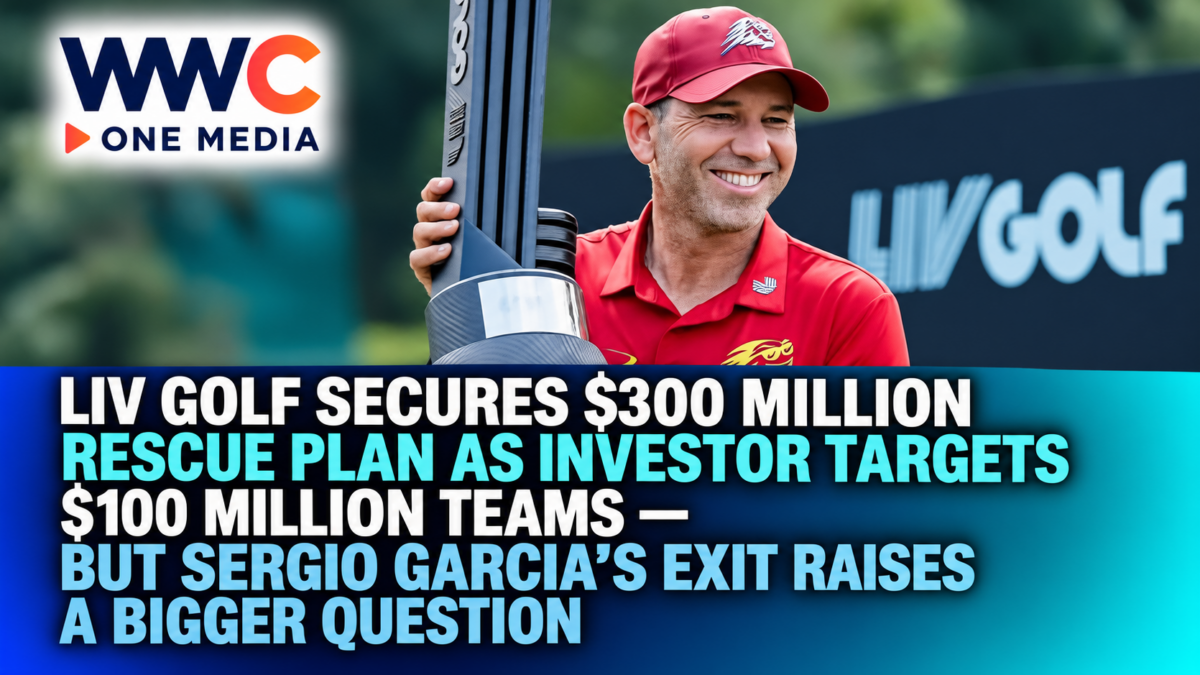
LONDON, UNITED KINGDOM — LIV Golf is preparing for its biggest transformation since launching in 2022, securing a financial rescue plan worth up to $300 million as its new backers pursue an ambitious vision of building professional golf teams valued at more than $100 million each.
But the comeback effort faces an immediate complication.
Spanish golf legend Sergio Garcia has secured his release from the troubled league, while several other prominent players are still deciding whether to participate in its proposed 2027 relaunch.
The developments come as LIV attempts to emerge from Chapter 11 bankruptcy following the withdrawal of financial support from Saudi Arabia’s Public Investment Fund.
At the center of the rescue effort is BC Partners Credit, led by private equity executive Ted Goldthorpe.
LIV Chief Executive Officer Scott O’Neil has described Goldthorpe as the league’s financial savior.
The two executives appeared at the Sportico Invest Conference in London on October 6, outlining their plans for a more commercially sustainable version of the competition.
Their vision includes reducing dependence on wealthy financial backers, giving players greater ownership and developing LIV’s existing teams into valuable sports franchises.
However, the financial commitments and projected team valuations have not eliminated the uncertainty surrounding LIV’s future.
The biggest question is whether investors can turn a bankrupt golf league into a profitable business while some of its most recognizable players are considering leaving.
BC Partners Emerges as LIV Golf’s Financial Rescuer
BC Partners Credit has committed an initial investment to support LIV Golf’s restructuring.
The funding forms part of a proposed financing package totaling up to $300 million.
The initial amount has been reported at approximately $4 million.
Additional financing would support the league’s operations and planned return in 2027.
However, the proposed funding arrangements remain subject to bankruptcy court approval and other conditions.
That distinction is important.
The announcement does not mean LIV has already received the entire $300 million.
Instead, the funding represents a proposed financial foundation for its restructuring and future operations.
For a league that previously benefited from billions of dollars in Saudi investment, the transition represents a fundamental change.
LIV must now develop a business capable of sustaining itself through commercial revenues rather than relying primarily on one exceptionally wealthy financial supporter.
From Saudi Billions to a New Business Model
LIV Golf launched in 2022 with support from Saudi Arabia’s Public Investment Fund.
The league attracted international attention by offering substantial financial packages to established professional golfers.
Those agreements helped recruit stars from the PGA Tour and other competitions.
However, the strategy required extraordinary spending.
The Public Investment Fund invested more than $5 billion before deciding to withdraw its financial backing.
That decision left LIV facing significant questions about its ability to continue operating.
In September 2026, the organization filed for Chapter 11 bankruptcy protection in New Jersey.
The filing allowed LIV to pursue a court-supervised financial restructuring while developing a proposed new business model.
The league’s future now depends on whether that restructuring can succeed.
LIV’s Bankruptcy Reveals Major Financial Problems
According to Reuters, LIV’s bankruptcy filing listed estimated assets between $100 million and $500 million.
Estimated liabilities ranged from $500 million to $1 billion.
Those figures illustrate the financial challenges facing the organization.
Several prominent golfers, including Jon Rahm, Bryson DeChambeau, Dustin Johnson and Cameron Smith, were identified among creditors with unsecured claims.
For a professional sports league, the situation is particularly sensitive.
Players are central to the organization’s commercial value.
If they lose confidence in its financial future, the league may struggle to retain the talent needed to attract broadcasters, sponsors and spectators.
The restructuring must therefore address both financial obligations and future player participation.
The proposed investment from BC Partners is intended to help stabilize the organization.
But funding alone will not determine whether LIV survives.
Investor Sees $100 Million Value for Each LIV Team
Goldthorpe has outlined an ambitious financial vision for LIV’s existing franchises.
Speaking in London, he suggested that individual teams could potentially achieve valuations exceeding $100 million relatively quickly.
LIV currently has 13 teams, including Jon Rahm’s Legion XIII and Bryson DeChambeau’s Crushers GC.
If every franchise eventually reached a $100 million valuation, their combined estimated value would exceed $1.3 billion.
That possibility could help explain why BC Partners sees an investment opportunity despite the league’s bankruptcy.
Professional sports franchises can become valuable commercial assets through sponsorships, media exposure, merchandising and fan engagement.
However, the $100 million figure is a target suggested by an investor, not a verified current valuation.
No evidence establishes that all 13 teams could presently be sold for that amount.
The financial value of each franchise will ultimately depend on its revenues, operating costs, commercial rights and investor demand.
Player Ownership Becomes Central to LIV’s Comeback
One of the most important changes involves ownership.
Under the proposed restructuring, players would receive equity interests in the league and its teams.
This could change how golfers participate financially in the competition.
Rather than relying mainly on appearance fees, signing bonuses and tournament winnings, players could gain exposure to the longer-term financial performance of their franchises.
If the teams become commercially successful, their ownership interests could increase in value.
But equity also carries risks.
The value of an ownership stake can decline.
A franchise may struggle to attract sponsors or generate sufficient revenue.
And investors cannot guarantee that the league will become profitable.
For players accustomed to lucrative guaranteed contracts, the proposed structure presents a different financial proposition.
They must decide whether the potential future value of ownership compensates for the uncertainty of LIV’s new business model.
Sergio Garcia Secures Exit From LIV Golf
While LIV’s investors are attempting to build confidence, Sergio Garcia has chosen to pursue his options elsewhere.
The 46-year-old Spaniard, who won the 2017 Masters, sought clarification from a New Jersey bankruptcy court concerning his contractual relationship with LIV.
His lawyers argued that the league’s restructuring had created uncertainty about whether his existing agreement remained enforceable.
They requested confirmation that Garcia could terminate the contract or that it had already ended.
The court subsequently lifted the relevant contractual restriction, clearing the way for Garcia to consider competing outside LIV in 2027.
The development is particularly important because Garcia was among the prominent golfers who joined LIV during its early years.
His departure highlights the difficult decisions confronting players as the organization changes its financial structure.
However, Garcia’s release does not automatically restore his eligibility for every major professional golf tour.
Different competitions maintain their own membership and eligibility requirements.
Garcia Could Return to European Golf
Garcia remains associated with the DP World Tour and has indicated that he intends to compete in European tour events during 2027.
His professional career includes 11 PGA Tour victories and 16 DP World Tour wins.
The former Masters champion has extensive experience across international competitions.
Leaving LIV could allow him to pursue a schedule better suited to his career plans.
However, a possible return to the PGA Tour presents additional complications.
The American circuit has not announced a general policy automatically readmitting all former LIV players.
Individual circumstances and applicable eligibility rules may influence whether returning golfers can compete.
Garcia’s release therefore represents an important contractual development, but not a guaranteed return to every competition he previously played.
Jon Rahm’s Future Remains Uncertain
Another important figure is Jon Rahm.
The Spanish superstar joined LIV with a lucrative long-term agreement and has become one of the league’s most prominent players.
His future is particularly important because he provides both competitive credibility and commercial visibility.
Rahm has continued performing at an elite level, winning another LIV individual season title in 2026.
However, his contractual situation remains subject to the broader restructuring process.
The uncertainty extends to other recognizable golfers, including players who have not publicly committed to the proposed relaunch.
LIV’s investors will need to convince them that the new ownership structure provides meaningful financial opportunities.
The league’s ability to retain top players could have a direct impact on sponsorship negotiations and franchise valuations.
October 25 Becomes a Critical Deadline
The restructuring agreement includes requirements relating to player participation.
According to Field Level Media, LIV must secure support from at least 50% of players with relevant financial claims against the league.
Those supporting players must also represent at least two-thirds of the total value of the applicable claims.
The original deadline was October 13.
It has now been extended to October 25, 2026.
The extension provides additional time for players and their representatives to examine the proposed agreements.
It also demonstrates that the negotiations remain complicated.
Players must consider the financial terms, ownership arrangements and competitive opportunities available under LIV’s proposed structure.
For the league, the deadline is a crucial test.
A rescue plan may be financially attractive on paper, but its commercial prospects depend on whether enough established golfers are prepared to participate.
LIV Plans a Smaller 2027 Tournament Schedule
The proposed restructuring also involves changes to the competition’s format and calendar.
According to the Associated Press, the league is planning a 10-tournament season in 2027, with approximately half the events taking place outside the United States.
The proposed schedule would be smaller than LIV’s previous competition calendar.
Reducing the number of events could help control operating expenses.
However, fewer tournaments could also limit sponsorship opportunities and the number of occasions when fans can watch their favorite players.
The challenge will be finding a balance between cost discipline and commercial appeal.
LIV wants to maintain its international identity while creating a more financially sustainable competition.
Whether a smaller calendar can deliver enough revenue remains uncertain.
Can LIV Compete Without Saudi Arabia’s Financial Power?
LIV’s original strategy relied heavily on guaranteed payments and significant tournament prize funds.
Those incentives helped persuade several high-profile golfers to join the breakaway circuit.
But the league’s proposed new structure cannot simply repeat the same approach without sufficient revenue.
The reported $300 million financing package is far smaller than the billions previously supplied by the Saudi Public Investment Fund.
That means management must make difficult decisions about costs.
Tournament expenses, player compensation, commercial partnerships and franchise operations will all require careful management.
The goal is to develop a league that attracts private investment because of its business prospects.
But investors will expect evidence of financial discipline.
The challenge is particularly difficult because LIV is attempting to rebuild while maintaining enough star power to attract fans.
Could LIV Become Golf’s Version of a Franchise League?
The emphasis on team valuations suggests that LIV wants to borrow elements of the franchise model used in other professional sports.
In traditional team sports, franchise owners can benefit from commercial revenues, media rights and rising asset values.
Successful teams can become valuable even when their annual profits fluctuate.
However, golf presents different challenges.
Professional golf has historically emphasized individual players rather than permanent teams.
Fans often follow particular golfers instead of developing loyalty to franchises.
LIV has attempted to change that pattern by creating named teams with captains, branding and team competitions.
Its proposed restructuring places even greater importance on that model.
But establishing a strong fan base for a team requires time.
A recognizable captain does not automatically guarantee commercial success.
The long-term value of LIV’s franchises will depend on whether fans, broadcasters and sponsors embrace team golf.
The PGA Tour Remains a Major Challenge
LIV’s financial problems do not eliminate the competitive pressures facing professional golf.
The PGA Tour remains one of the sport’s most established organizations.
It maintains extensive relationships with tournament organizers, broadcasters and sponsors.
LIV players who want to return may face eligibility restrictions.
The uncertainty has created difficult decisions for golfers whose contracts are affected by the bankruptcy process.
Some may prefer guaranteed opportunities on established tours.
Others may see greater long-term financial potential in LIV’s proposed equity arrangements.
The outcome could reshape the professional golf landscape.
A successful LIV restructuring could preserve a separate international team competition.
A failure could encourage more players to pursue opportunities elsewhere.
The Biggest Risk Is Losing Players Before the Relaunch
LIV’s investors are promoting an ambitious future.
They envision valuable franchises, shared player ownership and a financially sustainable league.
But the immediate reality is complicated.
Garcia has obtained his release.
Other golfers are examining their options.
Negotiations are continuing over outstanding financial claims.
And the full restructuring remains subject to legal approval.
The October 25 deadline is particularly important because LIV must secure sufficient participation from relevant players.
If major stars decline to commit, the league could struggle to deliver the commercial value projected by its investors.
That could also affect expectations for future sponsorships and team valuations.
LIV’s $300 Million Rescue Could Change Professional Golf
For LIV, the involvement of BC Partners Credit provides a potential path forward.
The proposed financing could support the league’s emergence from bankruptcy and help establish a more conventional sports-business structure.
Player equity ownership may also provide an incentive for golfers to help build the competition’s long-term commercial value.
But the challenges are substantial.
The organization must resolve its financial obligations, secure court approval, retain enough prominent players and develop a financially viable tournament schedule.
It must also demonstrate that its 13 teams can become valuable commercial assets.
Goldthorpe believes valuations exceeding $100 million per franchise are achievable.
Whether the market agrees remains to be seen.
Can LIV Golf Survive Its Biggest Transformation?
The latest developments reveal a professional golf league attempting to reinvent itself under extraordinary financial pressure.
LIV is no longer operating with the same level of Saudi financial support that fueled its original expansion.
Its new investors are promoting a different model focused on sustainability, team ownership and commercial growth.
But Sergio Garcia’s departure shows that not every player is prepared to remain part of that vision.
The coming weeks will reveal whether enough golfers are willing to commit to the proposed structure.
LIV Golf has secured a potential $300 million lifeline, and its new backers believe individual teams could eventually be worth more than $100 million.
But with Sergio Garcia moving on and other stars still weighing their futures, the bigger question is whether LIV can retain the players needed to make those ambitious valuations a reality.
The league may have found a financial rescuer—but saving its star-studded roster could prove to be the harder challenge.