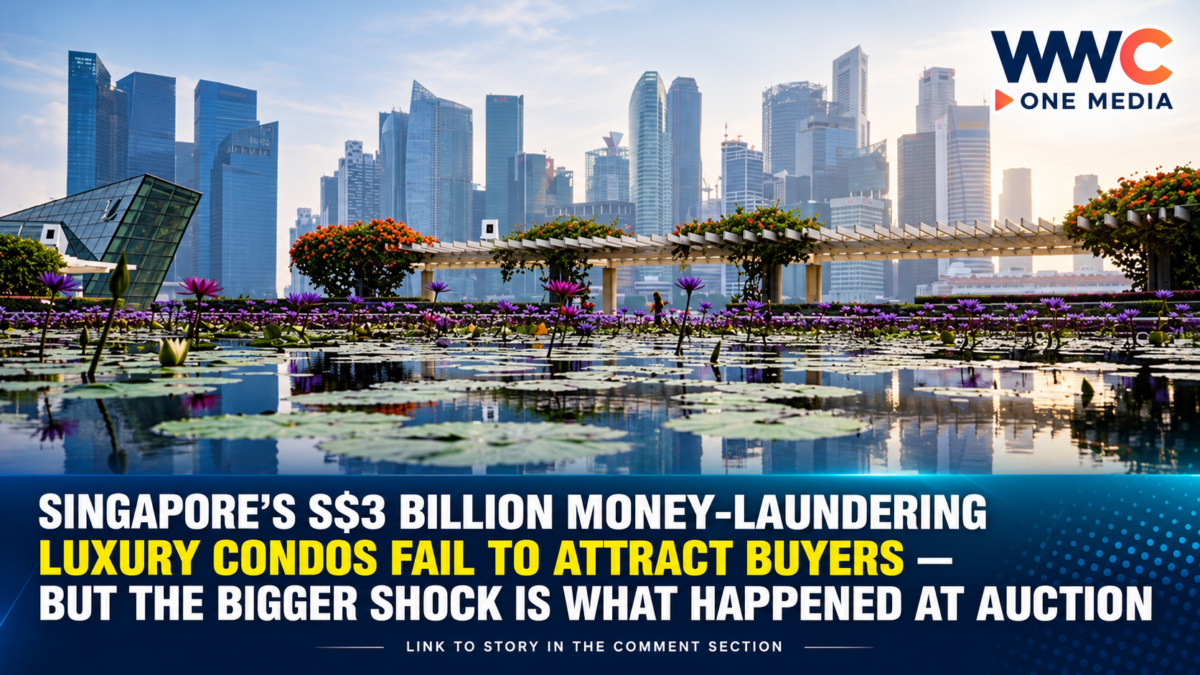
SINGAPORE — Multimillion-dollar penthouses, marble-clad apartments and exclusive condominium units confiscated in Singapore’s biggest money-laundering case are struggling to find buyers, revealing growing resistance to luxury property prices in one of Asia’s wealthiest real estate markets.
Properties once associated with the lavish lifestyles of convicted money launderers are being offered to the public following Singapore’s unprecedented S$3 billion criminal investigation.
But instead of fierce competition from wealthy investors, several auctions have been met with silence, rejected offers and unsold properties.
At the first major property auction on September 17, seven confiscated assets went under the hammer with combined opening prices exceeding S$43 million.
None sold.
A week later, another round of auctions produced just four successful condominium sales, leaving many of the more expensive properties without buyers.
The disappointing results highlight an emerging problem for Singapore’s luxury residential market.
The government has valuable properties to sell, but potential buyers are increasingly unwilling to pay the prices being sought.
And with more than 80 confiscated properties scheduled for disposal through mid-2027, the question is whether Singapore’s authorities can recover their value without making significant concessions.
Seven Luxury Properties Go to Auction — Not One Sells
The September 17 auction attracted considerable public attention.
Organized by Knight Frank Singapore, the event took place at Ocean Financial Centre.
According to The Business Times, approximately 65 people attended, including 30 registered bidders.
The properties included four apartments at Gramercy Park, two units at Sloane Residences and an office space at Suntec Tower One.
The developments occupy some of Singapore’s most desirable addresses.
Gramercy Park, located near Orchard Road, is associated with high-end residential living.
Sloane Residences is situated in the prestigious District 10 area.
Suntec Tower One is part of a prominent commercial complex.
Despite the premium locations, no property achieved its minimum acceptable selling price.
Some attracted no offers.
Others received bids below the sellers’ reserve prices.
By the end of the auction, every property had been withdrawn.
The outcome raised questions about whether the asking prices reflected what investors were prepared to pay.
A S$7.55 Million Apartment Gets a S$4 Million Offer
One of the most striking moments involved a luxury apartment at Gramercy Park.
The four-bedroom property measured approximately 2,659 square feet.
It featured extensive interior finishes and attractive views.
Its opening price was S$7.55 million.
But the initial response fell dramatically short.
A bidder offered just S$4 million.
The low offer drew laughter from people attending the auction.
It was rejected.
Bidding later improved, eventually reaching S$6.7 million.
However, even that amount failed to satisfy the reserve price.
The property was withdrawn.
The difference between the opening price and the initial offer illustrates the aggressive bargaining taking place.
Buyers appeared willing to consider prestigious properties, but only at prices they believed represented genuine value.
Another Gramercy Park Unit Misses Its Reserve Price
A smaller apartment in the same development generated stronger competition.
The 1,292-square-foot unit contained two bedrooms and a study.
It opened at S$3.82 million.
Several interested parties competed for the property.
Bidding eventually reached S$3.75 million.
But the seller’s undisclosed reserve price was still not met.
The apartment remained unsold.
The result showed that buyer interest was not completely absent.
Instead, buyers and sellers were struggling to agree on acceptable prices.
That difference is important.
A property attracting multiple offers is not necessarily unwanted.
It may simply be priced above what the market is prepared to pay.
S$25.3 Million Penthouse Also Fails to Find a Buyer
The difficulties continued at another auction held on September 23.
One of the most expensive offerings was a three-storey penthouse at South Beach Residences.
The property measured approximately 6,727 square feet.
It featured four bedrooms, a private lift lobby and a rooftop terrace.
Its guide price was S$25.3 million.
Despite the property’s exclusive features, no bidder was willing to match the opening price.
The auctioneer withdrew the listing after several minutes.
Other luxury units offered during the same session also failed to attract acceptable bids.
For Singapore’s high-end market, the results underscored the challenges of finding buyers for properties costing several million dollars.
Four Condominiums Finally Find Buyers
The auctions were not entirely unsuccessful.
On September 23, real estate agency SRI sold four condominium units for a combined S$16.28 million.
Two apartments at Martin Modern were sold for S$2.12 million and S$2.08 million.
Two larger units at Wallich Residence fetched S$6.6 million and S$5.48 million.
Wallich Residence occupies the upper floors of Guoco Tower in Singapore’s central business district.
The successful sales demonstrated that there was still demand for some premium properties.
However, the prices also suggested that buyers were exercising considerable bargaining power.
At Wallich Residence, both successful transactions closed below their opening prices.
The results reinforced the view that even wealthy investors were becoming more selective.
Singapore’s Foreign Buyer Tax Is Shrinking the Market
One reason for the weak auction response is Singapore’s restrictive property-tax framework.
Since April 27, 2023, most foreigners purchasing residential property in Singapore have faced a 60% Additional Buyer’s Stamp Duty (ABSD).
That tax comes on top of other applicable property acquisition costs.
For an overseas investor considering a S$10 million apartment, a 60% additional stamp duty could amount to S$6 million.
The total acquisition cost could therefore become substantially higher than the advertised property price.
Certain buyers may qualify for different treatment under applicable rules or exemptions.
Nevertheless, the general tax burden has discouraged foreign demand for expensive residential property.
That leaves a narrower pool of eligible and financially capable buyers.
Singapore’s cooling measures were introduced to manage housing demand and protect market stability.
But they have also made it harder to sell some luxury properties.
Local Millionaires Are Not Rushing to Buy Either
Singapore has a substantial population of wealthy individuals.
However, that does not mean every luxury property automatically attracts intense competition.
High-net-worth buyers can compare different properties and investment opportunities.
They may prefer newer developments, distinctive locations or assets offering stronger rental prospects.
Others may delay purchases while assessing the market.
At auction, buyers often expect an opportunity to acquire property at an attractive price.
If the seller’s asking price appears too high, they may simply walk away.
Property analysts have described the situation as increasingly favorable to selective buyers.
That does not establish a nationwide real estate collapse.
It suggests that certain segments of Singapore’s luxury market are experiencing weaker demand relative to the prices sellers want.
The S$3 Billion Money-Laundering Case Shocked Singapore
The properties being auctioned were confiscated following one of Singapore’s largest criminal investigations.
In August 2023, authorities conducted coordinated raids involving hundreds of police officers.
The operation uncovered a network associated with laundering proceeds from overseas criminal activities, including illegal gambling operations.
Ten foreign nationals were eventually convicted in connection with the case.
Authorities seized or froze assets that included luxury real estate, cash, vehicles, watches, jewelry and designer handbags.
The total value associated with the investigation reached approximately S$3 billion.
The scandal drew international attention because Singapore has long promoted itself as a highly regulated and reputable global financial center.
It also prompted scrutiny of how criminal proceeds had entered the country’s banking and property systems.
More Than 80 Properties Are Being Sold
The government is now working to dispose of assets forfeited through the criminal proceedings.
Deloitte Singapore was appointed by the Singapore Police Force in July 2025 to oversee the management and realization of non-cash assets.
The disposal program includes more than 80 real estate properties and over 1,000 luxury items.
Auctions began in September 2026.
The broader disposal process is expected to continue through mid-2027.
Several property agencies have been appointed to handle different assets.
These include Knight Frank, SRI and Edmund Tie & Company.
Other properties may be marketed through expressions of interest.
The government faces a difficult balancing act.
Selling too quickly could result in prices below achievable market values.
Waiting too long could create additional holding and maintenance expenses.
The Government Has Already Recovered S$1.4 Billion
Despite the slow property auctions, Singapore has already recovered substantial value from the money-laundering case.
According to figures cited in Bloomberg’s report, approximately S$1.4 billion in cash and proceeds from assets already sold had entered the government’s Consolidated Fund by the end of March 2026.
That is a significant amount.
However, the disposal of remaining real estate presents additional challenges.
Unlike cash, property must be marketed to prospective buyers.
The selling price depends on demand and the condition of the asset.
High-value residences may take longer to sell because fewer purchasers can afford them.
Meanwhile, government authorities must account for the cost of managing seized properties until they are sold.
This makes the successful liquidation of the remaining portfolio financially important.
Luxury Handbags Are Selling Faster Than Luxury Homes
The weak property auctions have produced a surprising contrast.
While expensive apartments struggled to attract acceptable bids, some confiscated luxury goods generated intense competition.
At a Hotlotz auction, a limited-edition Louis Vuitton handbag designed in collaboration with Japanese artist Yayoi Kusama attracted 81 bids.
The bag was estimated to be worth between S$12,000 and S$16,000.
It eventually sold for S$87,000.
That represents several times its estimated value.
Jewelry and other designer items also attracted substantial interest.
The difference illustrates how buyers evaluate luxury products.
A rare handbag may attract collectors willing to pay a premium because it is difficult to replace.
A condominium buyer, by contrast, may compare numerous properties before deciding how much to offer.
The notoriety surrounding the money-laundering case may also have attracted curiosity to the luxury-goods auctions.
But that attention has not translated into equally strong property sales.
Singapore’s Luxury Property Market Faces a Bigger Test
The auctions are taking place against a complicated property-market backdrop.
Singapore’s broader private housing market has demonstrated resilience.
However, demand for certain high-end properties has weakened.
Foreign-buyer restrictions have reduced the pool of potential purchasers.
Some luxury investors are demanding better prices.
Expensive properties in established districts are competing against other premium developments.
These factors have created a challenging environment for sellers.
The government’s confiscated properties are entering that market at a time when buyers have reason to negotiate.
This does not mean every luxury condominium in Singapore is losing value.
Property performance varies significantly according to location, condition, size and buyer demand.
But the auction results provide a visible example of price resistance in the upper end of the market.
Singapore Will Not Rush to Slash Prices
The government has indicated that it will review the results before deciding what to do with unsold properties.
On October 6, Home Affairs Minister K. Shanmugam addressed the matter in a written parliamentary response.
He said police, Deloitte and the appointed vendors would assess the auctions.
Unsold properties could be offered again through future auctions.
Authorities may also consider private negotiations with interested bidders or expressions of interest.
The approach will depend on market conditions and the characteristics of each property.
The government’s stated objective is to ensure an orderly and transparent process.
That means the authorities are not committed to accepting every bid simply to accelerate sales.
Instead, they must balance the desire to recover cash with the need to protect the value of public assets.
Could Buyers Benefit From Lower Prices?
The unsuccessful auctions may encourage prospective purchasers to monitor future offerings.
A buyer who previously considered an apartment too expensive could become interested if the asking price changes.
However, there is no guarantee that substantial discounts will be offered.
The government may choose to maintain certain reserve prices.
Alternatively, it may use different sales arrangements to attract qualified buyers.
Investors must also account for stamp duties, legal fees, maintenance expenses and other ownership costs.
A lower auction price does not necessarily mean a property is a bargain.
Its value depends on the total acquisition cost and the buyer’s assessment of future market conditions.
The Real Challenge Is Recovering Value Without Losing More
Singapore’s asset-disposal program has become an important test of financial management.
The criminal case resulted in substantial forfeitures.
But converting those assets into cash is proving more complicated.
The first auction failed to sell any of seven properties.
A later auction successfully sold four apartments.
Meanwhile, some of the most expensive homes continue to attract little interest at their guide prices.
Authorities must now decide whether patience, new marketing strategies or more flexible negotiations will produce better outcomes.
That decision matters because the assets have already been forfeited to the state.
The government has a responsibility to manage their disposal prudently.
The properties’ connection to a major criminal case does not eliminate the need to obtain commercially reasonable prices.
The Bigger Question: How Low Will Sellers Go?
The disappointing auction results reveal a striking contrast between the image of Singapore’s luxury property market and the prices buyers are prepared to pay.
Exclusive addresses and multimillion-dollar interiors are not enough to guarantee a sale.
Foreign-buyer taxes have narrowed demand.
Local investors are bargaining aggressively.
And auctioneers are discovering that attracting a crowd does not necessarily translate into completed transactions.
With dozens of confiscated properties still awaiting disposal, the pressure to find an effective selling strategy will continue.
Singapore has successfully confiscated valuable assets from one of its biggest money-laundering cases.
But selling those assets at acceptable prices has become a new challenge.
The bigger question is whether the government can afford to hold out for better offers—or whether increasingly patient buyers will eventually force prices lower.