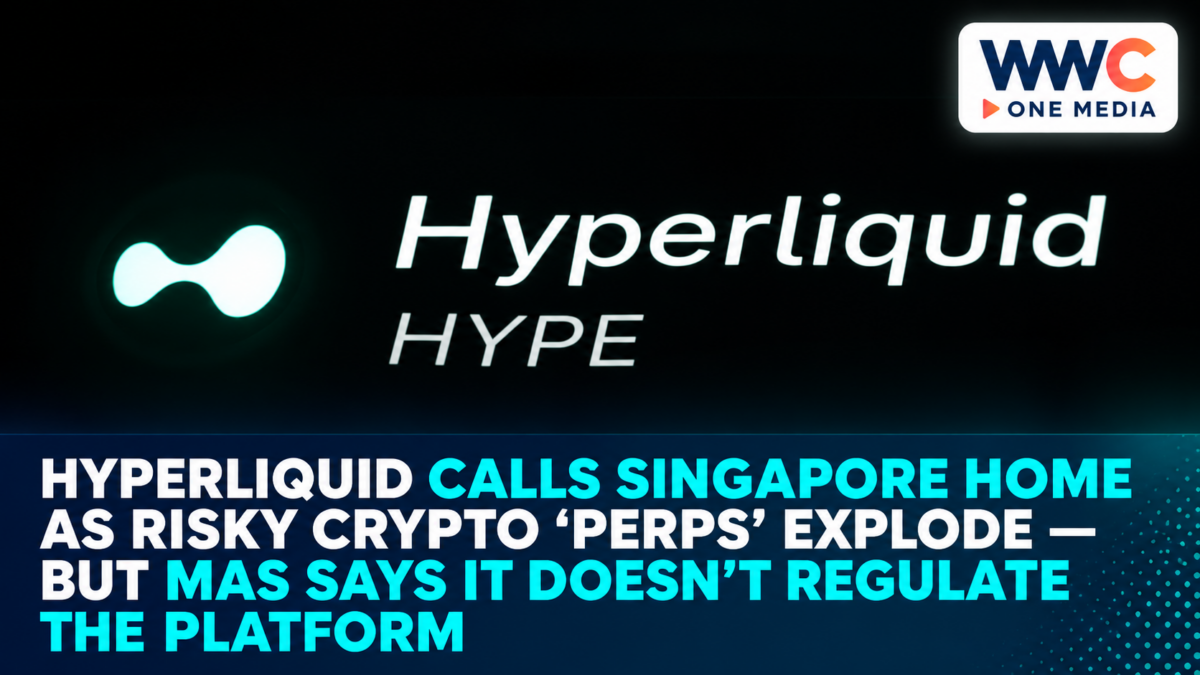
SINGAPORE — One of crypto’s fastest-growing trading platforms has put Singapore in an uncomfortable position: Hyperliquid Labs says the city-state is its home, yet Singapore’s financial regulator says it does not regulate the company — even as billions of dollars in highly leveraged trading pass through its ecosystem.
Hyperliquid has become a major force in cryptocurrency derivatives by specializing in perpetual futures, commonly called “perps” — leveraged contracts that allow traders to speculate on the price of crypto and other assets without an expiration date.
The products have become enormously popular among crypto traders.
They have also been described by consumer advocates as some of the riskiest instruments available to retail investors, because leverage allows traders to control positions far larger than the money they deposit — and potentially lose those positions almost instantly when prices move against them.
Now Hyperliquid’s extraordinary growth is colliding with Singapore’s carefully cultivated reputation as one of Asia’s most tightly regulated financial centres.
According to the Financial Times, Hyperliquid says it is headquartered in Singapore and has been building a local presence.
But the Monetary Authority of Singapore says Hyperliquid is not regulated by MAS and that it does not understand the platform to be regulated in any major jurisdiction.
Hyperliquid has separately acknowledged that it has never obtained a licence or regulatory approval from MAS.
That leaves Singapore confronting a difficult question:
How can the city-state encourage blockchain innovation and institutional crypto finance while distancing itself from one of the sector’s most aggressively leveraged trading platforms?
Hyperliquid Is Not a Small Crypto Startup Anymore
Hyperliquid’s growth has been extraordinary.
Industry data compiled in early October showed the platform had processed approximately $197.5 billion in perpetual-futures volume over the previous 30 days, with lifetime perpetual volume exceeding $5.4 trillion.
Open interest stood around $8.4 billion, while Hyperliquid accounted for roughly one-third of decentralized perpetual-futures trading volume.
Earlier this year, The Block reported that Hyperliquid’s share of the overall perpetual-futures market — including centralized exchanges — had risen to record levels.
Its monthly perpetual volume approached $200 billion as the platform increasingly competed not merely with decentralized-finance rivals but with giant centralized exchanges.
That growth has made Hyperliquid much harder for regulators to ignore.
What began primarily as a crypto-native derivatives venue is increasingly expanding into markets linked to equities, commodities and other traditional assets.
Hyperliquid’s HIP-3 framework, which allows approved builders to deploy new perpetual markets, had grown to nearly half of the platform’s daily perp volume by July as demand for on-chain stock-linked contracts surged.
What Exactly Is a Perpetual Future?
Perpetual futures resemble conventional futures contracts with one enormous difference:
They never expire.
A traditional futures contract generally has a settlement or expiration date.
A perpetual future can theoretically remain open indefinitely, provided the trader maintains enough collateral and continues meeting funding requirements.
That structure has made perps extremely popular in cryptocurrency markets, which trade 24 hours a day, seven days a week.
But leverage dramatically increases the risk.
On Hyperliquid, leverage can reach as high as 40 times on Bitcoin, while other markets allow smaller but still substantial multiples.
That means a trader with $1,000 could potentially control a position worth many thousands of dollars.
The benefit is obvious when the trade moves in the right direction.
The danger arrives just as quickly when it does not.
If losses reduce the trader’s account equity below required maintenance margins, the position can be automatically liquidated.
That means a relatively small adverse price move can wipe out the trader’s collateral.
Why Critics Call Perps So Dangerous
Leverage is what transforms an ordinary market move into a potentially catastrophic loss.
Imagine a trader controls a $20,000 position using only $1,000 of personal capital.
A relatively modest move against that position can destroy most or all of the trader’s deposit.
Crypto markets also operate around the clock and can experience sudden, violent price movements.
Liquidations can therefore happen overnight, during weekends or during geopolitical events when traditional markets are closed.
The Financial Times separately reported earlier this year that U.S. retail investors were rapidly embracing perpetual futures as regulated American platforms began introducing similar products.
Critics highlighted instant liquidations, leverage and limited consumer protections as major risks.
The product itself, however, is not inherently unregulated.
That distinction is critical to understanding Singapore’s dilemma.
Singapore Itself Offers Crypto Perpetual Futures
Singapore Exchange launched Bitcoin and Ethereum perpetual futures on November 24, 2025.
But SGX designed them specifically for professional market participants.
Its rules require members to restrict Singapore-based customers to:
accredited investors,
expert investors,
or institutional investors.
Retail customers in Singapore cannot simply open an SGX account and begin trading the contracts.
The products also operate within a regulated, exchange-cleared framework with formal margin and clearing requirements.
SGX said at launch that crypto perpetual futures were averaging more than US$187 billion in daily global trading volume, demonstrating how important the contracts had already become to digital-asset markets.
So Singapore’s problem is not that perpetual futures exist.
It is how they are offered, who can access them and which regulator stands behind the market.
MAS Put Hyperliquid on Its Investor Alert List
The clearest regulatory signal came on June 26, 2026, when MAS added Hyperliquid to its Investor Alert List.
The list identifies companies that may be wrongly perceived by consumers as being licensed, authorised or regulated by MAS.
MAS explicitly cautions that the list is not exhaustive.
Being placed on the list does not automatically mean a company has committed fraud or that its website has been banned.
It means consumers should not assume that Singapore’s financial regulator supervises or protects their dealings with the company.
That distinction could be particularly important for Hyperliquid because of its Singapore connections.
A trader could reasonably hear that the company is headquartered in Singapore and assume it therefore operates under MAS supervision.
According to MAS, that assumption would be wrong.
Britain Has Issued an Even More Direct Warning
The United Kingdom’s Financial Conduct Authority has taken an even sharper position.
The FCA placed Hyperliquid on its warning list in May and updated the notice in June.
It said Hyperliquid may be providing or promoting financial services without the required permission, adding that consumers should avoid dealing with unauthorised firms.
The FCA said Hyperliquid is not authorised in the UK.
That warning illustrates the central problem posed by decentralized financial platforms.
A conventional exchange normally has a clearly identifiable corporate operator and regulatory jurisdiction.
A decentralized protocol can have:
developers in one country,
a corporate entity in another,
users worldwide,
blockchain infrastructure distributed across multiple jurisdictions,
and financial activity that never passes through a traditional bank or brokerage.
Regulators were not originally designed to supervise businesses structured like that.
Singapore Is Trying to Draw a Very Fine Line
Singapore has consistently positioned itself as welcoming toward blockchain and institutional digital finance while remaining much more skeptical of speculative retail crypto trading.
That strategy makes economic sense.
The city-state wants:
digital-asset companies,
institutional capital,
tokenized securities,
blockchain infrastructure,
stablecoin innovation,
and financial-technology jobs.
But it does not want another major scandal damaging Singapore’s reputation for financial stability.
That history matters.
Terraform Labs, whose TerraUSD and Luna ecosystem collapsed spectacularly in 2022, had strong Singapore connections.
Three Arrows Capital, the crypto hedge fund that collapsed during the same broader market crisis, was also associated with Singapore.
Those failures helped accelerate the city-state’s more cautious stance toward retail cryptocurrency speculation.
Hyperliquid therefore arrives at a sensitive moment.
Singapore’s Crypto Industry Is Still Expanding
Regulatory caution has not stopped the country’s digital-asset sector from growing.
The Financial Times reported that crypto-related assets in Singapore expanded roughly 55% last year, underscoring how deeply the sector has embedded itself in the financial hub.
Singapore also remains one of the world’s most important locations for cryptocurrency conferences, investors and venture capital.
Hyperliquid itself has become part of that ecosystem.
An independent Hyperliquid Forum was held in Singapore on October 6, attracting speakers and participants connected to firms including Grayscale, Multicoin Capital, Wintermute and other institutional crypto investors.
That creates a striking contrast.
Singapore wants to distance its regulatory reputation from unlicensed crypto trading platforms.
Yet the city remains precisely where many of the companies, investors and developers surrounding those platforms want to do business.
Wall Street Is Starting to Take Hyperliquid Seriously
Hyperliquid is also becoming increasingly difficult for traditional finance to dismiss.
Intercontinental Exchange CEO Jeffrey Sprecher, whose company owns the New York Stock Exchange, publicly praised Hyperliquid’s technology earlier this year and said he had met its founders.
He highlighted the extraordinary trading activity generated by the platform and the sophistication of its small development team.
Traditional exchanges are also adopting products that resemble those pioneered by offshore crypto platforms.
The shift represents an important change.
Rather than regulated finance eliminating crypto-native products, Wall Street increasingly appears to be copying some of them — but placing them inside regulated structures.
The United States Is Moving Toward Regulation
That trend became even clearer this week.
On October 5, the U.S. Commodity Futures Trading Commission proposed a new federal framework for cryptocurrency platforms offering leveraged or margined products.
The proposal would allow qualifying platforms to enter federal regulation while subjecting them to requirements including anti-manipulation controls and proof-of-reserves rules.
The framework is still only a proposal.
But it shows how radically attitudes toward crypto derivatives have changed.
American regulators are no longer simply asking whether perpetual futures should exist.
They are increasingly asking how the products can be brought inside a regulated system.
That could eventually put pressure on offshore and decentralized platforms to choose:
remain outside traditional regulation,
or seek access to mainstream markets by accepting more oversight.
Hyperliquid’s Success Is Partly Because It Removed Traditional Friction
There is a reason traders like decentralized perpetual platforms.
They can offer:
24-hour markets,
rapid settlement,
self-custodied or wallet-based access,
wide selections of assets,
high leverage,
and markets unavailable through ordinary stock exchanges.
Traditional financial markets still close overnight and on weekends.
Crypto does not.
That difference became particularly visible during geopolitical crises, when traders used blockchain-based perpetual contracts to speculate on assets while conventional venues were closed.
For a generation accustomed to instant digital access, waiting for Monday morning can increasingly feel outdated.
Hyperliquid’s success suggests that demand for around-the-clock markets is real.
The question is whether regulators can preserve those advantages without importing the most dangerous parts of leveraged crypto speculation.
Regulation Could Become Hyperliquid’s Biggest Competitive Risk
Ironically, Hyperliquid’s success may eventually make regulatory ambiguity harder to maintain.
A small decentralized protocol can fly beneath governments’ radar.
A platform handling hundreds of billions of dollars every month cannot.
The bigger Hyperliquid becomes, the more regulators are likely to ask:
Who operates it?
Where is it legally based?
Who performs customer checks?
Who prevents market manipulation?
Who protects client assets?
Who handles complaints?
Who is responsible if a market fails?
And what happens when a leveraged position sold globally causes losses to investors in jurisdictions where the product was never authorised?
Those questions become increasingly difficult to answer simply by saying the protocol is decentralized.
Singapore Has More at Stake Than Hyperliquid
The issue also touches Singapore’s broader competition with Hong Kong, Dubai, London and the United States for digital-asset capital.
If Singapore regulates too aggressively, companies may move elsewhere.
If regulation is too loose, the city risks undermining the reputation that made it a major financial centre in the first place.
Singapore’s advantage has historically been trust.
Investors expect clearly enforced rules, conservative oversight and institutional stability.
Crypto challenges that model because many of its most innovative products were designed precisely to reduce dependence on traditional intermediaries.
Hyperliquid represents perhaps the clearest example yet.
It operates a product traders clearly want.
Its volumes are enormous.
Its technology is attracting attention even from Wall Street.
And its ecosystem is growing rapidly.
Yet the regulator of the country it calls home says it does not supervise the platform.
The Real Fight Is Bigger Than Hyperliquid
Perpetual futures are unlikely to disappear.
SGX offers them.
U.S. exchanges are introducing them.
Major crypto exchanges already rely heavily on them.
And global trading volume runs into hundreds of billions of dollars a day.
The regulatory contest therefore is not about eliminating perps.
It is about determining which version of them wins.
One version looks like SGX:
restricted investor access,
formal clearing,
regulated intermediaries,
margin controls,
and identifiable institutions responsible for the market.
The other looks more like decentralized crypto:
global access,
blockchain settlement,
fewer intermediaries,
24-hour trading,
and potentially much higher leverage.
Hyperliquid has demonstrated that traders love the second model.
Singapore is now confronting the uncomfortable question of whether a world-class financial hub can host the people building that model without appearing to endorse the risks that come with it.
Hyperliquid may have solved one of crypto’s biggest problems by creating a fast, liquid, always-open derivatives market.
But its explosive growth is creating another problem regulators cannot avoid: when trillions of dollars in leveraged contracts can be traded through decentralized infrastructure, who exactly is responsible when something goes wrong?