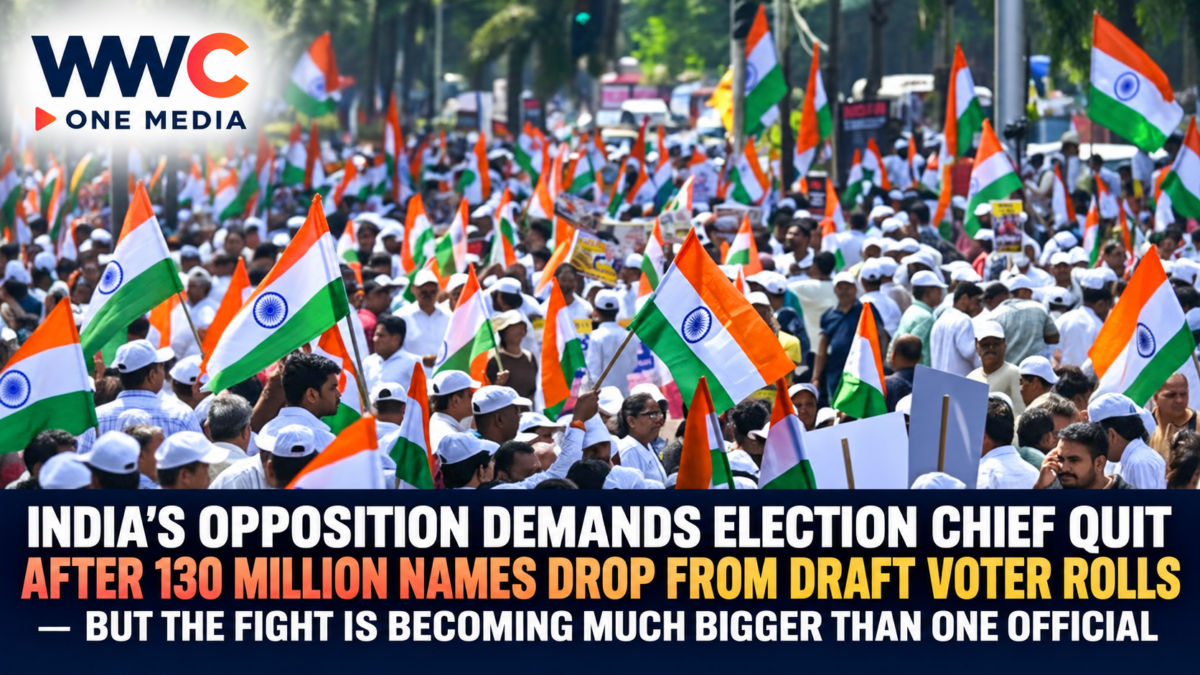
NEW DELHI — India’s simmering battle over who gets to vote has exploded onto the streets, with opposition leader Rahul Gandhi and other lawmakers briefly detained as protesters demanded the resignation of Chief Election Commissioner Gyanesh Kumar over allegations that a nationwide voter-roll overhaul could disenfranchise millions.
Hundreds of opposition lawmakers and supporters marched toward the Election Commission headquarters in New Delhi on October 6, accusing the election authority of mishandling its sweeping Special Intensive Revision, or SIR, of electoral rolls.
Police blocked the march, dismantled a sit-in and detained several politicians, including Gandhi and his sister Priyanka Gandhi, before releasing them.
The confrontation is the latest escalation in a dispute that has rapidly become one of the biggest political challenges facing Prime Minister Narendra Modi midway through his third term.
At the heart of it is an extraordinary number:
roughly 130 million names were dropped from draft voter lists during the nationwide revision exercise.
The Election Commission says the revision is designed to clean the rolls by removing duplicate registrations, people who have died, moved away or are otherwise ineligible.
Opposition parties and youth groups argue that legitimate voters have also been removed and that poorer communities, minorities and other vulnerable groups could be disproportionately affected.
No independent finding has established that the revision was deliberately designed to help Modi’s Bharatiya Janata Party.
But the sheer scale of the deletions — combined with revelations of internal disagreement inside the Election Commission — has turned what might have been an administrative exercise into a national political crisis.
Rahul Gandhi Takes the Fight to the Election Commission
Tuesday’s march began near parliament and was intended to reach the Election Commission headquarters roughly a kilometre away.
Opposition lawmakers carried India’s national flag and placards demanding Kumar’s resignation.
Congress President Mallikarjun Kharge accused the Election Commission of acting like a government-controlled institution.
Rahul Gandhi has gone even further, alleging that Kumar helped facilitate voter manipulation benefiting the BJP.
The BJP strongly rejects those accusations.
Party spokesperson Sambit Patra accused Congress and its allies of attacking constitutional institutions because they had failed politically.
The Election Commission has also denied acting for partisan purposes.
That distinction is critical:
The opposition is alleging electoral manipulation; the allegations have not been proven as fact.
But questions surrounding how the revision has been conducted are no longer coming only from opposition politicians.
Two Election Commissioners Reportedly Objected Internally
Perhaps the most damaging development came from an investigation by The Indian Express.
The newspaper reported that Election Commissioners Sukhbir Singh Sandhu and Vivek Joshi formally recorded objections at least 14 times over approximately 10 months regarding decisions connected with voter registration, deletions and the commission’s digital systems.
Among their concerns were changes made to Form 6, which Indians use when registering as new voters.
The two commissioners reportedly objected to questions requiring applicants to provide information about whether they, their parents or grandparents had appeared on electoral rolls during earlier revision exercises.
They described the changes as “illegal” and “unauthorised” and argued that they had not gone through the legally required process.
The disputed questions were technically displayed as optional, but applicants reportedly could not complete their online registration without answering them.
That revelation transformed the controversy.
The issue was no longer simply opposition politicians accusing the Election Commission from outside.
It suggested disagreement inside the three-member commission itself over procedures affecting voter registration.
The Election Commission Has Now Ordered a Special Re-Enrollment Drive
The Election Commission has responded to concerns about excluded voters by ordering a new enrollment campaign across the 20 states and Union Territories where the SIR has been completed.
The commission instructed election officials to identify people who had been “left out” and help eligible citizens register again.
Importantly, voters seeking re-entry will be able to use Form 6 without answering the controversial SIR-related question that had been challenged internally by the other commissioners.
The directive was issued after approximately 13 crore — around 130 million — names were dropped from draft rolls, according to The Indian Express.
That does not necessarily mean 130 million legitimate voters were permanently disenfranchised.
Draft-roll deletions can include deaths, duplicate registrations, migration and other legitimate removals.
Some voters can also be restored before final rolls are completed.
But the scale of the exercise has intensified demands for transparency.
Why India Is Revising Its Voter Lists
India’s Election Commission periodically updates electoral rolls.
The latest SIR is far more intensive.
It began in Bihar before expanding across most of the country.
Officials say the purpose is straightforward:
ensure that every eligible Indian citizen is registered while removing people who should no longer appear on the rolls.
Chief Election Commissioner Kumar has publicly said the commission’s objective is to make sure every eligible Indian aged 18 or older appears on the electoral register, regardless of religion, gender, disability or other status.
The controversy centers less on that objective than on how eligibility is being verified.
Critics argue that demanding historical family documentation can disadvantage citizens who are poor, elderly, displaced or otherwise unable to retrieve decades-old records.
For many Indians, especially migrant workers and lower-income households, paperwork that appears simple on a government form may be extremely difficult to obtain.
That is why what looks like an administrative database cleanup has become an argument over something much more fundamental:
the right to vote.
Some Regions Could See Huge Changes in Their Electoral Rolls
Reporting cited by Al Jazeera says Election Commission data indicates electoral rolls could shrink by as much as 30% in certain areas, though the effects vary widely by region.
Opposition parties say that raises questions about whether legitimate voters are being removed alongside duplicate or invalid entries.
The Election Commission argues that cleansing inaccurate rolls strengthens elections rather than weakens them.
It has also instructed officials to restore eligible voters who were inadvertently omitted.
That leaves both sides making fundamentally different arguments from the same numbers.
The government side says large deletions demonstrate how inaccurate previous voter databases had become.
Critics say removals on that scale demonstrate why the revision itself requires far greater scrutiny.
The Supreme Court Has Entered the Dispute
The controversy has now reached India’s highest court.
The Supreme Court has issued notices regarding allegations that Kumar made key SIR-related decisions without agreement from the other two election commissioners.
Petitioners are asking the court to examine a series of disputed decisions and have sought an investigation into voter deletions.
The court has not ordered Kumar removed and declined an interim request seeking such action.
Instead, it has sought responses from the parties while indicating that Election Commission decisions must remain consistent with existing law and can be subjected to judicial review.
That means the dispute is now unfolding simultaneously on three fronts:
in the streets,
inside the Election Commission,
and before the courts.
India’s Youth Movement Has Joined the Opposition
Another reason the protests matter is who is joining them.
The campaign is not being driven solely by established political parties.
India’s youth-led Cockroach Janta Party movement has emerged as a major participant.
The unusual name was adopted after young activists embraced a derogatory “cockroach” label and turned it into a symbol of resistance.
The movement gained national prominence earlier this year during demonstrations over examination-paper leaks.
Those protests eventually contributed to the resignation of Education Minister Dharmendra Pradhan.
Now activists have redirected their energy toward the Election Commission.
Hundreds demonstrated in Delhi and Mumbai beginning October 2, calling for Kumar to step down.
Further protests have been announced across several Indian cities.
That gives the voter-roll controversy something particularly uncomfortable for Modi’s government:
a connection between a traditional parliamentary opposition and a younger protest movement that has already demonstrated it can force political consequences.
Modi Faces a Different Kind of Political Challenge
Narendra Modi remains one of India’s most powerful political leaders.
But the latest unrest is unusual because it attacks not one specific government policy but public confidence in the machinery that decides elections themselves.
The Election Commission of India is constitutionally independent.
Its credibility therefore matters to every political party.
If voters begin believing the institution favors one side — whether or not those suspicions ultimately prove justified — damage to public trust can become difficult to reverse.
That explains why Kumar’s position has become so politically important.
For the opposition, forcing his resignation would represent a major victory and validate its campaign.
For the government and the commission, his resignation under political pressure could be interpreted as an admission that something was seriously wrong.
Analysts therefore believe the chances of the government voluntarily giving in are limited.
A Former BJP Ally Has Joined the Protest
The opposition campaign has also begun attracting parties beyond the core INDIA alliance.
The Biju Janata Dal, led by Naveen Patnaik, sent representatives to the October 6 protest.
The move is notable because the BJD historically cooperated with or supported the BJP on various issues.
Its participation broadens the political coalition challenging the Election Commission and suggests the controversy is no longer confined exclusively to Congress and its closest allies.
That could become important if protests continue spreading outside New Delhi.
Police Detentions Are Adding Another Layer of Tension
Security around central Delhi has been intense.
Police have imposed restrictions on gatherings and erected barricades around sensitive areas.
During Tuesday’s demonstration, Rahul Gandhi climbed onto a barricade while holding the Indian flag before police eventually detained him.
Nine police cases were reportedly filed in connection with events surrounding the October 6 protests.
Earlier demonstrations also resulted in arrests and allegations by some protesters and journalists of police mistreatment.
Police have denied wrongdoing in some of those incidents and say restrictions are required to maintain public order.
The result, however, is that the electoral-roll controversy is increasingly becoming intertwined with another debate:
how much space India allows for political protest.
This Is Not Yet Evidence That India’s Election Was “Stolen”
The scale of the controversy makes careful language essential.
Opposition politicians have used terms including “vote theft” and accused the Election Commission of deliberately helping Modi’s BJP.
Those are political allegations.
No court or independent investigation has established that India’s national elections were fraudulently decided through the current voter-roll revision.
Likewise, the fact that approximately 130 million entries were removed from draft electoral rolls does not mean 130 million citizens permanently lost their voting rights.
Some names represent duplicates, deceased voters, relocated people or other legitimately removable entries.
Others may be restored during corrections and appeals.
What has been independently established is significant enough without overstating it:
The revision produced extraordinarily large changes to the voter lists.
Two election commissioners reportedly raised repeated objections about parts of the process.
The Election Commission has now ordered a special drive to restore eligible voters who were left out.
The Supreme Court is examining legal challenges.
And major opposition parties and youth groups are demanding the chief election commissioner resign.
The Commission’s Response Could Determine What Happens Next
The Election Commission now faces enormous pressure to demonstrate that the process can identify mistakes and correct them before voters go to the polls.
Its special enrollment drive is therefore critical.
If large numbers of legitimate voters are restored quickly and transparently, some political pressure could ease.
If major discrepancies remain, opposition leaders will have powerful evidence to sustain their protests.
Transparency will matter just as much as the final numbers.
Political parties and election observers will want detailed information explaining:
how many voters were removed,
why they were removed,
how many appealed,
how many were subsequently restored,
and whether particular communities or regions were disproportionately affected.
Without credible answers, every unexplained deletion becomes fuel for allegations of manipulation.
The Bigger Fight Is Over Trust
India administers the largest elections on Earth.
Hundreds of millions of people vote across an enormous country containing vastly different languages, religions, income levels and political traditions.
That makes confidence in the electoral system extraordinarily important.
A voter-roll database will never be perfect.
People die.
People move.
Names are duplicated.
Records contain mistakes.
Cleaning those lists is a legitimate and necessary task.
But removing an eligible voter is also one of the most serious administrative errors an election authority can make.
That is why the SIR controversy has moved beyond spreadsheets and registration forms.
It has become a battle over whether Indians believe the institution overseeing their elections is independent.
Rahul Gandhi and the opposition are betting that growing doubts will become a national political movement.
The BJP is betting voters will see the protests as another opposition attempt to undermine institutions it cannot defeat politically.
The Election Commission insists it is simply doing its constitutional job.
But after approximately 130 million names disappeared from draft rolls, two election commissioners reportedly objected repeatedly to aspects of the process, the Supreme Court entered the dispute and opposition leaders were detained outside the commission’s headquarters, the issue is no longer merely administrative.
India’s election chief is now fighting not only to keep his job — but to preserve confidence in the institution that decides who gets to cast a vote in the world’s largest democracy.