RIYADH — A defence alliance linking Saudi Arabia, nuclear-armed Pakistan and NATO member Turkey has moved from paper to military reality, with the three countries activating their new collective-security pact as Houthi missile and drone attacks intensify across the Gulf.
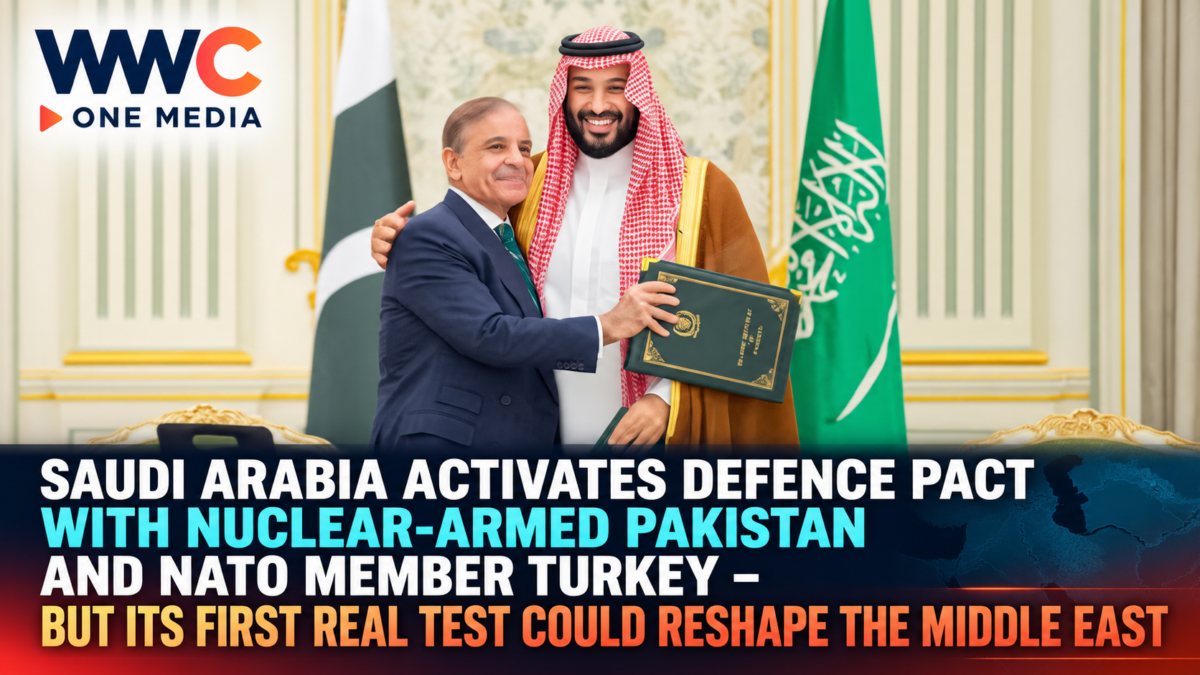
The development marks the first major test of the Mecca Joint Defence Agreement, signed on August 7 by Saudi Crown Prince Mohammed bin Salman, Pakistani Prime Minister Shehbaz Sharif and Turkish President Recep Tayyip Erdogan.
The pact contains a provision with an unmistakable resemblance to NATO’s Article 5:
An armed attack against one member is considered an attack against all three.
Now that promise is being tested.
Pakistan and Turkey have agreed to provide military support to Saudi Arabia as Riyadh confronts escalating attacks by Yemen’s Iran-aligned Houthi movement and pushes ahead with a major campaign on Yemen’s Red Sea coast.
But what happens next could prove far more consequential than the immediate conflict.
The alliance combines Saudi money and strategic geography, Turkey’s NATO-trained military and defence industry, and Pakistan’s large armed forces and nuclear capability.
If it survives its first battlefield test, the Mecca pact could become one of the most important new security blocs to emerge in the Muslim world in decades.
Turkey and Pakistan Pledge Military Support
At emergency talks in Riyadh on October 5, the three countries agreed on what officials described as a rapid deployment of military forces to assist Saudi Arabia.
Pakistan and Turkey are expected to provide personnel, equipment and other capabilities under the collective-defence arrangement.
But there are important limits.
Turkey cannot immediately deploy combat troops under the pact because the agreement still requires parliamentary ratification in Ankara, according to the Financial Times.
That does not necessarily prevent Turkey from providing intelligence, equipment, technical assistance or other forms of military support in the meantime.
Pakistan has been less explicit about what forces it will deploy.
Defence Minister Khawaja Muhammad Asif previously said Islamabad would use “whatever means are available” to defend Saudi Arabia, while declining to say whether Pakistani forces had already participated in strikes against Houthi targets.
That ambiguity is deliberate.
Pakistan wants to reassure Riyadh without becoming trapped in another prolonged Middle Eastern war.
Why Saudi Arabia Triggered the Pact
The immediate catalyst is Yemen.
Houthi forces have intensified missile and drone attacks against Saudi targets as fighting expands along Yemen’s western coast.
The Houthis have also threatened strategic shipping routes near the Bab el-Mandeb Strait, one of the world’s most important maritime chokepoints linking the Red Sea with the Gulf of Aden.
Saudi-backed Yemeni government forces launched a major counteroffensive and on October 5 said they had retaken Mocha, a strategic Red Sea port.
The fighting has displaced at least 184,000 people, according to reporting cited by Reuters, and threatens to further destabilize shipping routes already damaged by years of regional conflict.
Saudi Arabia is supporting the Yemeni offensive with air power, while U.S. intelligence assistance and other international support are also playing roles.
Turkey and Pakistan had previously been expected mainly to provide equipment and advisers.
The latest activation of the pact raises the possibility of deeper involvement.
A NATO-Style Clause — But This Is Not NATO
The alliance has inevitably been compared with NATO.
Turkish Foreign Minister Hakan Fidan himself said the collective-defence provision was technically comparable to NATO’s Article 5.
But the similarities should not be exaggerated.
NATO has:
a permanent integrated military command,
standardized operational procedures,
decades of joint planning,
interoperable forces,
shared logistics,
and established mechanisms for deciding how members respond to an attack.
The Mecca alliance is only months old.
Its command systems and operational arrangements are still being built.
The three governments have agreed to create joint political and military mechanisms, conduct exercises and deepen cooperation in areas including air defence, drones, electronic warfare and defence manufacturing.
A permanent secretariat is also being established in Saudi Arabia, initially headed by a Pakistani secretary-general.
But whether three militaries with different doctrines, equipment and strategic priorities can operate effectively together remains untested.
Together, They Have Enormous Military Weight
On paper, the alliance is formidable.
The three countries collectively field around 1.14 million active military personnel, according to figures cited by the FT.
Turkey possesses NATO’s second-largest military and an increasingly sophisticated defence industry producing drones, missiles, armored vehicles and naval systems.
Saudi Arabia is one of the world’s biggest military spenders and operates advanced U.S. and European combat aircraft and air-defence systems.
Pakistan fields one of Asia’s largest armed forces.
And unlike the other two members, Pakistan possesses nuclear weapons.
That final point has attracted enormous attention.
Does Pakistan’s Nuclear Arsenal Protect Saudi Arabia?
Not automatically.
Pakistan is the only nuclear-armed member of the alliance, but there is no publicly disclosed provision stating that Pakistan’s nuclear weapons form part of the pact’s collective deterrent.
Pakistani officials have also avoided suggesting that nuclear weapons would be used to fulfil the agreement.
When Defence Minister Asif promised to defend Saudi Arabia by whatever means were available, he did not mention nuclear forces.
That distinction matters enormously.
A formal Pakistani nuclear guarantee to Saudi Arabia would dramatically alter Middle Eastern deterrence calculations involving Iran and Israel.
Nothing publicly available establishes that such a guarantee exists.
The pact is therefore better described as a mutual-defence agreement involving a nuclear-armed member, rather than a Saudi-Pakistani nuclear umbrella.
The Alliance Was Built Before the Latest Houthi Crisis
The pact was not created overnight.
Reuters reported that Saudi Arabia, Pakistan and Turkey negotiated the agreement for nearly a year before signing it in Mecca on August 7.
The agreement says an armed attack on any member will be considered an attack on all three.
It was signed amid a broader deterioration in Middle Eastern security and increasing anxiety among Gulf governments about their dependence on Washington.
That timing is important.
The Houthi crisis did not create the alliance.
It is simply giving it its first serious operational test.
Saudi Arabia Is Looking Beyond Washington
For decades, Gulf security was built largely around the United States.
American military bases, arms sales and security guarantees formed the core of regional deterrence.
That structure is now becoming less certain.
Reuters reported recently that Gulf governments are increasingly questioning how far Washington is prepared to go to protect them amid escalating regional wars and attacks on energy infrastructure.
The Mecca alliance gives Riyadh something different:
regional partners with powerful militaries that have their own reasons to protect Saudi Arabia.
Pakistan has maintained deep defence and economic ties with the kingdom for decades.
Turkey has repaired relations with Riyadh after years of tensions and is rapidly expanding defence cooperation.
All three are also majority-Muslim states with strong interests in protecting Mecca and Medina, Islam’s holiest cities.
That gives the alliance a political and religious dimension that a conventional U.S. security arrangement cannot replicate.
But Pakistan Faces a Difficult Balancing Act
Pakistan may have the hardest strategic problem of the three.
Islamabad has extremely close relations with Saudi Arabia.
Millions of Pakistanis work in Gulf countries, while Riyadh has repeatedly provided Pakistan with financial support.
But Pakistan also shares a long border with Iran.
Islamabad therefore has little interest in turning the Mecca pact into an explicitly anti-Iran alliance.
Pakistan has continued diplomatic engagement with Tehran even as it condemns Houthi attacks.
Foreign Minister Ishaq Dar said Iran had suggested political engagement with the Houthis, and the alliance agreed to consider that proposal during its Riyadh discussions.
That illustrates the contradiction Pakistan must manage.
It wants to defend Saudi Arabia.
It does not want war with Iran.
And it would prefer not to become deeply involved in Yemen.
Turkey Has Its Own Complications
Turkey faces another layer of complexity.
It remains a member of NATO.
That means Ankara is simultaneously part of the Western military alliance and a new collective-security bloc with Saudi Arabia and Pakistan.
Turkish officials insist the Mecca agreement does not replace NATO.
The government also says it is not aimed at any particular country, including Iran.
Still, the existence of a separate alliance gives Erdogan greater strategic independence.
Turkey increasingly sees itself not merely as NATO’s southeastern flank but as a military power capable of shaping the Middle East, Caucasus, Central Asia and Muslim world.
The Alliance Could Get Bigger
The three-member pact may only be the beginning.
Turkish officials have openly discussed expanding the arrangement.
Foreign Minister Fidan has mentioned Egypt as a potential future participant.
Turkey’s parliament speaker Numan Kurtulmus has gone even further, suggesting the agreement could eventually grow into a broader security framework involving other Muslim-majority countries — potentially even Iran.
Bangladesh has also said it would consider joining after receiving an invitation, although membership would create significant geopolitical complications for Dhaka, particularly in its relationship with India.
Reuters reported that more than six countries have expressed interest in joining, although expansion is unlikely until the alliance becomes fully operational.
If even several of those countries join, the Mecca pact could evolve from a trilateral agreement into something much bigger.
The Red Sea Makes the Alliance Globally Important
The conflict triggering the pact is not merely a Saudi or Yemeni issue.
The Bab el-Mandeb Strait is a critical artery for global commerce.
Ships traveling between Asia and Europe through the Suez Canal normally pass through the strait.
Persistent attacks can force cargo vessels and tankers to sail around Africa instead, adding substantial time and cost to voyages.
The latest Saudi-backed offensive is therefore aimed partly at weakening Houthi control over territory capable of threatening maritime traffic.
Saudi-backed forces’ capture of Mocha could improve their position along that coast, although Yemen’s battlefield remains fragmented and highly unpredictable.
Washington Is Watching a New Security Order Emerge
The most important consequence may ultimately have little to do with Yemen.
A regional security system is beginning to emerge that is less dependent on the United States.
Saudi Arabia remains an American partner.
Turkey remains inside NATO.
Pakistan maintains important security ties with Washington.
None has abandoned the United States.
But they are building an additional layer of security among themselves.
The Council on Foreign Relations has argued that the pact reflects a broader weakening of the old U.S.-dominated Middle Eastern security structure as regional powers increasingly build their own arrangements.
That does not necessarily mean Washington is being replaced.
It means Riyadh wants more options.
The First Test Could Determine Whether the Alliance Is Real
Signing a defence treaty is relatively easy.
Actually defending another country is harder.
Pakistan and Turkey now have to decide:
How many forces will they deploy?
Will they participate directly in combat?
What happens if Houthi attacks escalate?
Would the alliance respond differently if Iran itself attacked a member?
Who commands a multinational operation?
And what happens if the three governments disagree over how far to go?
Those questions were largely theoretical when Mohammed bin Salman, Erdogan and Shehbaz Sharif signed their agreement in August.
They are no longer theoretical.
Saudi Arabia has invoked the pact during an active conflict.
Pakistan has promised assistance.
Turkey has pledged support.
And forces operating under the new alliance are beginning to confront their first real crisis.
The Mecca pact was created as a promise that an attack on one would become an attack on all.
Now the world is about to find out how much that promise is actually worth — and whether Saudi Arabia, Turkey and Pakistan have built another diplomatic agreement, or the beginnings of an entirely new military power bloc.