MANILA, Philippines — The Philippines’ three biggest mobile network operators are facing renewed regulatory pressure after government field tests revealed a troubling divide between extremely fast internet connections in some parts of Metro Manila and poor service in others.
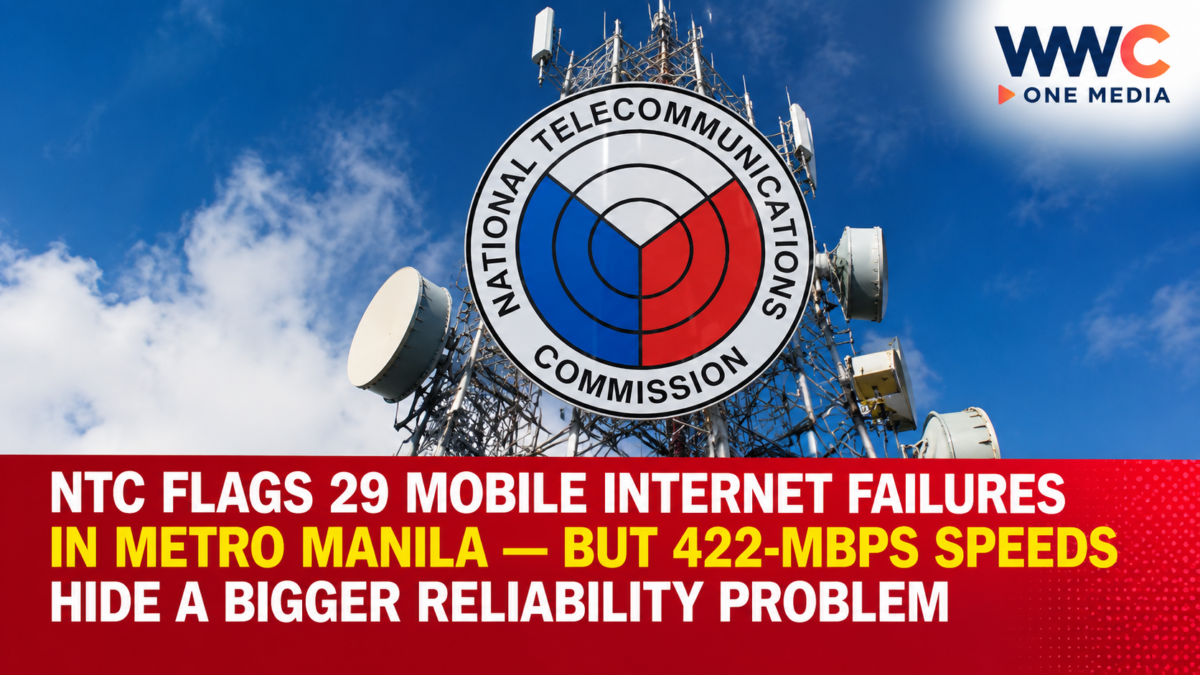
The National Telecommunications Commission (NTC) reported that 29 out of 142 mobile broadband test campaigns produced unsatisfactory results, even as many tested connections exceeded the regulator’s 50-megabit-per-second benchmark.
The tests covered Smart Communications, Globe Telecom and DITO Telecommunity as the agency intensified efforts to improve network quality following complaints about slow data services, dropped calls and unreliable connections.
While the strongest recorded download speed reached 422 Mbps, some locations registered single-digit speeds or no measurable download at all.
The findings expose an issue that goes beyond which telecommunications company can claim the fastest network.
For Filipino consumers paying for mobile data, the bigger question is whether those advertised speeds translate into reliable connections where they live, work and travel.
Nearly One in Five Tests Produces Unsatisfactory Results
According to the NTC’s findings released on October 14, 113 of 142 mobile broadband test campaigns recorded speeds above 50 Mbps.
The remaining 29, equivalent to approximately 20.4% of the tests, yielded unsatisfactory results.
This means roughly four out of five test campaigns met or exceeded the benchmark, while about one in five did not.
The commission described the performance in most tested areas as very satisfactory but expressed serious concern about the weaker results.
NTC Deputy Commissioner Andres Castelar said the deficiencies needed to be addressed immediately.
The tests were conducted with representatives from Smart, Globe and DITO present so the operators could observe the measurement process.
That transparency was particularly important because the three companies had previously raised concerns about the methodology used in regulatory network assessments.
The latest tests provide a more detailed picture of the problem: mobile networks may perform strongly at one test point but poorly at another relatively nearby location.
DITO Hits 422 Mbps — But Records No Measurable Download in Cubao
DITO Telecommunity delivered the highest reported download speed of the three operators during the latest field tests.
Its network reached 422 Mbps along Bonny Serrano Avenue in Barangay Socorro, Quezon City.
Such a result demonstrates that the operator’s network can deliver high-speed mobile broadband under favorable conditions.
However, DITO also recorded no measurable download speed during testing outside Farmers Market in Cubao.
The difference highlights how sharply mobile network performance can vary within one city.
A fast reading at one location does not guarantee similar service at another site.
It is also important to distinguish the NTC’s test result from a conclusion that DITO has no permanent signal coverage around Farmers Market.
The reported zero reading applies to the specific measurement conducted there.
It does not establish that every customer, device or time of day experiences the same result.
Globe and Smart Also Show Major Speed Differences
Globe Telecom and Smart Communications likewise recorded impressive maximum download speeds.
Globe reached 381 Mbps, while Smart posted 377 Mbps.
Both peak readings were recorded along San Francisco Street in Barangay Plainview, Mandaluyong City.
However, the weakest results for both operators were considerably lower.
Globe recorded a minimum of 11.10 Mbps along Mercedes Avenue in Barangay San Miguel, Pasig City.
Smart registered 6.32 Mbps along a route from Coronado Street in Mandaluyong toward J.P. Rizal in Taguig.
The contrast illustrates the importance of evaluating network consistency instead of looking only at peak performance.
A consumer who sees an advertisement highlighting hundreds of megabits per second may have a very different experience in a location affected by network congestion, weak indoor coverage or other technical conditions.
The NTC’s findings reinforce the need to examine service quality at individual locations.
What the NTC Tests Actually Measured
The agency used commercial 5G-capable Android smartphones equipped with Rohde & Schwarz QualiPoc measurement technology.
The equipment allows investigators to record mobile network performance under actual field conditions.
The testing approach differs from a controlled demonstration intended to show the highest theoretical capacity of a network.
Field measurements can better reflect conditions that subscribers may encounter, although they remain dependent on the specific testing routes, equipment and circumstances.
The NTC evaluated multiple aspects of telecommunications service, including mobile broadband download speeds, text-message success rates and dropped calls.
However, the results do not represent a comprehensive nationwide ranking.
They were collected at selected Metro Manila locations, including areas in Quezon City, San Juan, Pasig, Taguig and neighboring test routes.
Other locations may produce different results.
The 142 measurements should also not be confused with a count of all Metro Manila barangays or with a representative survey of every mobile subscriber.
Globe Leads Text-Message Reliability
Internet speed was not the only measure used in the government assessment.
The NTC also examined whether text messages were successfully delivered during testing.
Globe Telecom recorded the highest average SMS success rate at 99.41%.
DITO followed at 98.82%, while Smart registered 92.94%.
The regulator’s prescribed SMS success standard is above 99%.
This means Globe was the only one of the three operators to meet the required benchmark in the reported test results.
For consumers, reliable text messaging remains important even as messaging applications become more common.
SMS is still used for service notifications, account verification and communications with people who may not have reliable mobile data access.
But SMS reliability also differs from network security.
A high success rate does not establish that an operator blocks all fraudulent messages or guarantees that every authentication code reaches its intended recipient without delay.
Smart Records Zero Dropped Calls
Call reliability produced another set of contrasting results.
Smart Communications recorded an average dropped-call ratio of zero during the NTC assessment.
Globe followed at 0.74%.
DITO recorded 2.82%.
The NTC’s threshold for dropped calls is less than 2%.
Smart and Globe met the regulatory benchmark in the reported tests, while DITO exceeded it.
A dropped-call ratio measures the proportion of established calls that end unexpectedly during the assessment.
The result is relevant because voice connectivity remains important for business, family communication and emergency situations.
However, Smart’s zero-percent figure does not mean calls on its network never drop.
It means the regulator recorded no dropped calls within the specific testing sample.
Likewise, DITO’s 2.82% result describes the measured tests and should not be treated as its nationwide call failure rate.
NTC Threatens Additional Show-Cause Orders
The latest findings could lead to further regulatory action.
The NTC warned that it may issue additional show-cause orders against operators that continue failing to meet service-quality requirements.
A show-cause order requires a company to explain its position or respond to alleged regulatory deficiencies.
It is not automatically equivalent to a final finding of wrongdoing or a collected financial penalty.
The latest tests followed earlier regulatory action involving the three mobile operators.
In September, the NTC announced show-cause proceedings linked to continuing network deficiencies and reported potential daily penalties of ₱100,000 for each operator.
The companies, through the Philippine Chamber of Telecommunications Operators, questioned aspects of the testing and enforcement process.
That background helps explain why the October joint measurements were conducted with telecommunications representatives present.
The regulator intends to continue testing additional Metro Manila locations and evaluate whether identified deficiencies are corrected.
Why Internet Speeds Change From Street to Street
Mobile internet performance can vary because of several technical factors.
One is distance from the nearest functioning cell site.
Another is the number of users attempting to access the same network resources.
Large buildings, dense residential areas and other obstacles can weaken radio signals.
Indoor and outdoor performance can also differ, even within the same neighborhood.
The frequency bands used by a mobile network influence how signals travel through buildings and across distances.
Device compatibility, network technology and the ability to connect to 5G rather than 4G can also affect observed speeds.
Temporary network maintenance, equipment faults and transmission limitations may contribute to service problems.
However, the NTC’s published figures do not identify the confirmed engineering cause of each weak test result.
It would therefore be misleading to attribute all 29 unsatisfactory measurements to tower congestion, inadequate investments or deliberate service restrictions without additional evidence.
The appropriate next step is for operators to investigate the affected locations and implement targeted improvements where necessary.
Better National Scores Do Not Eliminate Local Problems
Globe has pointed to separate Department of Information and Communications Technology monitoring showing broader improvements in its network.
According to the company, its average download speed under the DICT’s monitoring rose from 36.5 Mbps in January to 51.53 Mbps in September 2026.
Its overall performance score increased from 77.2 to 82.6 over the same period.
Globe also reported that its share of disconnection complaints was lower than its subscriber market share.
These figures suggest improvement under the DICT’s measurement framework.
However, they should not be directly equated with the NTC’s latest field-test results.
The measurements may involve different locations, testing periods, metrics and methodologies.
A national average can improve even when individual streets or neighborhoods continue experiencing poor service.
For consumers, the difference is crucial.
What matters most may be whether the network works reliably at the particular locations where they spend their time.
Consumers and Businesses Depend on Consistent Connectivity
Reliable mobile internet has become essential to daily economic activity.
Small businesses use online payment platforms, digital ordering systems and messaging applications.
Drivers and delivery workers depend on navigation and real-time booking applications.
Employees use mobile data for work communications and authentication.
Students rely on connectivity for learning materials, research and online transactions.
An unstable connection can interrupt these activities even when the network occasionally delivers very high speeds.
For example, a business that uses a mobile device to receive payments may care more about dependable access throughout the day than a single exceptionally fast download test.
Similarly, users making voice or video calls may experience problems when connection quality changes suddenly.
This is why telecommunications service quality requires evaluation across multiple indicators.
Peak Speed Alone Cannot Decide the Best Network
The NTC results identify different strengths among the three operators.
DITO recorded the highest tested download speed.
Globe performed best in SMS success rates.
Smart produced the lowest dropped-call ratio.
But no single result establishes that one operator is universally superior.
The fastest peak download speed is not the same as the highest average network speed.
A high SMS success rate is not equivalent to superior data coverage.
And a strong voice-call result does not guarantee the fastest internet connection.
Consumers should consider the reliability of service at their frequent locations, device compatibility, available plans and pricing before choosing a mobile provider.
Coverage can vary even between different rooms in the same building.
The regulator’s report is useful because it identifies real-world differences, not because it provides a simple nationwide winner.
The Bigger Challenge: Turning High Speeds Into Reliable Service
The government’s findings show that the country’s leading mobile operators are capable of delivering download speeds exceeding 300 Mbps in selected Metro Manila areas.
But the same assessment uncovered 29 unsatisfactory test campaigns out of 142.
That contrast reveals a continuing challenge.
Building faster networks is important, but ensuring consistent service across neighborhoods is equally essential.
The NTC’s planned follow-up testing will help determine whether operators address the specific deficiencies identified.
For telecommunications companies, the next priority is demonstrating measurable improvements at weaker locations.
For regulators, the challenge is maintaining transparent and consistent testing while enforcing established standards through appropriate procedures.
And for subscribers, the most meaningful improvement will be fewer interruptions and dependable connections during ordinary daily use.
DITO reached 422 Mbps, Globe led SMS reliability and Smart recorded zero dropped calls in the latest NTC assessment. But with about one in five mobile broadband tests producing unsatisfactory results, the bigger question remains: Can the Philippines’ telecom giants deliver reliable service consistently—not just impressive speeds at their best-performing locations?