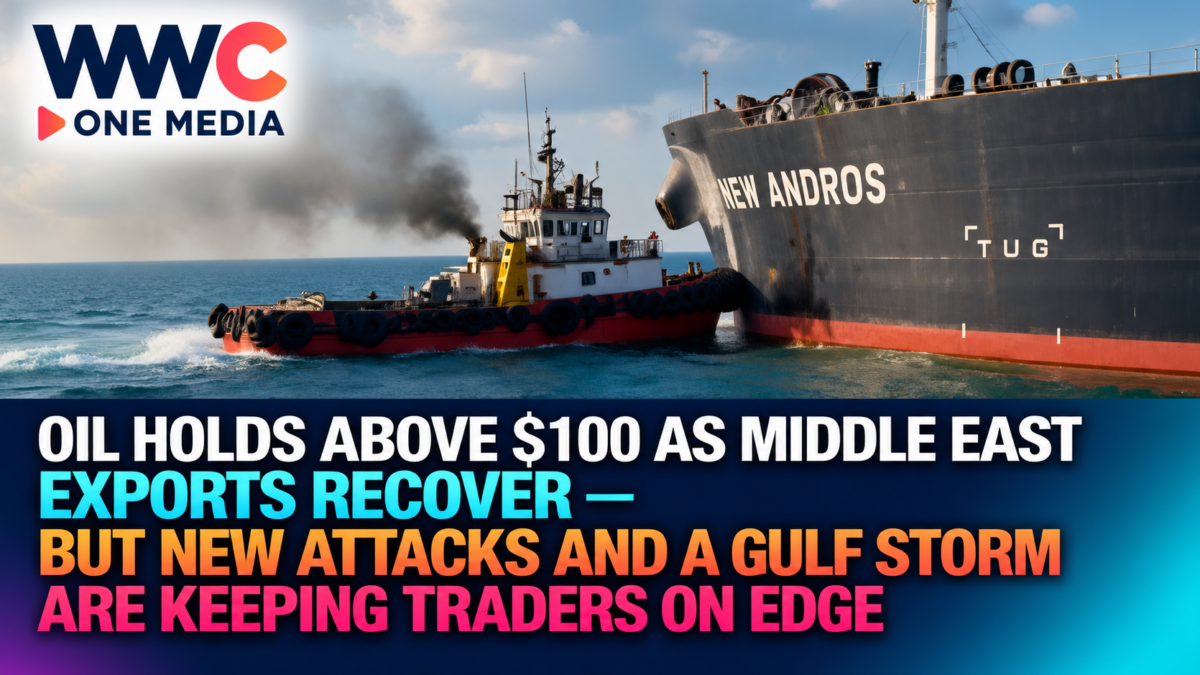
SINGAPORE — Oil prices are refusing to retreat far from $100 a barrel even as more Middle Eastern crude reaches world markets, highlighting just how fragile the global energy system remains after months of war, disrupted shipping and attacks on critical infrastructure.
Brent crude climbed to around $101.51 a barrel on October 7, while U.S. West Texas Intermediate rose to roughly $90.25 as traders weighed improving exports from the Persian Gulf against a fresh wave of supply threats.
The latest risks include a developing storm in the Gulf of Mexico, attacks by Yemen’s Iran-backed Houthi movement on Saudi targets, continuing danger to tankers in the Strait of Hormuz and already-tight inventories in several major markets.
The result is an oil market caught between two powerful forces.
More barrels are getting through.
But traders still do not trust that they will keep getting through.
That uncertainty is keeping oil elevated even after the worst fears of an outright Middle East supply collapse have eased.
Middle East Oil Exports Are Recovering
The biggest bearish development is the remarkable recovery in Middle East exports.
Vitol Chief Executive Russell Hardy said around 12 million barrels per day of crude oil and another 2 million barrels per day of refined products had left the region by tanker over the previous seven to ten days.
Those flows are critical because they are large enough to prevent the kind of extreme shortage that could send crude prices dramatically higher.
Hardy said the recovery in shipments has helped stabilize the market after months of disruption.
The return of more barrels through the region is one reason Brent has remained near $100 rather than moving toward much more extreme levels.
But the improvement has not eliminated the underlying risks.
Strait of Hormuz Flows Are Rising — But So Are Attacks
Bloomberg’s central October 7 theme is the contradiction in the Strait of Hormuz.
Oil flows are increasing.
At the same time, attacks against vessels are becoming more frequent.
The narrow waterway remains one of the most important energy chokepoints on earth.
A significant share of the world’s traded oil and liquefied natural gas normally moves through it.
That means even when tankers continue operating, every fresh attack raises the risk that insurers, shipowners or crews could eventually decide that the route is no longer worth using.
That possibility keeps a geopolitical premium embedded in crude prices.
The Oil Crisis Is Becoming a Logistics Crisis
Perhaps the most important change in the energy story is that the world is no longer facing only a simple shortage of crude.
It is facing a transportation, refining and insurance problem.
Reuters analysis notes that Middle East exports have recovered substantially, but shipping costs have surged and refiners remain constrained.
Tanker costs on some Middle East-to-Asia routes have reportedly exceeded $1.2 million per day.
At the same time, disruptions at refineries in the Middle East and Russia have tightened supplies of diesel and other fuels.
That explains why crude can keep flowing while fuel prices remain painfully high.
Getting oil out of the ground is only one part of the system.
It still has to be transported, insured, refined and delivered.
Every bottleneck adds cost.
Saudi Arabia Is Rerouting Oil Around the Danger Zone
Saudi Arabia has increasingly relied on its East-West Pipeline, which carries crude from producing regions toward the Red Sea export terminal at Yanbu.
Saudi Energy Minister Prince Abdulaziz bin Salman said oil moved through the line had reached 5.8 million barrels as of Tuesday morning.
The route has become strategically important because it gives Saudi Arabia an alternative to exporting everything through the Strait of Hormuz.
The kingdom has reportedly been rerouting roughly 4 million barrels per day through the system during periods of heightened disruption.
That represents around 4% of global oil consumption.
Without those alternative routes, the supply shock could have been considerably worse.
But Even Saudi Infrastructure Is Being Targeted
Alternative routes are not risk-free.
Saudi energy infrastructure has already been targeted during the wider regional conflict.
The East-West Pipeline was temporarily disrupted after drone attacks in September before operations resumed.
The Houthis have also claimed attacks against Saudi airports, military installations and an Aramco refinery.
Saudi authorities confirmed attacks on airports in Jizan and Najran this week that injured three people and caused damage.
That keeps traders focused on a much broader threat.
The risk is no longer just Hormuz.
It is the entire network of pipelines, refineries, ports and shipping routes required to move Middle Eastern oil.
The Houthis Are Again a Major Oil-Market Risk
The renewed fighting in Yemen is adding another layer of uncertainty.
The Iran-backed Houthis have historically targeted shipping around the Red Sea and Bab al-Mandeb, another crucial trade chokepoint.
Their latest attacks on Saudi Arabia have revived concerns that the conflict could again spill directly into energy infrastructure.
That matters because the Bab al-Mandeb sits along a key route connecting the Indian Ocean with the Red Sea and Suez Canal.
Disruption there can force tankers to travel thousands of additional kilometers around Africa.
Longer voyages mean:
higher fuel costs,
higher insurance,
fewer available tankers,
and ultimately higher prices for consumers.
A Gulf of Mexico Storm Is Adding Another Supply Threat
The geopolitical risks are now colliding with weather risk.
A storm developing in the Gulf of Mexico is forecast to strengthen and could become the first Atlantic hurricane of the 2026 season.
Reuters reports that facilities in its potential path account for around 15% of U.S. crude production and about 5% of U.S. natural-gas output.
Several large refineries could also be threatened.
That matters because the U.S. Gulf Coast is one of the most important refining and export centers in the world.
A storm does not need to destroy infrastructure to affect prices.
Companies often shut platforms, evacuate workers and reduce refinery operations before landfall.
Those precautionary closures alone can remove supply from the market.
U.S. Inventories Are Already Tightening
Adding to the pressure, preliminary U.S. data showed crude inventories falling by more than 2 million barrels.
Normally, rising inventories reassure traders that enough supply is available.
Falling stockpiles have the opposite effect.
When inventories are declining while geopolitical and weather risks are increasing simultaneously, traders tend to become much more reluctant to bet aggressively on falling prices.
That helps explain why oil bounced despite better flows from the Middle East.
OPEC+ Is Refusing to Add More Oil for Now
Another important factor is OPEC+.
The producer alliance agreed on October 4 to keep its November output targets unchanged.
That decision was largely expected, but it removes one potential source of immediate additional supply.
OPEC+ producers are balancing two competing goals.
They want enough supply in the market to prevent a destructive price spike.
But they also do not want to flood the market and cause prices to collapse.
With geopolitical risks still high, holding production steady gives the group time to assess whether the recovery in exports is sustainable.
G7 Governments Are Releasing Emergency Oil
Western governments are also trying to stop fuel prices from spiraling.
The Group of Seven has agreed to release up to 100 million barrels of crude and diesel from emergency reserves.
The release is intended to increase liquidity in energy markets and reduce pressure on fuel prices.
The International Energy Agency is expected to work out additional details of the release at meetings scheduled for October 14 and 15.
The G7 has also pledged to avoid new energy-export restrictions that could make shortages worse.
That commitment became important after fears that the United States might restrict diesel exports.
President Donald Trump later said the U.S. would not pursue such a ban.
But Emergency Reserves Cannot Fix Everything
Strategic petroleum reserves are designed to handle emergencies.
They are not a permanent source of supply.
A 100-million-barrel release sounds enormous.
But global oil consumption is measured in more than 100 million barrels every day.
That means emergency releases can calm markets and bridge temporary shortages.
They cannot replace sustained Middle Eastern exports indefinitely.
If geopolitical disruptions continue for months, governments eventually face an uncomfortable choice between using more reserves and preserving those reserves for future crises.
Diesel May Be an Even Bigger Problem Than Crude Oil
One of the most overlooked aspects of the current crisis is refined fuel.
Vitol’s Hardy warned that tightness in products such as diesel could persist through the winter.
European diesel margins remain extremely elevated, reflecting the damage to refining infrastructure and transportation routes.
Diesel matters because it powers:
trucks,
farm machinery,
construction equipment,
ships,
factories,
and parts of the heating market.
A diesel shortage can therefore feed directly into food prices, transportation costs and inflation.
For governments, that may be politically more dangerous than the headline price of Brent crude itself.
Oil at $100 Is Already Feeding Inflation Fears
The world does not need oil at $150 or $200 to feel economic pain.
Sustained prices around $100 already raise:
airline fuel costs,
shipping rates,
manufacturing expenses,
household gasoline bills,
and transportation costs.
Those expenses eventually flow into inflation.
That is one reason central banks are watching the energy market so closely.
High oil prices can make it harder for the U.S. Federal Reserve and other central banks to reduce interest rates.
If energy inflation persists, policymakers may have to keep rates higher for longer—or tighten again.
That creates a direct link between Middle Eastern shipping disruptions and global bond and stock markets.
Oil Has Become One of Wall Street’s Biggest Variables
Stocks have recently remained surprisingly resilient despite Brent holding near $100.
The S&P 500 and Nasdaq even reached new records on October 6.
But oil remains one of the market’s biggest macroeconomic risks.
If prices stabilize near $90 to $100, investors may conclude the economy can absorb the shock.
If Brent suddenly jumps toward $120 or higher, that calculation changes quickly.
Higher fuel prices would hit consumer spending.
Inflation expectations could rise.
Bond yields could increase.
Corporate margins could come under pressure.
And central banks could become more hawkish.
That is why energy traders are watching every tanker and missile almost as closely as official supply statistics.
China Has Been an Unexpected Stabilizing Force
Another important piece of the market has been China.
Vitol says China helped stabilize supply earlier this year by drawing down part of its own stored crude.
Those inventories gave Beijing the flexibility to reduce its need for emergency spot purchases while the Middle East was under severe stress.
Large strategic and commercial inventories can act like shock absorbers.
But once they are used, they have to be rebuilt.
That could create additional demand later.
So inventories can smooth the short-term crisis without necessarily reducing longer-term oil demand.
Shipping Companies Are Now Pricing War Risk Into Every Barrel
The modern oil market depends on transportation almost as much as production.
A barrel sitting in the Persian Gulf has limited value to a refinery in Japan, Europe or the United States if no tanker is willing to transport it.
War-risk insurance premiums have therefore become a critical component of oil prices.
When risk rises:
insurance premiums rise,
tanker owners demand more money,
shipping capacity becomes scarce,
and traders need larger margins to move crude.
That is why the recovery in physical oil exports has not pushed prices back to prewar levels.
The barrels may be moving.
But they are much more expensive to move.
The Industry Wants More Escape Routes
Energy executives are increasingly arguing that the world needs alternative export infrastructure.
TotalEnergies CEO Patrick Pouyanné has called for more routes that can bypass major chokepoints.
Oil companies are studying pipeline projects connecting Iraqi crude toward Mediterranean outlets and other routes that could reduce dependence on Hormuz.
The lesson from the current crisis is becoming increasingly obvious.
The world built an energy system optimized for efficiency.
Now the industry wants redundancy.
That means spending billions on pipelines and terminals that may not always be needed—but become invaluable when conflict shuts a major route.
From ‘Just in Time’ to ‘Just in Case’
That is perhaps the biggest structural shift emerging from the oil crisis.
For decades, companies minimized spare capacity and relied on efficient global shipping.
Now executives are increasingly talking about moving from “just in time” to “just in case.”
That means:
more storage,
more pipelines,
more tanker capacity,
more alternative ports,
and more strategic reserves.
All of that improves resilience.
But it also costs money.
And those costs will eventually show up somewhere in the price consumers pay for energy.
Why Oil Is Not Falling Despite More Supply
At first glance, the latest market seems contradictory.
Middle East oil exports are recovering.
Saudi Arabia has alternative pipelines.
The G7 is releasing emergency reserves.
OPEC+ is not cutting further.
Yet Brent remains around $100.
The reason is that the market is not pricing only today’s supply.
It is pricing tomorrow’s risk.
Traders know one successful attack on a refinery, tanker route or export terminal could quickly remove millions of barrels from circulation.
They also know Western inventories have already been heavily used.
And they know hurricane season now presents a second major threat outside the Middle East.
So oil is carrying an insurance premium.
The $100 Oil Market Is Stable — Until It Isn’t
For now, crude markets have achieved an uneasy balance.
Enough oil is reaching consumers to prevent a catastrophic shortage.
But supply chains remain vulnerable enough to prevent prices from collapsing.
That may keep Brent near $100 for some time.
The risk is that the balance depends on a remarkable number of things going right at once.
Tankers must keep moving through Hormuz.
Saudi pipelines must remain operational.
Houthi attacks must not seriously damage energy infrastructure.
U.S. refineries must survive hurricane season.
And emergency inventories must remain sufficient.
Any one of those assumptions could break.
That is why the latest oil market looks calm on the surface but remains extremely dangerous underneath.
The world is finally getting more Middle Eastern oil again.
But the bigger question is whether the tankers, pipelines and refineries carrying it can stay safe long enough for $100 oil to become the ceiling—not the starting point for the next surge.