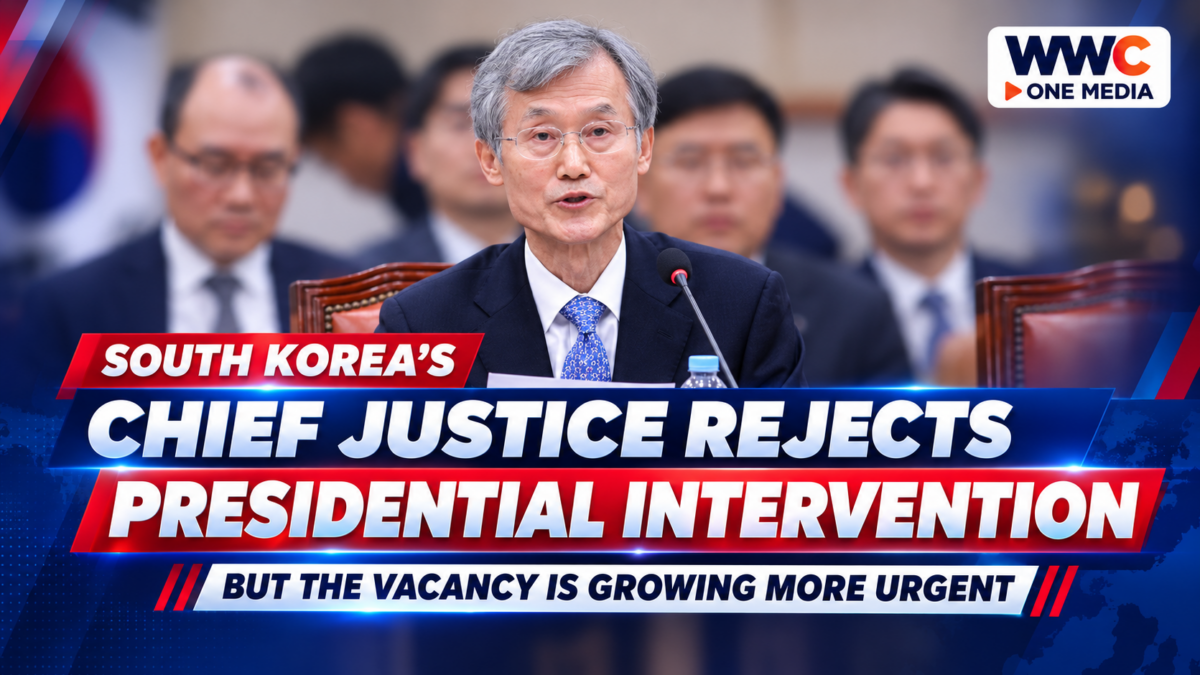
SEOUL — South Korea’s Supreme Court has become the center of a growing constitutional dispute after Chief Justice Cho Hee-dae said President Lee Jae Myung and the National Assembly have no authority to intervene in the chief justice’s recommendation of Supreme Court nominees.
Cho made the remarks Tuesday during a parliamentary audit, defending his decision to reject the presidential office’s request for another candidate to fill a long-vacant seat on the nation’s highest court. He argued that allowing political institutions to interfere with the recommendation process would conflict with the constitutional separation of powers and judicial independence.
How the Dispute Started
The vacancy was created after former Supreme Court Justice Rho Tae-ak retired on March 3. Cho later recommended Sohn Bong-ki, a senior judge at the Daegu District Court, for the position on Aug. 18.
However, the presidential office requested another recommendation on Aug. 28, saying there had not been sufficient consultation before the nomination. Cho rejected that request on Sept. 22, saying the presidential office had not provided specific reasons or constitutional grounds for asking him to submit a new candidate.
Under Article 104 of South Korea’s Constitution, a recommendation committee selects candidates, the chief justice recommends a nominee, the National Assembly considers the nomination, and the president makes the appointment after parliamentary consent.
Cho said consultations between the chief justice and the presidential office before nominations have occurred as a matter of practice, but he described them as customary cooperation rather than a constitutional requirement.
Presidential Office Maintains Its Position
The presidential office has maintained that the nomination process needs to move forward, particularly because the prolonged vacancy could affect the Supreme Court’s workload and the public’s right to a timely trial.
The office has argued that the process surrounding Cho’s earlier recommendation was procedurally incomplete and has pressed for another candidate.
The dispute therefore involves two competing institutional arguments: Cho is emphasizing the chief justice’s role in the recommendation process and judicial independence, while the presidential office is calling for a resolution to the vacancy and questioning the procedure used for the earlier recommendation.
Parliamentary Audit Turns Confrontational
The disagreement became more visible during Tuesday’s National Assembly audit.
Cho initially declined to take an oath as a witness, citing separation-of-powers concerns, although he remained at the hearing and addressed lawmakers’ questions through prepared remarks. The session also saw clashes between lawmakers over how Cho should participate in the audit.
Cho acknowledged public concern over the prolonged vacancy and said he would work toward resolving the situation, even as he continued to reject the request for a new recommendation without clearer constitutional grounds.
The standoff now leaves South Korea facing a difficult institutional question: how can the vacant Supreme Court seat be filled while the executive, legislature and judiciary maintain the constitutional boundaries each side says it must protect?
WWC ONE MEDIA G,A